Lot-Level QC Data Formats in Commercial Reagent Kits
Standardized inter-lot comparison criteria catch drift that intra-lot specs miss.
Lot-level QC documentation is the tool researchers rely on to answer a simple but consequential question: is the new batch of reagent the same as the last one. In cell-free protein synthesis (CFPS), where crude lysates depend on cell growth state, lysis conditions, and downstream processing, the answer is rarely a clean yes. Small differences in extract preparation or plasmid quality can produce large swings in protein yield, a fact recognized broadly across the field. Lot-level QC is the industry's response to that reality, a record of what a vendor measured on a specific batch before shipping it. But a Certificate of Analysis proves performance under the vendor's conditions, not performance in a researcher's hands, and that gap is where reproducibility problems start.
This is not a new problem, and CFPS is not the first field to confront it. ELISA kits have dealt with lot variability for decades and have built more standardized practices around it. Those practices show what a mature QC format looks like and how far CFPS still has to go to get there.
What a Certificate of Analysis contains (and what it typically omits)
The Certificate of Analysis (CoA) is the standard vehicle for lot-level data in commercial reagent kits, sometimes supplemented or replaced by a Product Specification Sheet depending on the vendor. Across CFPS kits and adjacent categories, a typical CoA includes a lot number and manufacturing date, an expiry or use-by date, one or more functional QC assays (most often a reporter protein yield measured under standard conditions), and a pass or fail statement measured against an internal specification.
What's missing matters more than what's there. Many vendors state that a lot "meets specifications" without ever disclosing what that specification actually is. Quantitative comparisons against prior lots are uncommon. Component-level data is rarely if ever disclosed. And most documents report only summary outcomes rather than the underlying measurements.
The "black box" critique that's been leveled at PURE reconstituted systems in the literature applies just as well to a typical CoA. A pass or fail stamp on a crude lysate tells a researcher that the extract worked on the vendor's reporter protein. It does not say why, and it says nothing about whether a different target protein, one with different folding requirements or a different codon profile, will behave the same way. Formulation opacity makes this worse: when component concentrations go undisclosed, a researcher watching yield drop between lots has no straightforward way to trace the cause back to a specific compositional change.
What total protein concentration means for assay performance
Most reagent lots get characterized by total protein concentration, because it's cheap to measure and easy to report on a spec sheet. The trouble is that total protein concentration lumps active material in with inactive species, degraded fragments, and non-functional forms. A number can look stable from lot to lot while the fraction of protein actually doing the work drifts underneath it.
A study out of Bristol-Myers Squibb (Harvey et al., Analytical Chemistry) put a number on this gap. Defining reagents by the concentration of functionally active protein rather than total protein cut immunoassay lot-to-lot coefficients of variation by more than 600% compared to the total protein approach, a reduction far beyond a marginal improvement. That's not a marginal improvement. It suggests that a large share of the noise researchers attribute to "lot variability" is really a measurement artifact, a byproduct of characterizing the wrong thing.
For CFPS, the implication carries directly. A lysate lot characterized only by total protein, or by yield on a single fluorescent reporter, can mask real shifts in the activity of translation factors, chaperones, or energy regeneration enzymes, the components that matter most for a researcher's actual target protein. This is a measurement problem before it's a formulation problem. Whether the format of the QC data even makes a functionally meaningful change visible, or lets it hide behind a number that looks fine, depends on how that data is presented.
QC data formats across commercial CFPS and comparable reagent categories
Reconstituted systems built from purified components have a structural advantage here, simply because a defined composition is more tractable to characterize down to the component level. Crude lysate systems, whatever their cost or yield benefits, are harder to characterize down to the component level by nature of how they're made.
Across the current commercial landscape, yield specifications are often stated at the product-line level rather than the lot level. Wheat germ-based kits, for instance, publish yield ranges (roughly 0.5 to 1 mg per 5.5 mL sample scale, in one commercial system) alongside claims about the breadth of proteins that fold successfully in that system, including kinases, GPCRs, and multimeric complexes. Other lysate-based kits state maximum yield figures, such as up to 3 mg/mL for premium-tier products and lower ceilings for economy tiers, but those are characterization benchmarks for the product line, not disclosed data for the specific lot a customer receives. Pre-aliquoted plate formats add a second variable on top of lot variability: dispensing consistency across wells, a separate axis of error that a single lot-level yield number doesn't capture. Some vendors offer lookup tools where customers can pull batch-specific data after the fact, and detection methods for confirming /* blocked */SDS-PAGE, Western blot, fluorescence-detection size-exclusion chromatography) are commonly listed; these confirm that a protein was made.
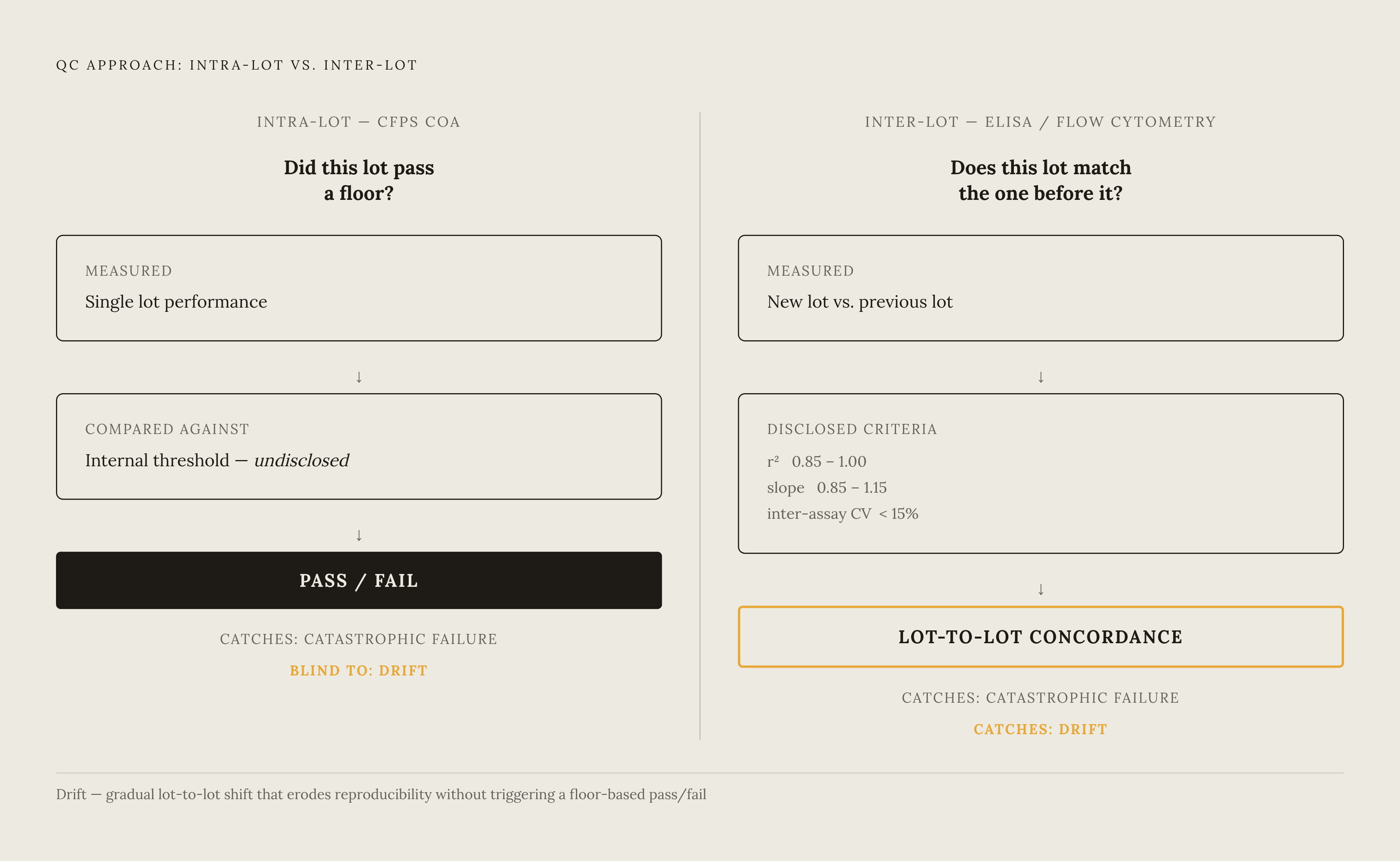
Adjacent reagent categories have gone further. ELISA kit manufacturers commonly evaluate each lot against internal specifications before release, examining standard curve values (EC20, EC50, EC80) and running QC controls alongside the standards. Some publish explicit inter-lot comparison criteria: a linear curve-fit between the current lot and a prior lot with an r-squared between 0.85 and 1.00 and a slope between 0.85 and 1.15, for example, or a requirement that inter-assay variance between an old and new lot stay under 15% coefficient of variation before the new lot ships. Flow cytometry reagent makers have taken this further still, characterizing each new lot against the previous one, with lot-specific data available to customers. The design target in these categories is "does this lot match the one before it," which is a fundamentally different, and more useful, question than "did this lot pass a floor." It's "does this lot match the one before it," which is a fundamentally different, and more useful, question.
That's the structural gap. Most CFPS CoAs specify an intra-lot pass or fail against a threshold the customer never sees. ELISA and flow cytometry formats specify inter-lot comparison criteria that are disclosed upfront. The former catches catastrophic failure. The latter catches drift, which is the failure mode that actually erodes reproducibility over the course of a research program. Sepia Biosciences' OpenCFPS™ platform has taken a similar approach to the flow cytometry model, publishing lot-level QC data and documenting formulations openly, so a researcher can see what was measured on their specific lot and troubleshoot against that baseline rather than against a vendor's internal spec they'll never see.
How often lot-to-lot variability matters in practice
The scale of the problem has been measured, at least in one adjacent setting. A study of an NABL-accredited clinical biochemistry laboratory, tracking reagent lot changes over June 2018 through May 2019, found that 10 of 60 lot transitions (16.7%) produced a statistically significant performance difference (P<0.05). Roughly one in six lot changes, in other words, shifted something measurable.
That figure comes from a clinical lab running active QC monitoring on every transition. In a research setting without that kind of monitoring in place, a significant lot change could easily go undetected for weeks, appearing only as an unexplained blip in a screen or a result that doesn't replicate. There is no broadly agreed consensus method for lot-change comparisons, and practices vary considerably across settings. Most researchers are improvising their lot-change practice on the fly.
Crude lysate CFPS carries extra risk on this front. Small differences in the culture's condition at the moment of harvest ripple through every downstream step of extract preparation. For a protein engineering screen that spans multiple lots without a bridging experiment tying them together, a yield difference between an early variant and a late one might reflect nothing more than lot drift. That's a false lead, and it's expensive: a promising variant gets deprioritized, or a dud gets carried forward, because nobody checked whether the reagent shifted under the experiment.
What questions a lot-level QC document should answer
A useful QC document answers four questions, and if it doesn't, the researcher is flying blind on faith rather than data. What was actually measured, specifically the reporter identity, the assay conditions, and the reaction scale, not just a vague reference to "a functional assay." What the numerical result was, not a bare pass. What the specification threshold is, and whether it's disclosed at all, because an undisclosed threshold can't be audited by anyone outside the company that set it. And how the current lot compares to the ones before it, since even a simple trend line carries more information than one isolated pass or fail.
Beyond those four, check a few more details. Whether the QC reporter belongs to the same protein class as the actual target of interest matters quite a bit: a soluble fluorescent reporter like GFP says relatively little about whether a membrane protein will express well, since the two have very different folding and insertion requirements. Whether replicate measurements are reported at all, since a coefficient of variation within a lot has direct consequences for plate-based screening throughput. And whether formulation components are disclosed, since that's what lets a researcher trace a yield change to an actual compositional cause instead of guessing.
There's a practical workaround when a document doesn't supply enough of this on its own: run the old lot and the new lot side by side on a known protein target, under standard conditions, before trusting either one with new experimental data. The delta between them becomes the noise floor for that lot transition, a baseline against which subsequent results can be judged. For high-throughput screening in particular, a lot change mid-screen ought to be logged as a protocol event, and bracketed with controls from the previous lot wherever that's feasible, the same discipline applied in reagent categories with more mature lot-change protocols. When formulations are documented and lot QC data is made public, this whole audit becomes a five-minute check of published numbers instead of a support ticket and a wait for a vendor's reply. That's a real difference in the time cost of doing science carefully.
The path CFPS QC practice needs to take as the format matures toward higher-throughput and more standardized use
CFPS is moving toward automation-compatible, plate-based formats, 96-well and 384-well, built for liquid-handling integration. In that context, lot variability doesn't just persist, it compounds. A silent drift that would show up as a minor discrepancy in a handful of tube reactions turns into a systematic error across hundreds of wells in a single overnight run, and it can be very hard to catch after the fact.
The market is growing into this problem rather than away from it. CFPS is projected to grow from USD 217.2 million in 2025 to USD 308.9 million by 2030, a 7.3% compound annual growth rate, MarketsandMarkets reports. As pharmaceutical and biotech companies doing high-throughput screening make up a larger share of that market, tolerance for undocumented lot variability is going to shrink, because the cost of an undetected drift scales with the number of reactions riding on it.
Quality by Design (QbD) approaches, already under discussion in the bioprocessing community, offer one path forward: treat lot consistency as something engineered into the extract preparation process itself, rather than something screened for after the fact. Third-party and independently manufactured reference controls, a tool that's gained traction in adjacent reagent categories for monitoring lot integrity over time, remain largely absent from CFPS, and closing that gap would strengthen confidence in lot consistency.
The ask for vendors is not complicated: disclose the specification thresholds, publish lot data openly, and report inter-lot comparison metrics as a matter of course. That's not a regulatory burden; it's a commercial advantage for any customer trying to standardize a workflow across lots. The ask for researchers is just as direct: treat lot qualification as a routine workflow step rather than a one-time act of trust in a vendor relationship, and favor reagent systems whose documentation makes that step fast and traceable rather than something that depends on taking the vendor's word for it. Sepia Biosciences has positioned its OpenCFPS™ platform, with open formulations, published lot-level QC data, and pricing as low as $25/mL, as a direct answer to this gap, aimed at making lot qualification tractable without vendor mediation, at the scale and price point where high-throughput CFPS actually needs that discipline to hold up.