How Reagent Monopolies and Consolidation Affect Research Reproducibility
Supplier consolidation leaves researchers dependent on undisclosed reagent changes.

Reagent market consolidation threatens research reproducibility by making laboratories dependent on fewer suppliers whose lot changes may remain undisclosed. For high-throughput protein production, researchers need to choose systems with documented formulations, published lot-level QC and application-specific validation because repeat runs can wipe out the savings from smaller reactions. The remedy is transparency built into reagent design and supply.
Why reproducibility is a reagent problem, not just an experimental design problem
The conventional account of the reproducibility crisis emphasizes bad statistics, p-hacking, underpowered studies and incomplete reporting. These are real weaknesses, but they do not explain an experiment whose inputs changed without the researcher knowing. The failure can begin before data exists. A reagent may meet its stated specifications while behaving differently in the assay where it is used, making an apparently controlled experiment dependent on an uncharacterized input.
The deNOVO Biolabs 2026 analysis distinguishes obvious defects from the untested assumptions it identifies as the starting point for many downstream reagent failures. That distinction becomes more consequential as assays become sensitive, multiplexed and distributed across sites, or operate in complex biological matrices. A certificate of analysis cannot establish fitness for every one of those conditions. Batch differences can compound into assay drift, QC failures, comparability problems and regulatory delays. Reproducibility therefore depends on how reagents are designed, characterized and supplied.
How market consolidation reduces the number of suppliers controlling critical reagent categories
Consolidation concentrates control of critical reagent categories among fewer independent suppliers. Supplier diversity provides a practical diagnostic resource. When a reaction fails, an independent comparator can help distinguish a problem with the biology from a problem with the batch. As independent sources disappear, that comparison becomes harder to make, while competitive pressure on lot quality weakens.
Platform lock-in deepens the dependency because a supplier can control both instrument hardware and the proprietary consumables required to operate it. Aftermarket services raise switching costs further, leaving laboratories dependent on one supplier’s consistency even when alternatives nominally exist. An alternative is not always a practical exit. Changing suppliers may mean replacing the platform that the workflow runs on along with the single input. Researchers consequently have limited ability to investigate variability outside the supplier’s own system.
Specialized reagent categories are particularly exposed to this structure because their pool of qualified commercial suppliers is already small. Cell-free extracts illustrate the problem. Consolidation can turn a thin market into a near-monopoly in practice, with little room for independent cross-validation. Concentration removes options for detecting and responding to poor quality when it occurs.
What suppliers are not required to tell you about what changed between lots
Even with access to a supplier, researchers may lack access to the information needed to interpret its products. There is no industry-wide requirement to disclose formulation changes, manufacturing process shifts or upstream sourcing changes that drive lot variability. A familiar product name therefore gives no assurance that one lot will work the same as the next under the conditions of a particular assay.
The deNOVO analysis describes researchers asking how reagents were validated, where they underperform and which assumptions their performance depends on. Standard datasheets do not answer those questions. Functional validation requires relevant assay conditions and characterization of failure modes. Even if researchers can measure what a reaction produces, they need formulation disclosure to check for themselves the assumptions about composition behind a supplier’s claims.
Cell-free protein synthesis, or CFPS, provides a concrete illustration of that information gap. Extract variability can originate in source-strain growth state, harvest conditions, metabolite levels and differential lysis. A standard COA does not show how those sources interact. When an assay drifts between lots, the researcher may therefore be unable to distinguish a biological effect from a reagent artifact.
How reagent opacity propagates through the scientific record
An undisclosed reagent difference does not remain confined to the laboratory that first encounters it. Once the data from that work enters the scientific record, other researchers take on the same uncertainty and may never know it is there. Methods can describe the procedure accurately yet leave its changing inputs unresolved. A laboratory trying to replicate the work may get a reagent with the same name but a different composition and get a different result. That failure then casts doubt on the original finding without identifying the actual source of disagreement.
Eckmann et al. 2025 compared software tools intended to check rigor and transparency in published work, which assess what authors report. Their reach stops at the available record. A methods section or reporting checklist cannot reveal an undisclosed composition difference simply because it identifies the reagent used. Even a recorded lot number needs associated characterization data to make the difference scientifically interpretable.
The problem grows as workflows span sites, complex matrices and multiplexed readouts, giving hidden reagent differences more opportunities to confound comparisons. The deNOVO analysis accordingly treats reproducibility as a data integrity requirement. That changes the scope of responsibility. Better controls and reporting checklists still help, but they cannot account for upstream changes that the information they check does not show.
Why cell-free protein synthesis is especially vulnerable to lot variability—and especially capable of escaping it
Growth conditions, media composition, harvest timing, metabolite levels and lysis method can all change how an extract behaves. Yield-only QC leaves part of that behavior unexamined. Two lots can differ in ways that a single protein-yield measurement does not capture, while limited supplier diversity removes the comparator that could help distinguish target-protein difficulty from a lot-quality shift.
Yet the same reaction format offers a route out of that uncertainty. CFPS has an open reaction environment in which toxic, unstable and multi-domain proteins can be expressed and reaction conditions can be changed directly. That access also makes characterization more tractable. In principle, every component can be characterized and disclosed, providing a basis for lot-specific QC. Researchers with that information can isolate lot effects through controls and standardize reactions across sites and time points.
The PURE system demonstrates the reproducibility value of defined composition. Reconstituted from purified, defined components and without protein-degrading enzymes, it attracts attention for reproducibility even though its yields are lower than those of crude extract systems. The comparison exposes a clear technical tradeoff. Defined composition makes the reaction more interpretable, while crude extracts offer higher yields with greater characterization demands. The remedy is not to accept lower output as the unavoidable price of transparency, but to build transparent characterization into high-performing extract systems.
What transparent reagent design actually requires in practice
Transparent reagent design needs formulations that are documented, lot-level QC that is published and checked against defined functional criteria, and characterization of what fails as well as what works. Identity and purity are not enough. The deNOVO analysis says reagent assessment must check functional binding behavior, how the structure relates to native targets and how stable the signal is across assay conditions.
A reagent that performs well in buffer but fails in serum or a cell-free extract matrix has not been adequately characterized for that use. Context is part of the quality specification. For CFPS, this means testing how well an extract works with a range of template types and difficult targets, including toxic, membrane-associated and disulfide-rich proteins. Yield from an easy template does not establish functional performance on a difficult one.
Published lot data helps researchers plan bridging experiments when they switch lots, so they can check for drift before they have completed the assays. Application-driven design extends that principle to the workflow itself, including plate-based, automated production. The distinction is between designed compatibility and incidental success. OpenCFPS™ is a concrete example built around documented formulations, published lot-level QC data and pricing intended to make transparent high-throughput reagent systems accessible.
How automation and plate-based workflows expose—and reward—reagent consistency
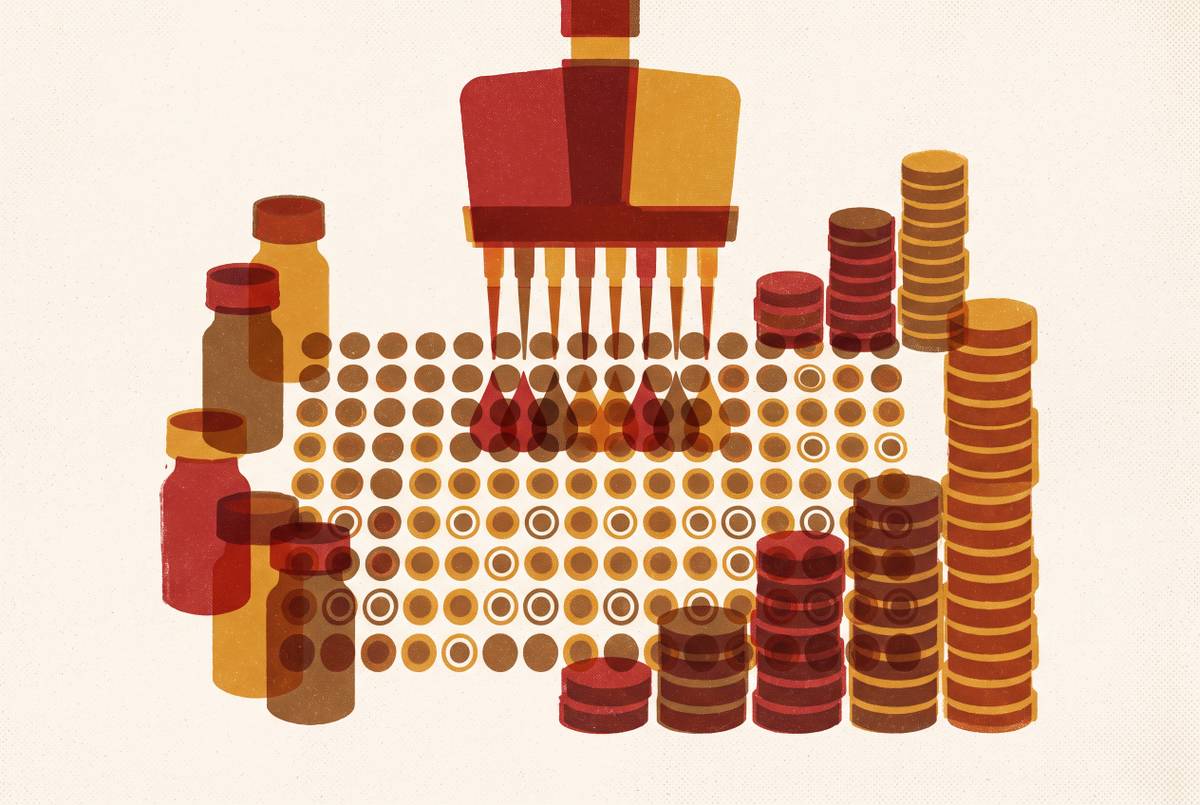
Automation makes reagent consistency more consequential because it distributes the same input across many reactions at once. In a 96-well CFPS plate, a lot-dependent shift can become a systematic confound across every well. Repetition does not remove a shared reagent problem. Precise liquid handling cannot make up for a change in how an extract works between runs. Comparisons across wells, plates and campaigns consequently depend on reagent characterization as much as on assembly consistency.
Protein Production Sweden at the University of Gothenburg operates a fully automated CFPS workflow using an Opentrons OT-2 liquid-handling robot named “Obi-Wan”. The workflow supports up to 96 parallel reactions and delivers purified protein in less than four hours. Its applications depend on valid comparisons at speed. They include rapid construct screening, work with difficult-to-express proteins, high-throughput expression optimization, directed evolution and variant screening. In these settings, an unexplained lot effect can undermine the comparisons that automation was introduced to accelerate.
Acoustic liquid-handling technology combined with HeLa cell-free extracts extends the argument to eukaryotic CFPS. Small-volume, automated reactions have supported parallel screening of promoter and IRES variants and accurate reproduction of complex regulatory dynamics, including CRISPR/dCas9 transcriptional repression. These workflows have been demonstrated. Their ability to compare regulatory behavior depends on consistent extract performance, making reagent opacity a constraint on interpreting the data.
The economic consequence follows from the same dependency. Small reaction volumes use less reagent, but repeat runs, re-optimization and manual calibration can wipe out those savings. For high-throughput protein production, functional performance on relevant targets and lot-level evidence belong beside reagent cost when assessing an extract system. Transparency is a cost-control mechanism.
Why the antidote to consolidation is transparency in reagent design, not more experimental controls
Better experimental controls, statistics and reporting are necessary responses to uncertainty, but none can substitute for disclosure of what enters an experiment. Controls operate on the inputs researchers receive. If the supply chain leaves composition changes undocumented, a laboratory may see that results differ but lack the information to explain why. Consolidation makes that limitation more acute by reducing the independent alternatives available for diagnosis.
The practical response is to change procurement requirements. Researchers should require documented formulations, lot-level QC and application-specific validation at a minimum, and judge suppliers by how willing they are to provide them. Reporting norms should make those disclosures usable. Methods sections should record lot numbers and link to supplier-published lot-level QC, turning reagent variability into a traceable, citable parameter. This connects supplier accountability to the scientific record rather than asking authors to report information they never received.
For CFPS, that change protects the reason for adopting the technology. Cell-free systems remove cytotoxicity constraints, permit direct manipulation of the reaction environment and compress production timelines from days to hours. Those advantages depend on an interpretable extract system. The growing expectation that reagents invite scrutiny shows that transparency is already becoming a selection criterion, while systems such as OpenCFPS demonstrate that it can be built into reagent supply. The field’s leverage lies in making that design standard routine, so experimental control begins with the reagent.