Reagent Opacity and Irreproducibility in Protein Expression Workflows
Invisible reagent changes undermine months of protein research with no way to diagnose the cause.
A protein expression experiment worked in March. It does not work in July. Same protocol, same operator, same freezer full of stock reagents, and the readout has moved just enough to throw off a whole month's worth of downstream planning. The certificate of conformity for the new reagent lot says everything matches spec. It does not say what "matches spec" was measured against, and it does not say what's actually in the tube. This is closer to a weekly occurrence in a protein expression lab, and it traces back to two distinct kinds of opacity that the reagent market has, largely, chosen not to fix: not knowing what's in a reagent, and not knowing whether it works as claimed. It is a recurring occurrence, and it traces back to two distinct kinds of opacity that the reagent market has, largely, chosen not to fix: not knowing what's in a reagent, and not knowing whether this lot matches the last one. Both leave a scientist with the same dead end when results shift: no way to tell whether the biology changed or the reagent did.
That distinction matters because the two failures get treated as one vague complaint about "reagent quality," when they're actually separate design choices. A supplier can publish a full ingredient list and still ship lot-to-lot variation that nobody measures. A supplier can also disclose nothing about formulation at all, so even a stable lot is a black box on arrival. Either way, the researcher loses the one thing needed to diagnose a failed run: a baseline they can trust. None of this is a law of nature. It is a decision, made upstream, about how much information to release with a product.
What reproducibility means in a protein expression workflow
Reproducibility, in this context, has a fairly narrow and testable definition: same protein target, same protocol, same intended reagents, and the run should produce the same yield, the same activity, and the same functional readout, regardless of who ran it, on what instrument, or in what month. That's distinct from replicability, which just means the same lab and the same hands can repeat a result. It's also distinct from biological noise, the inherent variability of living systems that no amount of documentation will eliminate. The piece here is concerned with a third category: reagent-introduced variance, which is, in principle, controllable. It just isn't being controlled, because the information needed to control it isn't being shared.
Protein expression sits in an unusually exposed position on this question, because the output of the workflow is itself a reagent. The expressed protein doesn't just get measured and filed away, it gets fed into a binding assay, an activity screen, a structural study. Any variance introduced at the expression step doesn't stay contained. It rides along into every downstream measurement that depends on that protein, and it compounds.
Cell-free protein synthesis (CFPS) makes this especially visible. CFPS reactions run on cell extracts, an energy source, and a genetic template, all combined in an open reaction environment outside a living cell. That openness is the whole appeal, it means the reaction can be tuned, supplemented, and adapted in ways a living cell won't allow. But it also means there are simply more variables in play, more knobs that can shift between one extract lot and the next without anyone noticing until the readout changes.
Cell-based expression doesn't escape the problem either. Decades of fermentation work have pinned down a lot of the relevant parameters there, growth conditions, induction timing, and so on. But the reagents feeding into that pipeline, extraction kits, lysis buffers, enzyme mixes, carry the exact same opacity problem CFPS has. The reproducibility standard being described here is the baseline requirement for data that can actually support a decision: which variant gets advanced, which hit gets prioritized, whether a protein is behaving the way the model predicted. It's the baseline requirement for data that can actually support a decision: which variant gets advanced, which hit gets prioritized, whether a protein is behaving the way the model predicted.
How reagent lot changes became the dominant source of inter-batch variance
Any workflow has multiple sources of noise: who ran it, which instrument, what time of day, and which reagent lot went into the tube. The question that matters is which of these actually dominates, because that's where the fix belongs.
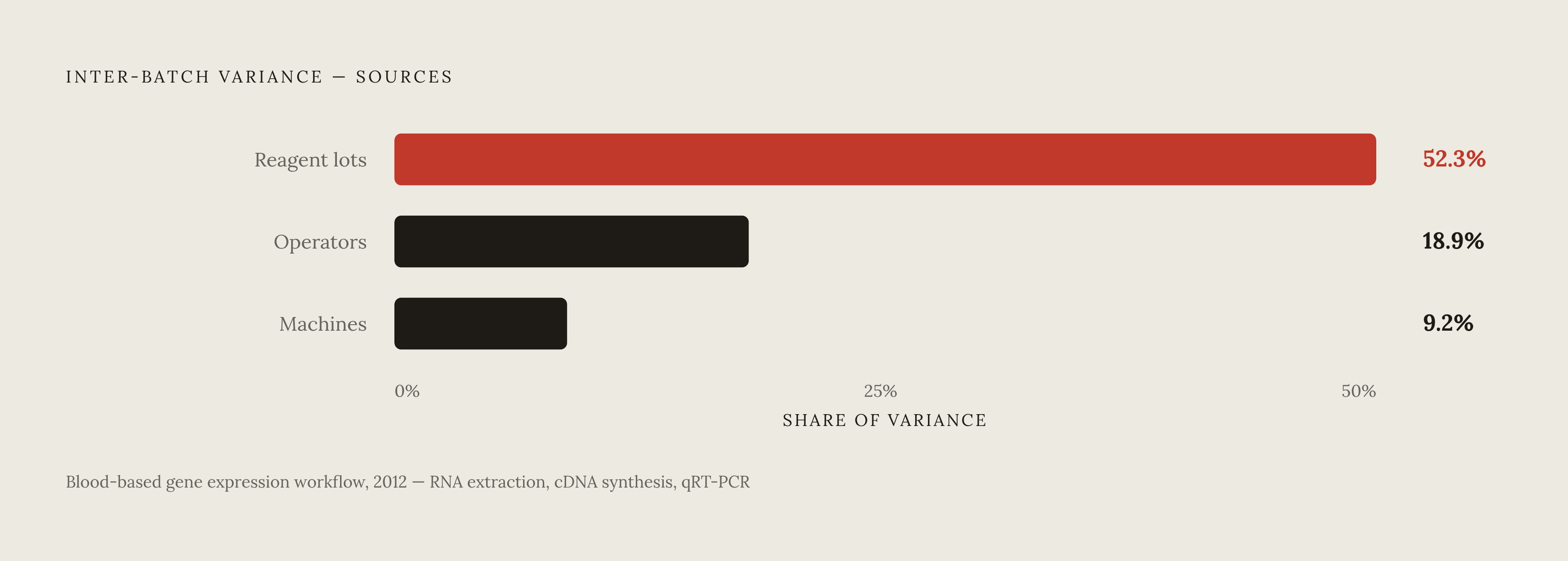
A study quantifying these factors in a blood-based gene expression workflow found that reagent lots, specifically for RNA extraction, cDNA synthesis, and qRT-PCR, accounted for 52.3% of inter-batch variance. Operators accounted for 18.9%. Machines accounted for 9.2%. The study is from 2012, but it gets cited in current literature because the pattern it describes hasn't gone away. Reagent lots, not people or hardware, were the largest single source of variation, by a wide margin.
Sit with that 52.3% for a second, because it has a practical implication most labs don't act on. When an experiment stops working, the standard institutional response is to retrain the operator or recalibrate the instrument. That breakdown shows that fixing both of those, perfectly, addresses less than a third of the actual variance. The reagent lot is where the problem actually lives, and it's the piece almost nobody audits.
There's a second layer to this that's easy to miss: lot-to-lot differences in protein activity appear even when the nominal concentration is held perfectly constant across lots. The research shows this happens partly because traditional total-protein measurement techniques misrepresent what's actually active in the tube, since they count multiple inactive species right alongside the functional molecule. Two lots can read identically on a total protein assay and still deliver meaningfully different concentrations of the molecule that actually does the work. That gap between what's measured and what's active is a structural blind spot in how concentration gets reported. It's a structural blind spot in how concentration gets reported.
The cost of not catching lot drift: evidence from immunoassay and binding studies
A pilot study out of Bristol-Myers Squibb, looking at recombinant sLAG3 batches (Harvey et al., Analytical Chemistry, DOI: 10.1021/acs.analchem.3c05607), put a number on this problem. Defining the reagent by assay-specific concentration, what's actually active in the assay, rather than total protein concentration, cut immunoassay lot-to-lot coefficients of variation by over 600%.
That figure deserves unpacking rather than just citing. A 600% reduction in CV means that most of what looked like lot-to-lot biological variability, in kinetic binding parameters that seemed to drift between batches, was actually an artifact. It came from invisible swings in the active-molecule fraction rather than from any real change in the biology being studied. Conclusions built on those measurements, about binding affinity, dose-response curves, relative potency, were systematically off, in a direction nobody could have caught without lot-level active-concentration data in hand.
Polyclonal antibody reagents make this worse still. Each new lot carries inherent biological variability that a total-protein measurement simply cannot see. The BMS study isn't an outlier case from a struggling lab, either. It came out of an organization with substantial analytical resources behind it. If a lab with that much infrastructure needed a dedicated study to reveal this gap, smaller labs running standard total-protein QC almost certainly carry the same error, just without anyone having measured it yet.
The same active-versus-total-protein ambiguity carries straight over to CFPS extract lots, where the hidden variables are constituent enzyme concentrations and metabolite levels rather than antibody titer. Lot-level measurements of either rarely appear on commercial certificates of analysis.
Why CFPS extract opacity is a distinct and harder problem than buffer opacity
A CFPS extract is a crude lysate, carrying ribosomes, tRNA, dozens of enzymes, metabolites, and regulatory factors all at once, unlike a defined chemical mixture such as a buffer. It's a crude lysate, carrying ribosomes, tRNA, dozens of enzymes, metabolites, and regulatory factors all at once. The real "formulation" of a CFPS extract is the entire physiological state of the source cells at the moment they were harvested, which is a much harder thing to pin down, and a much harder thing to disclose, than a buffer's recipe.
A review on industrial CFPS quality control published in Microbiology by Aw makes the case directly: measuring the Raw Material Attributes of a whole cell extract, meaning constituent protein and metabolite concentrations, is both essential and technically demanding. Understanding and controlling these complicated enzymatic reactions is a requirement for centralized production and for distributed production alike. Several variables shift between extract lots and rarely make it onto a commercial certificate of analysis: what growth phase the cells were in at harvest, the lysis method and the shear conditions used, the clarification protocol, and the freeze-thaw history of the material. Such process-level detail is rarely captured on a standard CoA.
The same review by Aw points to a workable mitigation, though: if a reagent can be prepared at large scale, mixed thoroughly enough to guarantee homogeneity, and then aliquoted, some of the composition and concentration control problems can be reduced. That fix, however, requires the supplier to actually do the homogenization work, validate it, and publish the results. That last step of validation and disclosure is not commonly undertaken. pH is among the parameters that must be sufficiently controlled, with deviations carrying downstream consequences for reaction performance. It's exactly the kind of parameter that crude-extract suppliers almost never report on a lot-by-lot basis.
The end result for a scientist troubleshooting a failed CFPS reaction is a system with more unknowns in it than knowns, and reagent documentation that does nothing to shrink that gap. None of this is a knock against CFPS as a platform. It's a criticism of how extract-based reagents get supplied and documented. The open reaction environment that makes CFPS so flexible is the same feature that turns every undisclosed variable into a lever for irreproducibility.
How the reproducibility failure propagates from the extract lot to the scientific record
Follow the chain from the reaction outward. An undocumented shift in extract activity changes the yield of a reaction. Changed yield changes the protein concentration sitting in the crude reaction mixture. That concentration then feeds every downstream assay that reads off it. Nothing about that chain requires bad intent or careless work, it's just the mechanical consequence of a hidden input changing.
In variant screening, activity rankings taken directly from crude CFPS mixtures can track closely with rankings from purified protein, when the system is well-controlled, a result shown for staphylokinase variants run on PUREfrex (Tomková et al., FEBS Open Bio, August 2026, epub March 24, 2026). The corollary cuts the other way: when extract lot activity drifts and nobody catches it, those rankings stop being trustworthy. A variant that looks inactive in the screen may just have had the misfortune of being expressed in a weak lot.
Plate-based assay workflows carry the same risk without the buffer that purification normally provides. A 2025 protocol from the University of Kent (Baker and Mulvihill, Current Protocols, DOI: 10.1002/cpz1.70255) showed that expressed protein can go straight into plate-based enzymatic assays without a purification step in between. That's a genuine efficiency gain, but it also means any variance sitting in the extract lot passes straight through into the assay, with no purification step to average it out or normalize concentration along the way.
Zooming out to the level of published results reveals the same mechanism as a batch effect. In multi-omics and gene expression work more broadly, reagent lot changes introduce batch effects that skew data integration, and there's no reason to think protein expression is exempt from the same dynamic: an unreported lot swap partway through a study creates a hidden batch effect that can look, to an unsuspecting analyst, exactly like a real biological signal.
The scale of the downstream damage is visible in widely reported reproducibility studies showing that large fractions of landmark preclinical findings fail to replicate when independently tested. Irreproducibility at that scale has more than one cause, obviously. But reagent opacity sits among the structural contributors, quietly, at the level of individual experiments that later get published and cited as settled fact. The propagation is asymmetric, too: a lot that performs better than expected inflates apparent activity and risks a false positive, while a weak lot produces a false negative. Neither error announces itself. Both require lot-level documentation to catch.
What adequate lot-level documentation looks like, and what it enables
Adequate documentation for a CFPS reagent isn't a mystery, and it isn't expensive to imagine, even if it's rarely delivered. At minimum: lot-specific yield on a reference protein, active concentration rather than just total protein, pH at the point of formulation, and a record of the source strain and harvest conditions. That's four data points, not a research program.
The BMS sLAG3 study already demonstrated the gap between assay-specific concentration and total protein concentration, and adequate QC means measuring what a lot actually delivers into the assay, not what it weighs on a protein assay. For polyclonal or mixed-protein reagents, that means titer, specificity, and activity characterization done per lot, going beyond a batch certificate that just confirms conformity to a nominal spec. For crude extracts, the UCL review's point stands: reproducibility can be demonstrated and validated when reaction conditions, pH included, are controlled and any deviations are evaluated. That requires the supplier to publish the validation data rather than run it quietly in-house and keep the results private.
What this buys the working scientist is concrete. It means being able to bridge lots, calculating a correction factor when switching from one to the next, catching a bad lot before burning a week on a full experiment, and attributing a shift in results to its actual source instead of rerunning the same experiment three times hoping it behaves. What it buys the field is bigger: shared reference standards, comparability across labs, and the kind of CFPS-specific quality framework that a 2026 perspective (Aw, Microbiology, PMC13466024) identifies as a prerequisite for CFPS moving into industrial use. None of this documentation is technically out of reach. The information already exists inside the manufacturer's own QC records. It's a market choice not to release it.
What changes the incentive for the reagent market to self-correct
Opacity isn't irrational, from where a supplier sits. A proprietary formulation is a competitive moat, and publishing it lowers the switching cost for a customer who might otherwise stay locked in. Lot-level QC data creates a paper trail of accountability, and that paper trail raises the cost of ever releasing a substandard lot. Withholding both is, in a narrow business sense, the safer play.
Incumbency reinforces this. Once a lab has built and validated a protocol around a specific commercial kit, the cost of switching is high, and that cost lands on the scientist, who has to revalidate everything, not on the supplier. That asymmetry insulates opaque products from ever having to compete on the basis of transparency. Meanwhile the reproducibility crisis itself is diffuse: its costs land as wasted reagents, failed experiments, and retracted papers scattered across many individual labs, rather than as a concentrated loss to any one supplier. Diffuse costs don't generate market pressure the way concentrated losses do.
What actually shifts the incentive is customers who start selecting, explicitly, for lot-level QC data and documented formulations at the point of purchase, and institutions that build reagent documentation into what counts as a complete experimental record. Fields that begin requiring reagent lot information in methods sections push the same pressure further upstream. The 2026 Aw perspective (PMC13466024) makes a related point: closing the gap between academic CFPS work and industrial adoption is going to require shared standards and validated workflows, none of which the market has produced on its own. Regulatory and community frameworks look like the more plausible catalyst.
There's an early signal of that shift already. The point-of-care manufacturing framework introduced in the UK in July 2025 puts CFPS in regulated production settings under that framework, and once that happens, reagent documentation becomes a requirement rather than a nice-to-have. Labs that have already standardized on transparent reagents will face no transition cost when that requirement lands. The ones still running on opaque kits will.
Choosing reagents that reduce opacity, and how OpenCFPS fits in
Everything above translates into a fairly short purchasing checklist. Look for a published formulation or a full ingredient list, lot-level yield data measured against a reference protein, assay-specific active concentration rather than a total protein number, documented source strain and harvest conditions, and QC records that are actually accessible, not a CoA that only shows up after a special request.
A documented formulation does more than satisfy a transparency principle. A scientist who knows what's actually in the tube can troubleshoot degradation when something goes wrong, swap in an individual component if a supply chain disruption takes one ingredient offline, and adapt the system to a new protein target without starting the whole optimization from zero. Compatibility with automation and plate-based formats matters here too, and it's an adjacent form of transparency in its own right: reagents built for standardized plates and robotic liquid handlers constrain variability by design, which cuts down the operator-to-operator share of variance, the same share that accounted for close to a fifth of inter-batch differences in the study cited earlier.
OpenCFPS™ from Sepia Biosciences is built around this set of criteria directly. It's engineered for two modes of use, rapid screening across large protein variant libraries, and milligram-scale production, with formulations documented openly and lot-level QC data published rather than held back. That gives a scientist the foothold for diagnosis that an opaque kit simply denies them by design. Pricing as low as $25/mL is a deliberate choice too, aimed at removing the cost barrier that otherwise keeps labs from running the volume of replicates needed to catch lot-to-lot variance. When reagent cost forces a lab to cut replicates or stick with fewer lots, variance gets harder to see because there's no data structure left to reveal it. Lower per-mL cost restores that structure.
For the hardest expression targets, toxic proteins, unstable ones, insoluble constructs, multi-domain assemblies that cell-based systems struggle to fold correctly, CFPS already carries a structural advantage: an open reaction environment that a living cell can't offer. That advantage only pays off, though, if the reagent behind it comes with the documentation to make the results trustworthy from one lot to the next.