Access Inequity in Research Reagent Pricing Across Institution Types
Transparent reagent formulas and lot-level data lower barriers for under-resourced labs.

Reagent pricing inequity across institution types is structural, built into supply chains, bundled kits, and undisclosed formulations. For high-throughput protein production, documented cell-free protein synthesis (CFPS) systems offer a concrete route to lower costs without treating complex proteins as expendable. Transparent formulations, lot-level quality data, and honest pricing make that route usable beyond well-funded institutions.
How reagent pricing gets set and why it falls hardest on under-resourced labs
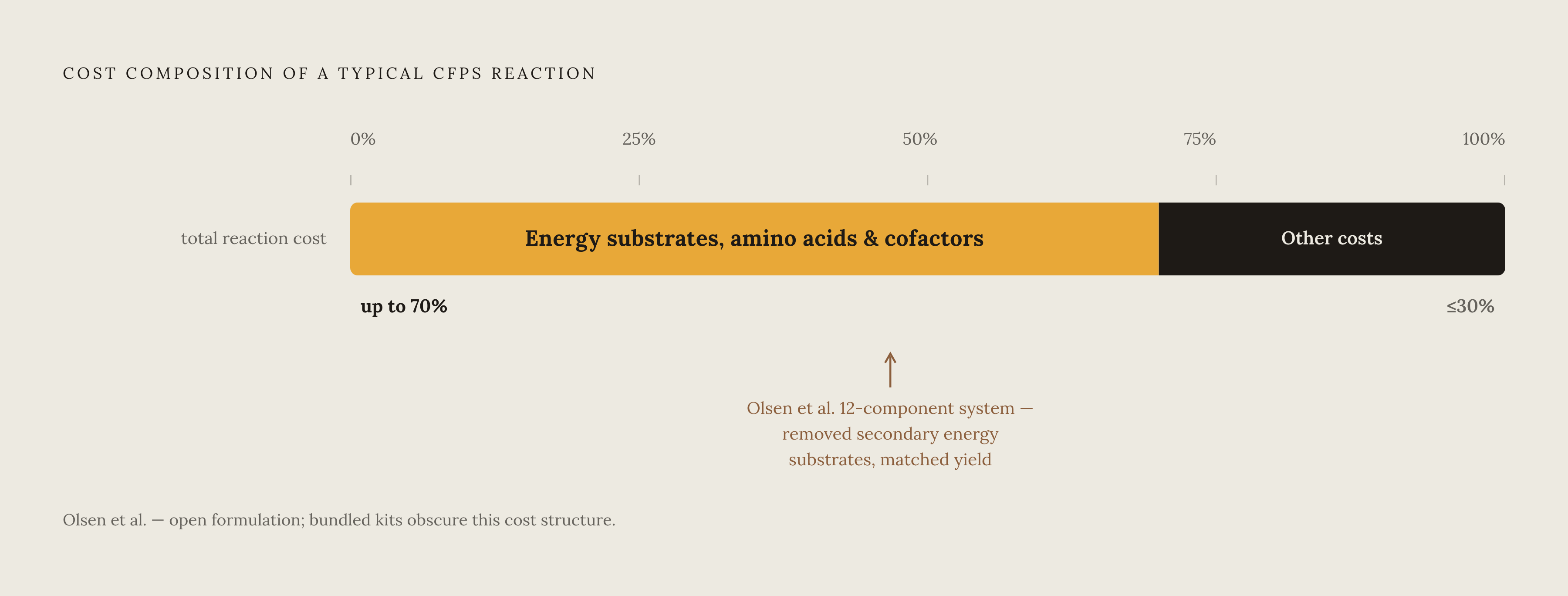
Supply chains and kit economics distribute costs unevenly before a researcher begins an experiment. In CFPS, expensive purified amino acids, energy regeneration molecules such as phosphoenolpyruvate (PEP) and creatine phosphate, and cofactors can account for up to 70% of total production costs. Yet buyers usually encounter these components as a bundled kit. The bundle hides the relationship between component costs and the price charged for a working reaction. Without a disclosed formulation, the researcher cannot audit that relationship or distinguish necessary expense from a costly formulation choice.
Institutional and geographic position then compound the base price. Labs in lower-income countries and peripheral institutions face longer delivery timelines and higher per-unit costs on top of kit charges. Well-funded institutions have purchasing power and staff who can negotiate contracts or absorb the overhead. Smaller labs have less room to maneuver, so the same reagent system places a different constraint on their work. Inequity emerges from this cost architecture without requiring an accusation about any individual supplier’s motives.
A different purchasing model makes the components and their price open to examination. Sepia Bio’s OpenCFPS™ product line combines documented formulations and lot-level QC data with pricing starting at $25/mL. Open formulations are not the only response to supply-chain overhead, and they do not remove delivery costs. They do, however, expose a part of the cost structure that institutional purchasing power otherwise helps determine who can afford.
Why opaque formulations turn a cost problem into a reproducibility problem
An undisclosed formulation also limits what a researcher can know when experimental performance changes. Biological reagent components, including lysates and cofactors, can vary between lots and shift the outcome of a reaction. A new vial does not itself tell the researcher whether relevant experimental conditions have changed. When the composition and lot performance are unavailable, the change arrives without the information needed to interpret it.
That uncertainty falls unevenly across institutions because purchasing patterns determine exposure to new lots. Labs with enough funding can buy in bulk or reserve a validated lot for an extended workflow. Labs that buy small amounts when their budgets allow have no such buffer when lots change. Having to buy this way makes it harder for them to tell whether a change comes from reagent drift or from something else in the experiment. The conventional protection of buying at volume from a single validated supplier consequently brings the researcher back to the purchasing dependency that affordability efforts seek to reduce.
Lot-level QC disclosure provides a different basis for continuity. With per-lot performance data and open formulations, as provided through Sepia Bio’s OpenCFPS™ system, researchers have information with which to detect drift and troubleshoot. The technical distinction matters because a formulation describes the system’s composition, while lot-level data describe the performance of a particular batch. Neither substitutes for the other. Together, they support standardization without making bulk purchasing, vendor support calls, or institutional memory the main safeguards against an unexplained change.
What the cost of energy substrates reveals about where the real price floor is
The strongest evidence for a lower CFPS cost floor comes from changing the formulation and measuring what happens. Olsen et al., in Nature Communications 2026, used a multi-dimensional definitive screening design across more than a thousand reagent formulations. Their objective was to identify components that could be removed without sacrificing yield.
Olsen et al. made a 12-component system that left out costly secondary energy substrates and gave protein output on par with more complex, expensive formulations. The system worked well with multiple batches of cell lysates, in the hands of multiple users, and in multiple locations. It also supported synthesis of more than 20 different proteins, including fifteen therapeutically relevant products and full-length aglycosylated monoclonal antibodies. Those results make the economic finding more useful than a cheaper reaction demonstrated for a single easy target. They show that a simpler formulation can retain breadth as well as output.
Capable CFPS can operate without an expensive energy system. Formulation choices contribute to the gap between kit pricing and the cost needed to support protein production, so the kit price cannot be read directly as the biological price floor. OpenCFPS™ from Sepia Bio represents a commercial approach to that same principle through documented reagents intended for screening and scale-up. Olsen et al. demonstrate what systematic component removal can achieve, while a commercial system must be assessed on its own documented performance.
The science that becomes inaccessible when pricing is prohibitive
For a defined class of proteins, the consequence of unaffordable CFPS is not a choice between equivalent production methods. Those in vivo systems cannot reliably make proteins that are toxic to host cells, unstable under cellular conditions, or incompatible with standard expression hosts. These targets include membrane-associated proteins, certain multi-domain proteins, and proteins that are too toxic to keep a living culture going. For these targets, keeping the host alive can conflict with producing the protein. Cell-free expression removes the need to keep the host alive, so access to reagents affects what science a lab can do.
The staphylokinase variant screening workflow published in FEBS Open Bio (2026) illustrates the application-level value of CFPS. The workflow screened a therapeutically relevant, difficult-to-handle fibrinolytic in crude CFPS mixtures in microplate format. The proteins ranked much the same by activity in the crude reactions as they did after purification. This provided functional readouts without the purification step that would otherwise be required.
That example does not establish that every difficult protein requires CFPS or that every crude reaction can replace purified material. For targets that cannot be produced reliably in living hosts, a cheaper cellular workflow is not an adequate substitute. A lab that cannot afford CFPS may lose the chance to work on the target even if it has more time to make it. The scientific loss includes both a narrower range of experimentally reachable questions and fewer reactions a budget can buy.
How high-throughput variant screening concentrates capability in well-resourced labs
Access also differs within CFPS because the highest-throughput workflows depend on specialized capital equipment. The 2025 Harvard MRSEC study reported that droplet microfluidics paired with CFPS provides roughly 1,000× the throughput of robotic well-plate screening. Researchers used the platform to engineer Bacillus subtilis Lipase A (BsLipA) variants with substantial thermotolerance improvements after a single round of mutagenesis. That result demonstrates the value of pairing cell-free production with a highly parallel screening format.
The distinction between droplets and plates reflects different tiers of access. Most labs operate in the plate-based world, where CFPS still supports useful variant screening, as the staphylokinase workflow demonstrates. For those labs, reagent economics remain central because the available budget must support the reactions that make a campaign informative. Labs thus need to compare what they can keep doing with the equipment they have and the reagents they can afford to keep buying.
For AI biology protein production campaigns, that comparison needs criteria that say more than a platform label does. These include template compatibility, functional screening readouts, support for complex proteins, lot-level traceability, and a path from screening to scale-up. OpenCFPS™ supports linear DNA and plasmid DNA and is designed for both screening and scale-up, making it one documented option against those criteria. Its starting price per reaction volume does not, by itself, establish a cost per milligram for an antibody campaign. The supplied screening studies and that price give too little information to rank AI-driven platforms by antibody production cost, and such a ranking would mix up what the platforms can do with what antibody production costs.
What a multi-site global CFPS network demonstrates about structural solutions
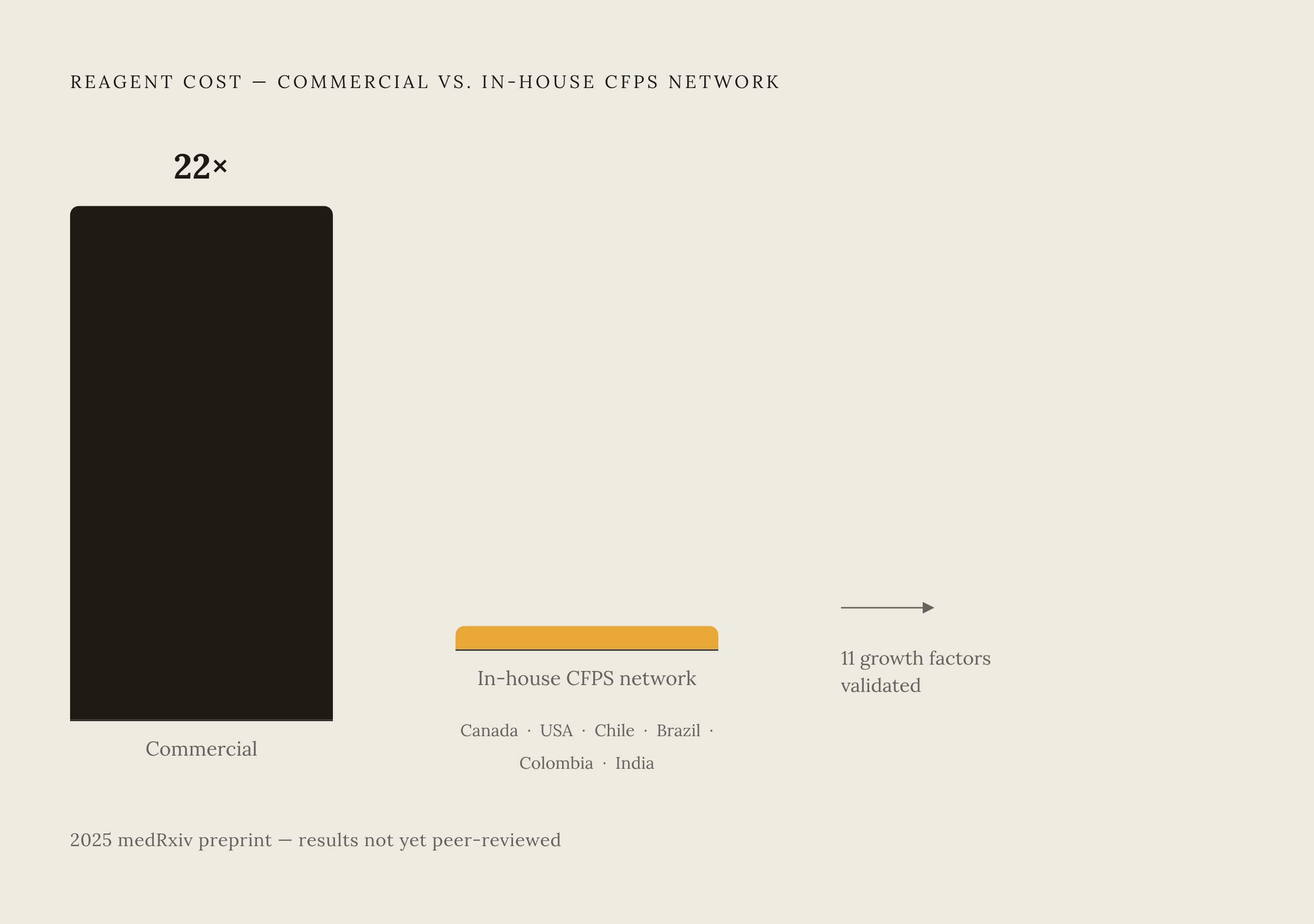
A distributed production network addresses different barriers to obtaining reagents than faster screening equipment does. The international multi-site CFPS preprint (2025, medRxiv) describes a collaboration spanning Canada, the USA, Chile, Brazil, Colombia, and India. The collaboration produced and validated a repertoire of eleven growth factors commonly used in mammalian cell culture and relevant to regenerative medicine. It reported in-house CFPS production costs roughly 22-fold below commercial equivalents. The work has not been peer-reviewed, so it provides a provisional illustration of a structural possibility.
The network tries to make local production work in a range of settings. That changes the question from whether an individual lab can afford a commercial reagent to whether multiple institutions can use a transferable production system. A shared technical basis can support local implementation without presuming that every participating lab has identical resources. The reported cost comparison concerns reagents with a defined research use. Even so, it should not be treated as a universal saving available to every institution or every target.
The network’s broader contribution is to make distributed access concrete. It brings standardized production, local capability, and cross-site transfer together in one working system. Its preprint status limits the strength of the conclusion, but not the relevance of the structural question it asks. If a reagent system is intended to move between institutions, its composition and performance must be understandable beyond the originating lab. Transferability therefore depends on incorporating documentation into the system as production is established.
Why formulation transparency is the precondition for all other solutions
The technical, economic, and distributional parts of this argument converge on the same prerequisite. Cost reduction requires knowing which components contribute expense and which can be changed. Lot-level standardization requires a known formulation and information about batch performance. For multi-site transfer, labs need to share enough knowledge for another site to reproduce the reagent system. Automation compatibility likewise depends on a defined system, rather than an unexplained input whose behavior must be accepted without examination.
Olsen et al. could optimize their formulation because individual components could be enumerated and manipulated. A black-box kit does not permit that same systematic analysis, and it places a similar limit on a lab trying to troubleshoot a reaction. Transparency is thus more than an ethical preference about access to information. It is practical infrastructure for learning from an experiment and carrying that knowledge into another batch, workflow, or institution. Affordable pricing becomes more useful when researchers can understand the system they are paying to use.
The strongest objection is that disclosure reduces a supplier’s ability to defend its product from competition. Yet defensibility built on opacity leaves customers unable to inspect a source of cost and experimental uncertainty. Reproducibility offers a different basis for durable value, particularly for customers who need to standardize across sites and over time. Transparent, documented reagent systems with honest pricing leave some institutional disadvantages in place, but free labs from having to rely on hidden formulations because they lack the budget to do otherwise. Knowing what is in the reagents is the first capability a lab needs to troubleshoot, standardize, and scale.