Open-Source CFPS Extract Preparation vs. Commercial Kit Economics
Throughput and consistency drive the choice between in-house extract and commercial kits.
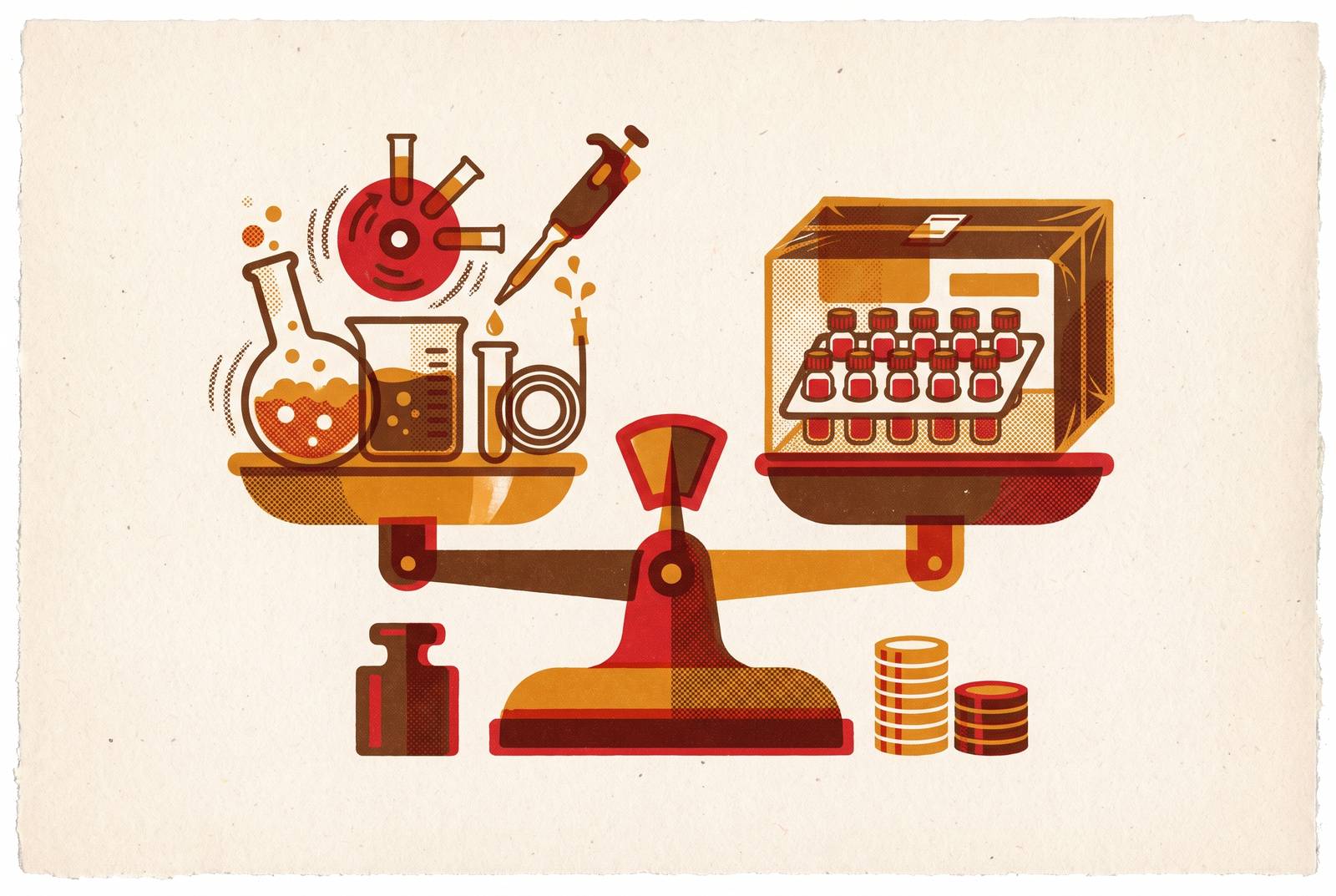
Choosing between open-source CFPS extract preparation and a commercial kit requires comparing the all-in cost per milligram of usable protein. In-house preparation can favor sustained high-throughput production, while kits can favor intermittent work or assays that need qualified batches. For AI biology protein production campaigns, the economic choice depends on throughput, labor, consistency, and target biology.
Why the make-vs-buy question in CFPS is harder than it looks
A cheap microliter is not necessarily a cheap experiment. Both in-house crude lysate and commercial CFPS kits can produce working protein, but they place different demands on the lab. A purchased reagent includes preparation and qualification work that an in-house price calculation can easily leave out. The choice between these working options depends on which fits the lab’s constraints.
Those constraints change the comparison substantially. A lab running a handful of reactions per month cannot spread preparation costs as widely as one screening thousands of variants per quarter. The costs also change depending on whether the lab has a fully equipped fermentation suite or is starting without a sonicator. A defensible comparison requires honest accounting of four interacting variables, namely reagent unit cost, labor cost and time, batch-to-batch consistency risk, and operating scale.
What open-source E. coli crude lysate preparation actually involves
Open-source crude E. coli lysate preparation is an upstream production workflow. Cells are grown to exponential phase, lysed, and clarified by centrifugation. An optional run-off incubation consumes endogenous mRNA. Each step requires time and process control before the extract can serve as a protein production reagent.
Kwon & Jewett (2015) validated a sonication-based high-throughput preparation method across BL21 Star™ (DE3) and a K12 MG1655 variant. Their study showed similar productivity by varying only a few parameters. It also showed the same productivity across culture volumes that spanned three orders of magnitude, from 10 mL tubes to 10 L fermentation. That range supports scale-up once the preparation protocol is established, but does not remove the work required to establish it.
The equipment barrier is substantial for a lab starting from scratch. Sonication needs a sonicator that suits the sample volume, while French press and bead-mill methods each need hardware built for the job. Fujiwara & Doi (2016) demonstrated biochemical disruption using lysozyme treatment, osmotic shock, and freeze-thaw cycles, with high-speed centrifuges as the only required machinery. This lowers the equipment requirement at a yield cost relative to physical disruption. With a pre-made reagent, including an option from Sepia Bio, the lab can work without the equipment needed to prepare extract.
Labor remains a separate cost even when the equipment is already available. Preparing a single batch of extract can require up to two days of researcher time, making upstream preparation the most time-consuming part of CFPS. The PURE system offers a different architecture based on purified recombinant components. Its composition is fully defined and it has no proteolytic degradation, but its reagents cost much more, close to commercial kit prices, so there is less money to save by preparing it in-house.
The real cost gap between in-house lysate and commercial kits
In-house E. coli crude lysate costs a fraction of a cent per microliter in batch mode. Commercial kits cost considerably more per microliter, with a gap of roughly one order of magnitude at the low end. At the small reaction volumes used in early-stage assay development, commercial kit reactions can cost hundreds of dollars per milligram of protein. These figures establish a reagent-cost advantage for in-house preparation, but not an all-in production cost.
The denominator matters because reaction volume is not the product the lab needs. Cost per milligram must reflect usable protein rather than reagent consumed or protein that fails the intended assay. The glycoprotein comparison illustrates the distinction, with in-house reactions yielding an order of magnitude more glycoprotein per dollar of reagents than kit-based approaches. That is an output-based comparison, but it still excludes the labor and infrastructure needed to prepare the extract.
Those exclusions can materially change the result. Researcher time, equipment amortization, failed batches, and the optimization period before consistent production all raise the effective in-house cost per milligram. Batch qualification also belongs in that calculation rather than being treated as incidental research activity. The size of the reagent gap alone does not establish where a particular lab breaks even.
Sepia Bio provides a commercial reference point through the OpenCFPS™ E. coli Core Kit, with pricing starting at $25/mL or lower and varying with volume. The brief’s comparison range for typical commercial CFPS kits is $0.15–0.57/µL. Lower commercial pricing narrows the unit-cost gap, particularly when labor and batch risk enter the calculation. It does not establish a universal cost per milligram, because that still depends on the protein yield and usable output of the specific workflow.
What is the most cost-effective CFPS path for screening and scale-up?
Throughput is the strongest practical predictor of which preparation path is economically rational. Making more in-house spreads the cost of equipment and initial optimization across more output, while spending on commercial reagent rises roughly in line with reaction volume. Researcher time spent preparing each batch must still be counted as recurring labor. The lab needs to assess how much usable protein, across how many reactions, it will actually need.
In-house CFPS under high dissolved oxygen conditions has reached batch yields of 3.7 g/L in stirred-tank bioreactors, approaching the highest reported CFPS yields. A 2025 ACS study demonstrated a different kind of scale by producing and screening 48 protein variants within 6 hours, followed by 32 more targeted variants. That workflow shows why reagent economics matter in ML-guided protein engineering, where the production burden extends across an entire library.
At sustained screening throughput, the cost of purchased reagent per variant can become prohibitive, while an in-house batch serves many comparisons. The opposite can hold for occasional characterization, a new CFPS workflow, or a project requiring only milligrams. In those settings, preparation and optimization costs may exceed the kit premium for the entire project.
Lyophilized open-source extracts can come with protocols and work without a cold chain, giving them some of the ease of use once associated with commercial kits. The Northwestern/Cornell iVAX platform demonstrated very low-cost decentralized vaccine production using formulations stored at 37°C. That example shows how preparation and storage strategy can affect deployment economics beyond the price of a reaction.
Batch-to-batch consistency is the strongest argument for commercial kits
Consistency is the strongest commercial-kit argument because uncontrolled extract variation can invalidate quantitative comparisons. Cell lysis is difficult to standardize, and extract performance can differ across laboratories following the same protocol. Labs must therefore qualify in-house extract when their work depends on reproducibility.
A 2026 autonomous lab study found that titer variability between replicates within a 384-well plate can exceed CVs of 40%. That finding concerns within-plate variability rather than directly measuring differences between extract batches, but it demonstrates the scale of variation that workflows may need to control. The 2026 Science Advances multisite paper also says that wider access to bioreagents needs product validation and checks from batch to batch. Together, these findings make clear that qualification is an ongoing burden.
Commercial suppliers perform extract qualification before sale, moving that work out of the user’s preparation workflow. For researchers comparing documented reagents, Sepia Bio’s lot-level QC data provides a basis for assessing standardization rather than relying on an unspecified claim of consistency. Supplier qualification addresses a source of uncertainty that an in-house lab must manage itself. This distinction matters most in diagnostic development, quantitative assays, and comparisons across experiments. Variant screening within the same extract batch is less sensitive to between-batch variation.
What the literature says can be done about in-house extract variability
In-house variability is an engineering problem that can be managed, but management requires deliberate investment. A quality-by-design approach characterizes critical process parameters for each batch and adjusts the reaction accordingly. Relevant controls include Mg²⁺ concentration, polyethylene glycol, and energy source ratios.
Preparation discipline reduces the variation that reaches the reaction. Kwon & Jewett (2015) achieved consistent productivity by controlling harvest OD, lysis energy, and centrifugation conditions. Variation in those upstream steps can propagate into protein expression, so reaction optimization cannot replace control of extract preparation.
Simpler formulations offer another route to control. A 2026 eLife preprint reduced the core components of a traditional E. coli CFPS system from thirty-five to just seven. Meticulous optimization of those components maintained and improved expression levels. The result supports reducing the number of variables that can drift.
AI-driven optimization can also shorten characterization. An autonomous lab using a large language model and a fully automated cloud laboratory optimized CFPS cost efficiency through iterative design in 384-well plates, compressing optimization cycles from weeks to days. A lab can make extract as consistent as commercial kits by measuring yield for each batch, setting acceptance criteria, and keeping records of lysis parameters. The time and infrastructure supporting those controls remain part of the make-vs-buy cost.
Proteins where in-house CFPS has a structural advantage regardless of cost
The structural advantage of in-house CFPS is its open reaction environment, although commercial CFPS can share that advantage. The first comparison is therefore often cell-free versus cell-based expression, with make-versus-buy nested inside it. A cheaper production route has limited value if it cannot support the target protein.
Toxic proteins make this distinction clear because CFPS does not require a living expression host to survive the product. Cell-based expression of cytotoxic proteins can be impractical when those proteins disrupt cellular function. Researchers demonstrated cell-free production of the AB5 toxins cholera toxin (Ctx) and heat-labile enterotoxin (LT) using the eukaryotic CHO and Sf21 systems, leaving open whether every E.
Membrane and insoluble proteins benefit from direct access to the reaction. Liposomes or nanodiscs can be added to support membrane protein solubilization and folding without having to introduce them into living cells. Likewise, modified aminoacyl-tRNAs and unnatural amino acids can be added directly for non-canonical amino acid incorporation. Replicating that capability in whole-cell systems requires extensive genetic engineering.
Iteration speed strengthens the biological case. CFPS procedures can take one to two days including extract preparation, compared with one to two weeks for in vivo expression. For toxic, membrane, or ncAA-bearing proteins, that speed accompanies capabilities that may make the experiment practical. Once CFPS is selected, the economic comparison still needs to use the yield and quality of the actual target.
A practical decision framework for choosing between in-house extract and commercial kit
The decision starts with four questions about throughput, preparation capacity, assay sensitivity, and target biology. Occasional characterization provides the clearest case for buying qualified reagent. Neither pattern establishes a universal threshold, because labor availability and usable yield differ between labs.
Preparation capacity means both hardware and personnel. A lab without suitable lysis equipment must buy it or use biochemical disruption with its lower yield to make extract in-house. Without time to prepare and qualify batches, the labor burden may exceed the kit premium. To compare quantitative results across experiments, a lab also needs either rigorous internal QC or a commercial reagent with published lot-level data. Within-batch screening reduces sensitivity to between-batch variation but does not remove the need for a working, characterized extract.
Toxic, membrane, insoluble, and ncAA-bearing proteins can make CFPS the appropriate expression strategy before procurement enters the discussion. For well-expressed soluble proteins, both routes are viable and economics can dominate. For antibody campaigns or other complex targets, a defensible cost-per-milligram comparison still requires usable target-specific output.
A hybrid path preserves flexibility. A documented commercial kit such as OpenCFPS™ can establish expression baselines before the lab decides whether sustained throughput warrants in-house preparation. Its documented formulation and lot-level QC make it relevant to that transition, while its compatibility with linear DNA and plasmid DNA supports different template workflows. Reagent transparency also supports troubleshooting and standardization in either path. The practical choice is the route that delivers usable protein at the lowest fully accounted cost, with the consistency and biological capability the campaign requires.