Inter-Lab Comparisons of E. Coli Extract CFPS Systems
Operator and reagent choices, not extract quality, drive variability between labs.
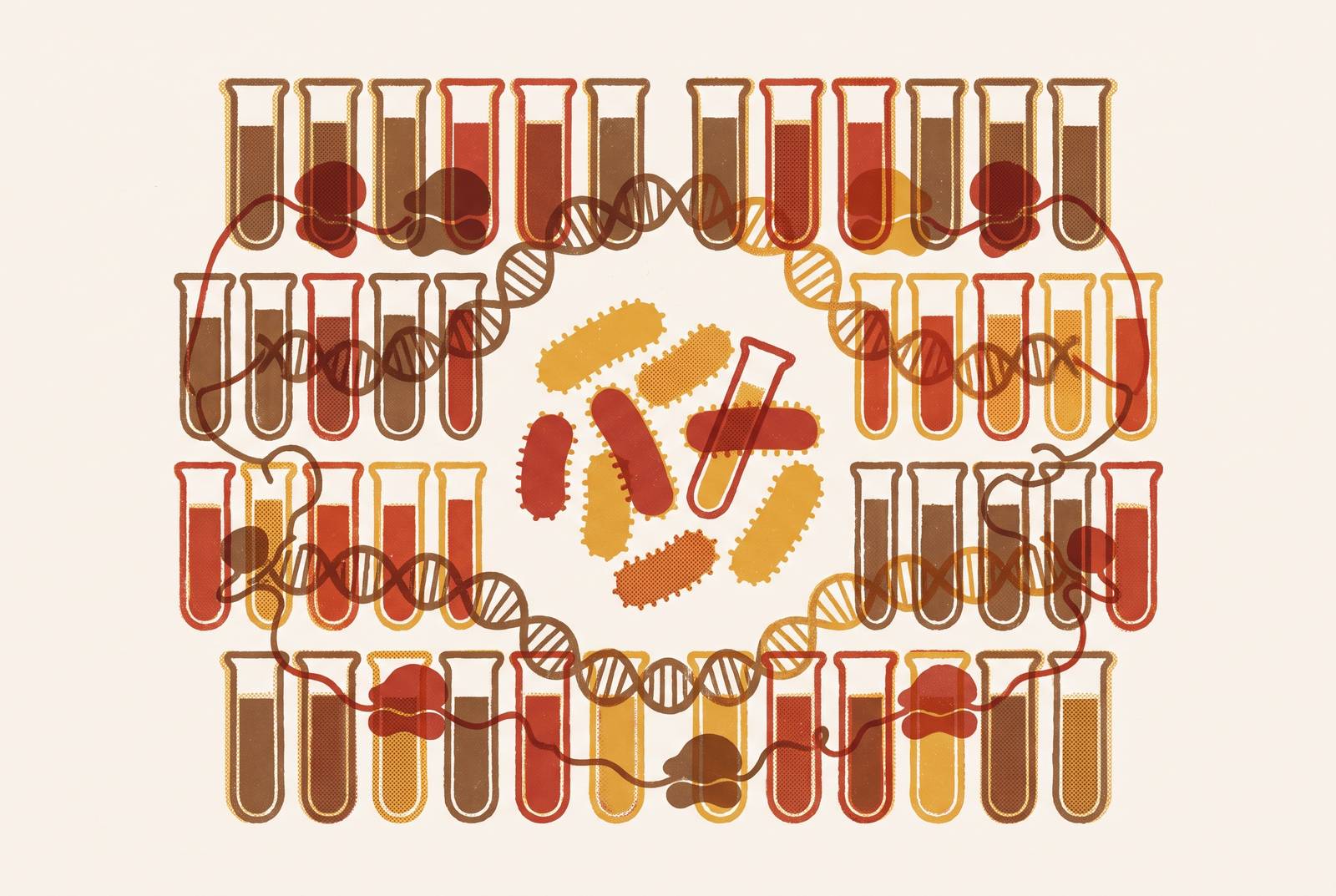
E. coli extract cell-free protein synthesis (CFPS) reassembles the transcription and translation machinery from lysed cells, letting protein synthesis happen outside the constraints of a living cell. It has become the dominant prokaryotic cell-free platform for that reason: it runs faster than cell-based culture, it can be manipulated freely in ways a living host resists, and it can express proteins that would be toxic or unstable if produced inside a cell. The whole system depends on one thing: the extract itself has to be high-quality and consistent from batch to batch. Because the extract functions as the system rather than as an input to it, any variation in how that extract gets made is variation in the experiment itself.
That dependency is what makes inter-lab comparisons of CFPS unusually informative, in a way that ordinary reagent-kit comparisons are not. A kit comparison just tells a buyer which vendor's formulation performs better under fixed conditions. A CFPS inter-lab study asks a sharper question: when two labs run what is nominally the same protocol and get different results, is the difference coming from the biology, from the written protocol, or from the lab running it? That question matters to anyone trying to reproduce a published result, anyone evaluating whether to adopt the platform for a new application, and anyone trying to write a standard that other labs could actually follow.
Where protocol decisions in extract preparation accumulate into variability
Extract preparation follows a fixed sequence: cell growth, harvest, wash, lysis, centrifugation, a runoff incubation to deplete endogenous mRNA, and dialysis. Each of those steps sounds like a checklist item, but each one carries a discretionary choice that a protocol document rarely spells out in full, and those choices accumulate across the pipeline rather than canceling out.
Strain selection is the first fork in the road. Kim et al. (2019) described extract preparation from a genomically engineered E. coli, which shows how directly strain engineering choices propagate into the character of the resulting extract. When a target protein is sensitive to proteolytic degradation, E. coli strain B, defective in OmpT and Lon protease activity, becomes the preferred host. Chumpolkulwong et al. showed that a mutation in ribosomal protein S12 alters how efficiently mRNA codons get read and raises protein productivity; extract performance is partly written into the genome of the source strain before lysis ever happens.
Growth phase at harvest is treated as a near-universal constraint. Exponential-phase harvest is standard practice because it is assumed to capture the most active translation machinery available. Failmezger et al. (2017, Scientific Reports) tested that assumption directly and found that extracts from non-growing, heat-stressed E. coli produced synthesis rates comparable to extracts from fast-growing cells, because the stoichiometry of ribosomes and key translation factors stayed conserved even as total ribosome and protein levels fell.
Lysis method resists standardization more than any other step in the pipeline. Bead-milling, sonication, and French press each impart different shear profiles and different cell disruption efficiencies, and the specific choice is rarely documented with enough precision to reproduce reliably across different equipment generations or different lab settings. The runoff incubation that follows, meant to clear endogenous mRNA before the CFPS reaction itself begins, is a time-temperature parameter, and if that parameter varies, it quietly shifts the translational baseline every lab starts from, often without anyone noticing it happened. Kim et al. (2018, US Patent 10,088,493) showed that pH drift during ATP regeneration depresses protein yields, and that controlling pH enzymatically, using amino acid decarboxylase, substantially improves output. Labs that are not managing pH during the reaction start from a lower, less stable baseline before any other variable comes into play.
The first quantitative inter-lab study's measurements and findings
The first quantitative assessment of interlaboratory variability in CFPS had three laboratories implement a single shared protocol and exchange materials and personnel, a design built specifically to isolate the separate contributions of site, operator, extract preparation, and supplemental reagent preparation to the variability observed.
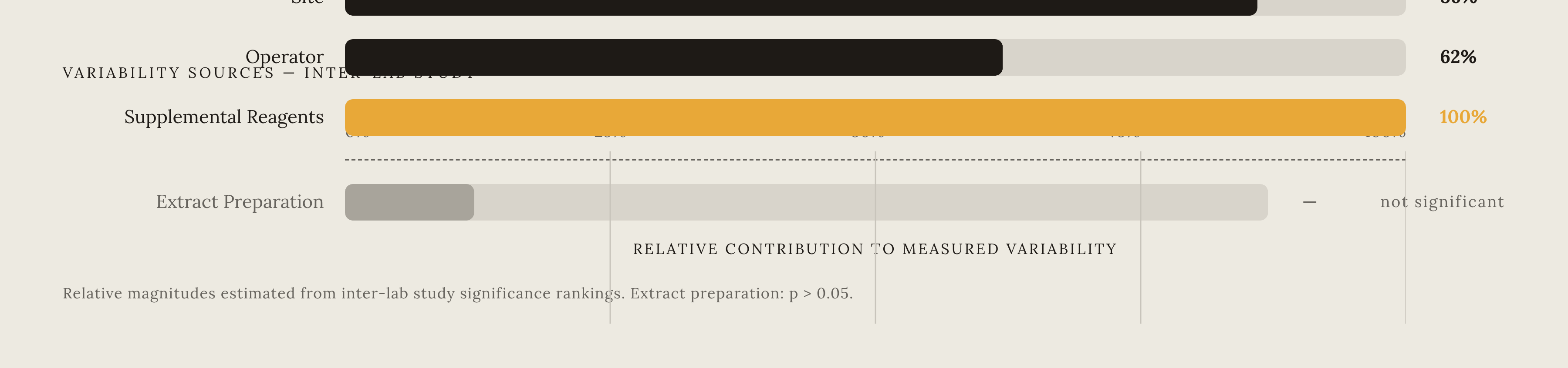
The result ran against the field's working assumption. Extract preparation, the step most labs would point to first as the dominant source of variability, did not explain a statistically significant portion of the variability measured, even when the extract was prepared in different laboratories by different operators. That finding deserves to be read slowly, because it contradicts the instinct behind nearly every troubleshooting conversation about CFPS performance: the extract is not where the inconsistency is concentrated.
What did explain the variability was different. Site and operator each contributed independently to the differences observed, and supplemental reagent preparation turned out to be a significant source of divergence on its own. If extract batch is not the primary driver, and operator and reagent preparation are, then standardization efforts that focus exclusively on the extract protocol are aimed at the wrong target. The reagent environment surrounding the extract carries at least as much weight as the extract itself.
Supplemental reagent variation as the under-appreciated driver of CFPS irreproducibility
Supplemental reagents, the energy substrates, amino acids, salts, and buffers added to a CFPS reaction, are not inert background to the extract. They shape the chemical environment the extract operates inside, so lot-to-lot variation in any one of them transmits directly into yield and into reproducibility. The field has, by and large, treated these components as fixed and uninteresting next to the extract, and the inter-lab evidence says that treatment has been backwards.
The upstream supply chain offers a documented case. The composition of yeast extracts used in growth media can vary dramatically from lot to lot, driven by differences in yeast strains, production processes, autolysis methods, or downstream purification steps. If a yeast extract lot changes, it can measurably affect cell growth rate, and that effect reaches the character of the cell extract before lysis is even attempted. Amino acid stability presents a parallel vulnerability. Calhoun and Swartz (US Patent 7,312,049) tackled total amino acid stabilization during CFPS reactions, and found that amino acids degrade during the reaction itself, a source of yield loss that varies with reaction conditions. A lab unaware of that degradation pathway runs its reactions against an invisible drift in substrate availability, with no way to know the drift is happening.
Extract batch variation, yeast extract lot variation, amino acid degradation, and pH drift together form four independent sources of reagent-environment variability, each one compounding the others rather than operating in isolation. None of these four sources appears in a protocol description that only specifies extract preparation steps. A lab can reproduce the extract protocol exactly, down to the lysis method and the runoff timing, and still see performance differences traceable to a different lot of a supplemental reagent, because the source of the discrepancy lies outside what the protocol document covers.
Site and operator effects that persist even when extract and reagents are held constant
Site and operator effects in the inter-lab study were not downstream artifacts of extract or reagent differences. They persisted as independent contributions to the variability measured, and this points toward tacit knowledge, the execution judgments a person makes while running a protocol that never make it into the written document describing that protocol.
Lysis supplies the clearest example. Cell lysis procedures are notoriously hard to standardize across labs: if you run the same nominal protocol on different equipment, or if operators have different physical intuitions about how much sonication intensity is enough, you get extracts that differ in ways the written protocol never describes. NIST has held a workshop devoted specifically to sources of variability in CFPS experiments, reflecting the field's view that reproducibility requires institutional attention, not just incremental fixes to individual lab protocols.
The operator effect carries a further consequence: onboarding, the transfer of CFPS capability from one lab or one person to another, is itself a reproducibility event, not a neutral administrative step. Failmezger et al. (2017) noted that traditional extract preparation methods are laborious, and that a simplified growth protocol could draw in new entrants who would otherwise be excluded from working with the platform. So the operator pool is expanding into less experienced hands just when gaps in tacit knowledge pose the greatest risk. Protocol-based standardization has a ceiling, and that ceiling is tacit knowledge: a written document can specify a temperature and a duration, but it cannot transfer the physical judgment an experienced operator brings to a step like lysis. That ceiling is what makes the case for standards and transparency that sit outside the protocol document itself.
What the multisite international comparison added to the picture
A study published in Science Advances reported a multisite evaluation of E. coli lysate-based CFPS across five laboratories in five countries, Canada, Chile, Colombia, India, and Brazil, testing a constitutive lacZ expression construct. The result showed that the platform can produce reproducible reporter assay performance across laboratories separated by continents.
That positive result carries weight precisely because of what it required to achieve. Five sites don't end up running the identical construct under standardized protocols by accident. The reproducibility demonstrated in that study is a property of the coordination built into the comparison's design. Set beside the single-lab-to-single-lab variability documented elsewhere, the contrast sharpens the argument: when sites share a construct and a tightly defined assay, reproducibility follows; when sites share only a general written protocol and prepare their own reagents independently, variability follows instead. Reproducibility in CFPS turns out to track what is actually standardized between labs, construct, assay, and reagent source, rather than whether two labs claim to be following the same protocol on paper.
Extract harvest timing and the scrutiny it deserves
The rule that extract should be harvested at exponential growth phase, to capture the most active translation machinery available, is followed almost universally. It went untested at a systematic level until Failmezger et al. (2017) demonstrated that extracts from non-growing, heat-stressed E. coli produced synthesis rates comparable to those from fast-growing cells.
Why this result happens matters as much as the result itself. Even in cells that are stressed and not actively growing, the stoichiometry of ribosomes and key translation factors remains conserved, so the translational system stays intact even as overall ribosome and protein levels decline. If that finding holds across a broader range of conditions, the operational consequences are significant: extract production could be decoupled from the narrow timing window that exponential growth phase currently demands, making production more schedulable and less sensitive to the natural variability of a growth curve. That alone would remove one documented source of batch-to-batch irreproducibility from the pipeline.
The finding comes with a caveat that the field has not yet resolved. Failmezger et al. showed this under one specific set of conditions, so whether it generalizes across different strains, different lysis methods, and different classes of target protein is still an open question. A deliberate inter-lab comparison is needed to answer it, since a single lab testing the claim once cannot distinguish a general property of stressed-cell extracts from a property specific to its own equipment and operators. Harvest timing has sat unchallenged as a canonical assumption for long enough that the field has stopped treating it as an assumption at all, and that is itself a reproducibility risk: an unexamined rule is a rule nobody has checked for hidden variability.
The cost of poor reproducibility, especially for difficult proteins
CFPS earns its place most clearly with proteins that living cells cannot produce at all: toxic proteins, unstable or insoluble proteins, and multi-domain proteins, all of which benefit from a reaction environment where cell viability is not a limiting constraint. Demonstrated toxic protein targets include onconase (RNase), pierisin, cecropin P1, and colicins, proteins for which the expression platform has to be reliably productive because no cell-based fallback method works for them.
Filaggrin (FLG) illustrates a related problem. In vivo expression of FLG has a negative effect on cell growth, reducing total biomass and therefore reducing protein yield. CFPS with processing optimization gets around that growth-impairment effect, but only on the condition that the CFPS reaction itself is reliable enough to produce consistent results from one attempt to the next. When batch-to-batch extract variability is high, projects involving proteins like these stall for a reason that has nothing to do with the underlying biology being impossible. They stall because the platform cannot distinguish a genuine expression failure from a bad batch, and that failure to distinguish consumes the time of the exact researchers who have no simpler system to fall back on. Reproducibility matters most where the alternative to CFPS does not exist, and that is precisely where current variability inflicts the most damage.
What formulation transparency and lot-level documentation solve
The inter-lab evidence points to a specific, nameable failure mode: reagent and operator variability that cannot be diagnosed because the inputs feeding a CFPS reaction are not documented at the resolution needed to trace a performance change back to its source. A researcher watching a yield drop has no way to ask whether the cause was the extract, a reagent lot, or an operator's technique, if none of those three is documented in enough detail to check.
Formulation transparency, publishing what is actually in a reagent rather than only the name it is sold under, gives a lab the information it needs to troubleshoot a deviation when one occurs. If a run underperforms, a scientist can check whether the reagent formulation changed, whether a specific lot differs on a documented parameter, and whether the deviation traces to the extract or to a supplement. Lot-level QC data closes the gap that formulation transparency alone leaves open: a reagent whose formulation is public but whose manufacturing variation goes undocumented still leaves a scientist unable to tell a biology problem apart from a reagent problem. Lot-level data makes that distinction possible for the first time.
OpenCFPS, a system offered by Sepia Biosciences, is built around that exact logic: openly documented formulations, published lot-level QC data, and a pricing structure that does not penalize high-throughput use, meaning large variant libraries run across many reactions are not priced out of reach by reagent cost. That pricing choice functions as a reproducibility enabler in its own right, since it allows researchers to run enough replicates to actually detect variability when it occurs rather than inferring it after the fact from a single failed attempt. The choice between preparing extract in-house and sourcing it commercially remains a real trade-off: in-house preparation gives a lab direct control over every variable in the pipeline, but it also concentrates all of the tacit-knowledge risk and all of the reagent-sourcing risk inside that one lab, with no external documentation to check against when something goes wrong.
Sources
- Method for cell-free protein synthesis involved with pH control with amino acid decarboxylase
- Cell-free protein synthesis from non-growing, stressed Escherichia coli
- Extract of E. coli cells having mutation in ribosomal protein S12, and method for producing protein in cell-free system using the extract
- A Crude Extract Preparation and Optimization from a Genomically Engineered Escherichia coli for the Cell-Free Protein Synthesis System: Practical Laboratory Guideline
- Total amino acid stabilization during cell-free protein synthesis
- Quantification of Interlaboratory Cell-Free Protein Synthesis Variability
- Quantification of Interlaboratory Cell-Free Protein Synthesis Variability