Sources of Systematic Variability in CFPS Across Different Lab Environments
Reagent formulation, not cell extract, drives inconsistency across labs.

A lab runs the same cell-free protein synthesis protocol at two sites, with the same plasmid and the same published method, but it gets two different answers. This is not a hypothetical edge case. Variability in cell-free expression systems is a known and unresolved challenge that appears between individuals, between laboratories, between instruments, or between batches of materials, yet only a small number of studies have tried to measure that variability outside the comfort of standard replicates run by one scientist, with one batch of materials, on one day. Most of what the field knows about CFPS consistency comes from exactly that narrow condition: single operator, single site, single reagent lot. The moment any of those three variables changes, the picture gets murkier, and the field has had comparatively little data to explain why.
The default explanation reaches for the lysate. Crude extract carries thousands of native proteins, residual metabolic machinery, and batch-dependent biological activity, so it feels like the obvious place where two preparations could drift apart. That intuition shapes where labs spend their time: tightening harvest timing, refining lysis protocols, tuning centrifugation speeds and durations, chasing the extract as if it were the one unruly ingredient in an otherwise controlled system. Other variables get far less scrutiny, because they don't match the story researchers already tell themselves about where biological systems misbehave.
The problem carries enough institutional weight that forward-looking assessments of the field address it directly. Aw (2026) lists reproducibility among the persistent barriers keeping CFPS capability from translating into routine manufacturing use. That's a strong claim for an industry that has otherwise made significant progress on yield, cost, and scale, and it means the barrier is a lack of clarity about which part of the system is actually responsible for the inconsistency everyone has learned to expect.
What the first quantitative interlaboratory study found
The first study to quantify interlaboratory CFPS variability directly tested the extract hypothesis, and the extract hypothesis did not survive. The study, led by Cole and colleagues, had three laboratories implement a single shared CFPS protocol and then systematically exchange materials and personnel between sites. The result reorders the entire conversation: reagent preparations contributed significantly to the variability observed across labs, while extract preparations explained none of it, even when different laboratories and different operators independently prepared their own extracts.
That finding runs against the working assumption much of the field has built its optimization efforts around. If extract isn't the source of interlaboratory drift, the hours spent refining harvest OD curves and lysis timing, while not wasted on quality grounds, are not addressing what actually drives inconsistent results across labs.
The same study found two more contributors working independently of extract and independently of each other: the site itself, and the individual operator running the protocol. Both carried measurable weight in the observed variability. Researchers chasing reproducibility need to track two separate sources of inconsistency rather than one diffuse "human factor. National Institute of Standards and Technology convened a dedicated workshop on sources of variability in CFPS experiments because the field needed to rebuild its assumptions from the data rather than from intuition. The sections that follow take each of these three drivers in turn: reagent formulation, site conditions, and operator practice.
Why supplemental reagents are the dominant variable
Supplemental reagents carry the reproducibility burden that extract was assumed to carry, and the reason comes down to how each is built. Extract preparation follows a biological logic that tends toward self-correction: growth curves, optical density endpoints, and spin conditions all give a scientist a visible signal to calibrate against, so small deviations in timing or technique often wash out before they reach the final reaction. Supplemental reagent mixes don't have that cushion. Energy substrates, amino acids, cofactors, and salts are each weighed or diluted independently, and a multi-component master mix is, at its core, an arithmetic problem. A concentration error in a single component doesn't get buffered by any biological process. It propagates directly into the reaction and shows up as a quantifiable difference in output.
Commercial reagent formulations make this diagnosis harder rather than easier. When the exact composition of a supplemental mix is undisclosed, a lab that sees a performance shift between lots has no way to trace which ingredient moved. All it can observe is that the output changed, with no path back to the cause. That opacity converts an ordinary preparation error into an unexplained and unresolvable source of noise, which is a different problem than a mistake a lab can find and fix.
Site-level conditions and unspecified variability
A written protocol cannot fully capture how site conditions act on a CFPS reaction, because many of the variables involved are instrument-dependent or environment-dependent rather than procedure-dependent. Two labs can follow an identical method on paper and still run reactions under meaningfully different physical conditions. Incubator temperature uniformity is one clear example: a difference of even a degree or two between incubator models, whether the incubator is used for the cell-free reaction itself or for growing cells before lysis, can shift cell physiology and downstream extract activity. Pipette calibration status is another, since calibration schedules and standards are rarely audited identically across sites. Local water quality and the pH of in-house-prepared buffers add a third layer: they alter effective salt concentrations in the final reaction without ever appearing as a deviation from the written protocol.
These effects matter more in CFPS than in many other lab workflows because the reactions themselves are run at very small volumes, a property that, as Batista and colleagues (2021) note, makes CFPS well suited to liquid-handling automation. When volumes are small, small absolute errors in temperature, pipetting, or buffer chemistry turn into comparatively large relative shifts in the reaction.
The clearest real-world evidence for site-driven variability comes from a multisite implementation study that deployed freeze-dried CFPS across ten sites in countries including Canada, Chile, Colombia, India, and Brazil. Performance across those sites was comparable to commercial gold standards, and that alone is a meaningful result. But the design choice behind that result tells its own story: shipping reagents freeze-dried and stable at ambient temperature was a deliberate strategy to strip out reagent variability introduced at the point of use. Building that safeguard into the study design is itself an acknowledgment that site and operator effects remain live risks even when the reagent supply chain is tightly controlled.
How operator practice adds variability beyond site conditions
Operator effects are a separate, confirmed source of variability rather than a stand-in for site effects measured imprecisely. In the Cole et al. study, the personnel exchange experiments found that outcomes changed when an operator moved between sites, no matter which site that operator worked at, so operator identity is its own variable rather than a proxy for environment.
Each of these mechanisms is knowable: when you mix sensitive reaction components, your technique and speed can shift outcomes measurably. Timing and temperature control during reaction setup matter most for components that degrade or lose activity quickly. Pipetting style at small volumes, including dead-volume handling, tip-wetting habits, and whether an operator uses reverse pipetting, shifts delivered volumes by margins that matter at nanoliter and microliter scales. Judgment calls during extract preparation, such as deciding when a culture "looks ready" or when lysis "looks complete," are exactly the kind of decisions a written protocol cannot fully standardize because they rely on trained visual or tactile assessment rather than a measured endpoint.
These challenges hit new users hardest. Gregorio and colleagues (2019) note that CFPS remains difficult to implement for newcomers precisely because of variability rooted in small reaction volumes and sensitive reagents, so the operator effect is not evenly distributed. It concentrates in less-experienced hands, which makes training alone an incomplete fix: experience reduces but does not eliminate operator-driven variance.
Automation, not better technique, is the structural answer to this problem. The Labcyte Echo Acoustic Liquid Handler, described in the context of cell-free reactions by Rhea, McDonald, Cole, and colleagues, uses acoustic energy to transfer nanoliter-sized droplets, letting researchers build miniaturized reactions by combining nanoliter-volume transfers of cell-free components directly in plates. That approach removes pipetting from the equation as a human variable rather than asking operators to execute it more consistently.
Circuit complexity and qualitative variability
The consequences of CFPS variability scale with what a researcher is trying to measure. Rhea, McDonald, Cole, and colleagues found that for simple genetic circuits, qualitative performance stayed reasonably consistent even when raw activity levels varied widely across conditions, as long as results were normalized within each circuit across those conditions. That consistency broke down in the most complex case tested, where three proteins were expressed and results departed from qualitative consistency. That breakdown marks a real threshold rather than a vague warning: normal, expected levels of variability can disrupt whether prototyping results from one run can be trusted to hold in the next.
That threshold gives researchers a practical decision rule. If you compare results in relative terms rather than read them as absolute yields, interlaboratory variability can likely be tolerated for single-protein expression or simple two-component circuits. For multi-protein assemblies, the same magnitude of variability stops being tolerable, because it can change which qualitative conclusion the experiment supports.
This has direct bearing on difficult protein targets: multi-domain proteins, membrane-associated proteins, or any target requiring co-expression of chaperones. These sit squarely in the high-complexity zone where the same variability that simple circuits absorb without issue can produce a misleading qualitative result rather than just a noisier quantitative one. Aw (2026) points out that increasing system complexity, particularly in eukaryotic CFPS platforms that go beyond E. coli, is likely to make reproducibility harder to manage, which suggests this threshold problem will become more common, not less, as the field pursues more sophisticated expression targets.
Why crude lysate vs. defined system doesn't fix reproducibility
The i-POPFLEX system shows both the appeal and the limits of this approach: it is built from 34 translational components and a split T7 RNA polymerase, all individually synthesized in vitro using automated liquid handling, it achieves substantial cost reduction and yield improvement compared to commercial PURE kits, and its modular design is explicitly built to let you selectively include individual components. That is a genuine advance if you need precise compositional control, such as for genetic code reprogramming, where a crude lysate's native background makes fine-grained control difficult or impossible.
None of that resolves the cost and scale gap that still separates defined systems from crude lysate for most research labs. The system's own developers acknowledge that matching crude lysate costs will require bulk reagent production, optimized procurement strategies, and specialized equipment, and that reaching milliliter- and liter-scale production will take further work in upstream synthesis, downstream purification, and quality control to hold performance steady at industrial throughput. i-POPFLEX is validated at technology readiness level 4 to 5, not yet at production scale, and the cost differential against crude lysate remains a decisive practical objection for most labs considering the switch.
Defined systems are not a wrong choice. They solve a different problem than the one this article is tracing. The reagent formulation, site, and operator factors identified in the Cole et al. study operate inside both crude and defined formats alike, so choosing a defined system changes the biological substrate of the reaction without changing whether the supplemental reagents are well documented, whether the site conditions are controlled, or whether the operator's technique is standardized.
A principled framework for diagnosing and reducing interlaboratory variability
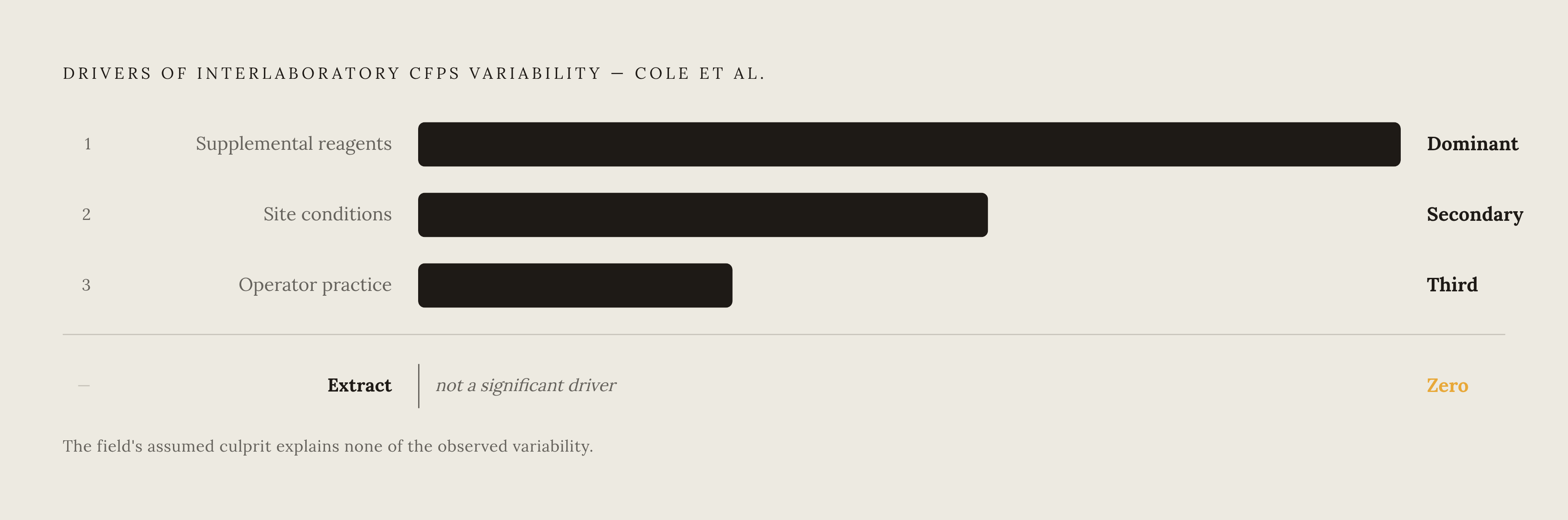
The evidence ranks three variability drivers in a clear order: supplemental reagents first, site conditions second, operator practice third, with extract preparation itself largely cleared of blame. A diagnostic framework for any lab trying to improve reproducibility should follow that same order, starting with the highest-leverage intervention rather than the most intuitive one.
The first step is reagent transparency and lot documentation. A lab should ask directly: are its supplemental reagent formulations documented in full, and does lot-level quality control data exist for each batch? If the answer is no, that opacity is the largest single source of variability a lab cannot resolve, because it removes the ability to trace an output change back to its cause. For labs preparing supplemental reagents in-house, every component, concentration, and preparation batch should be documented as a matter of course, and the mix itself should be treated as a controlled process with defined acceptance criteria rather than a routine step folded into the broader protocol.
The second step addresses site conditions directly: auditing incubator temperature uniformity, pipette calibration schedules, and local water and buffer quality across every location running the protocol, rather than assuming a shared written method guarantees shared physical conditions. The third step addresses operator variability by separating what training can fix from what automation needs to fix. If a step depends on judgment, such as pipetting at small volumes, acoustic or nanoliter-scale liquid handling handles it better than operator retraining alone, since training reduces but does not eliminate individual variation.
Running through all three steps in order gives a lab a diagnostic path rather than a single corrective action. If a lab documents its reagents, audits its site conditions, and automates its operator-dependent steps, it has addressed the three factors the data shows actually drive interlaboratory variability, in the order of the weight each one carries.
Sources
- Microbial cell-free protein synthesis and its progression toward industrial use - PMC
- Automated, modular assembly of reconstituted cell-free systems from in vitro-produced components - ScienceDirect
- Optimising protein synthesis in cell‐free systems, a review - PMC
- Variability in cell-free expression reactions can impact ...
- International multisite implementation of distributed cell-free protein biomanufacturing to advance health and research equity
- Quantification of Interlaboratory Cell-Free Protein Synthesis Variability
- CELL-FREE (Comparable Engineered Living Lysates for ...