Inter-Lab Standardization of Cell-Free Expression Benchmarks
Reagent opacity, not protocol flaws, blocks reproducible cell-free protein synthesis.

Cell-free protein synthesis is expanding fast across biofoundries, consortia, and distributed labs, and the assumption driving that expansion is simple: run the same protocol in two places, get the same result. That assumption breaks down constantly in CFPS, even when the protocol on paper is word-for-word identical. Sloppy technique doesn't explain it, and neither does bad documentation. The reagent itself is the reason, and until the field treats reagent formulation, not the protocol, as the thing that needs standardizing, cross-lab comparability stays out of reach.
What CFPS reactions depend on, and where variability enters
At the center of every cell-free reaction sits a lysate, the crude transcription and translation machinery pulled out of lysed cells. Everything downstream, yield, folding, activity, traces back to what's in that lysate and how it was made. That's also the system's strength: because the reaction runs in an open tube rather than inside a living cell, researchers can tune composition, add or remove substrates, and watch conditions directly in ways a whole-cell system never allows.
Openness cuts both ways, though. Every component that can be tuned is also a component that can drift, and lysate prep carries several of these drift points built right in. Cell harvest timing is usually pinned to OD600, a proxy for cell density that sounds standardized until you notice that growth media differs between labs and spectrophotometers are calibrated differently from one bench to the next. Two labs reading "OD 0.8" may be harvesting cells at meaningfully different actual densities. Lysis method and conditions add another layer of variation, and the runoff and dialysis steps that follow add more still.
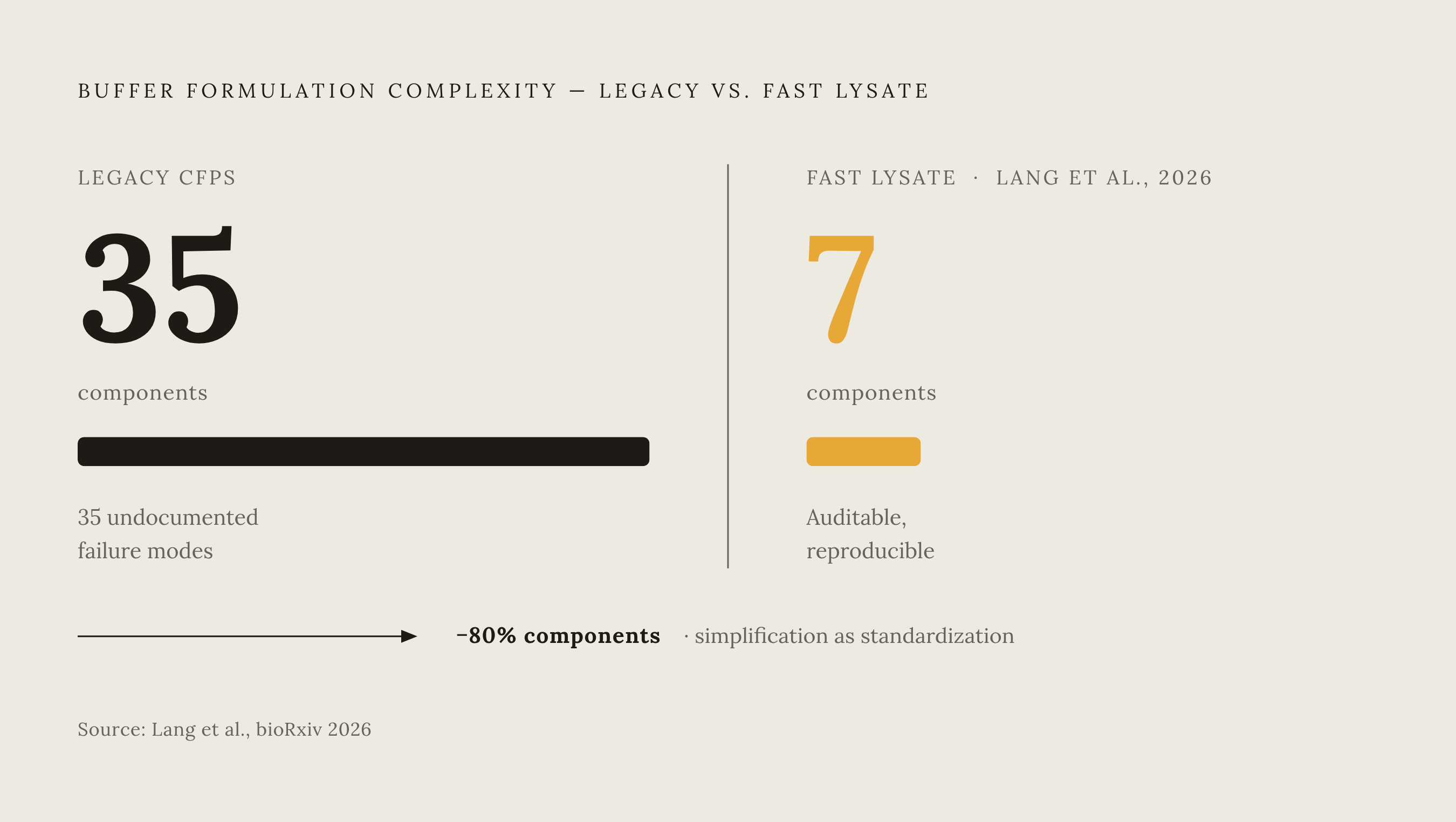
Then there's the reaction buffer. Conventional E. coli CFPS systems have leaned on formulations with as many as 35 separate components, and each one, every salt, every cofactor, every energy-regeneration substrate, is a potential source of lot-to-lot drift. Thirty-five components means thirty-five places where two "identical" reactions can quietly pull apart from each other.
How undocumented reagent formulations make benchmarks meaningless
A benchmark only works if it's tied to something fixed. In CFPS, that anchor has to be the reagent, because the reagent decides how the reaction behaves. When the formulation is opaque, the anchor isn't fixed, and everything measured against it drifts along with it.
The commercial landscape reflects this gap directly: no systematic, objective comparison across CFPS platforms and protein classes has been published in a way that resolves the field's benchmarking problem, a gap the field openly acknowledges rather than papers over. Part of the reason is structural. Many available systems rely on proprietary lysate formulations whose concentrations never get disclosed. Lot-level QC data, when it exists at all, rarely gets published, so a lab receiving a new lot has no way to check whether it performs like the lot used in the paper it's trying to reproduce. And where labs prepare lysate in-house, the protocols are often laborious enough that a smaller or less-equipped lab simply can't replicate them.
The practical consequence is blunt. A yield number or a folding result published by one group isn't actually reproducible by another group, unless both happen to be running the same lot of the same undocumented reagent. That's a coincidence dressed up as a data point, and treating it as evidence of a working protocol is the mistake the field keeps making.
Cross-lab performance gaps revealed by the multisite CFPS implementation study
The clearest documented case of this problem comes from da Silva and colleagues, whose 2026 Science Advances study tracked an international, multisite rollout of distributed cell-free protein biomanufacturing across labs in Canada, Chile, Colombia, India, and Brazil. The project was framed explicitly around health and research equity, which makes it a useful test case: same scientific goal, different countries, different levels of lab infrastructure.
That's precisely the scenario standardization is supposed to make possible: a result achieved in one location that another location can trust and repeat. A study built this way can trace performance gaps across sites back to reagent sourcing, local lysate prep, or differences in buffer composition, revealing whether "equity" in distributed biomanufacturing is a real outcome or just an aspiration written into a grant proposal.
Equity claims collapse fast if reagent opacity goes unaddressed. A well-funded lab and a resource-constrained lab chasing the identical benchmark are not on equal footing if one of them can pull documented, quality-checked reagents off a shelf and the other has to reverse-engineer an undisclosed formulation from scratch, component by component, on a fraction of the budget.
Lot-level QC data as the missing infrastructure for CFPS benchmarking
Clinical diagnostics and sequencing solved a version of this problem decades ago. Reagent lots in those fields ship with certificates of analysis, performance data tied back to a defined reference standard, letting a lab confirm before it opens the box that a given lot behaves the way it's supposed to. CFPS has almost none of that infrastructure yet, and pretending otherwise is how labs end up chasing ghosts in their own data.
Building it isn't complicated to describe, even if it takes real coordination to pull off. Start with a defined assay run on every lot before release, at minimum the yield of a standard reporter protein. Publish that QC record and make it accessible, so a lab can check a lot's performance before it commits time and material to an experiment. Set tolerance ranges too, not just a nominal expected value, because "pass" and "fail" have to mean something concrete rather than a vibe.
NIST's Cellular Engineering Group has active projects aimed squarely at this gap, working on automation methods and quantitative assays meant to make cell-free expression more reproducible and higher-throughput, building on earlier NIST work examining variability in DNA template preparation. What matters is the signal that sends: this is a measurement-science problem, not a commercial annoyance for companies selling kits, and it's serious enough to justify a federal metrology program.
Reference proteins as shared benchmarks: what makes a good CFPS standard
Documented reagents and published QC data solve half the problem. Labs still have to agree on what to measure, and that means settling on a shared reference protein, one whose behavior under CFPS conditions is understood well enough that its yield or activity can work as a cross-lab yardstick.
A good reference protein for this job has to be easy to detect and quantify. A cost that lack of a good reference protein creates appears constantly in CFPS work for that reason. It needs characterized behavior across multiple platform types, and it needs to be commercially available or easy enough to produce that access itself isn't a barrier. A reference panel built right pairs an easy reporter with at least one genuinely difficult protein class, because a system tested only on one easy fluorescent reporter tells you nothing about how it handles a protein that actually fights the reaction.
No such panel exists in any agreed-upon form right now. No comprehensive, objective comparison across CFPS platforms spanning multiple protein classes has been published, and the field lacks agreement on what to benchmark against.
Toxic proteins and GPCRs belong on any serious list of stress tests, and this much is understood even without a formal panel in place. Toxic proteins are the obvious case: cell-based expression can't produce them at all, but CFPS, with no living cell left to kill, handles them natively. GPCRs belong on the list too, given that they account for roughly a third of FDA-approved drugs and remain a notoriously hard target for expression systems generally. Insoluble or aggregation-prone proteins, along with multi-domain proteins that need coordinated folding, round out the set of cases that separate a system that merely works from one that holds up under pressure.
How reagent complexity impedes standardization
Thirty-five components is a long ingredient list, and more than that: it's thirty-five separate things that each need independent characterization, sourcing, and lot-matching. Every added component is another failure mode sitting quietly in the formulation, waiting to drift. Complexity is a direct obstacle to standardization, full stop, not a neutral fact about how the chemistry happens to work.
A 2026 bioRxiv preprint from Lang and colleagues makes the case for the alternative in concrete terms. Through systematic screening, the essential core reaction components got reduced from 35 down to 7 without losing expression performance. That same "fast lysate" protocol dropped the runoff and dialysis steps that add time and variability to lysate prep. Separately, other groups have applied systematic screening designs across large numbers of formulation variants and similarly landed on reduced-component systems with improved reproducibility.
The logic here isn't complicated. Fewer components means fewer places for undocumented variation to hide, and a simpler formulation is structurally easier to disclose in full, since there's less of it to disclose. Fewer components also means QC assays have fewer things to check and fewer ways to miss a drifting ingredient. And for a lab without deep pockets, a 7-component or 12-component system is a far more realistic thing to build than a 35-component legacy buffer, which makes simplification a research-equity issue as much as a technical one.
What a practical inter-lab standardization framework for CFPS requires
None of this is mysterious. The causes of CFPS's standardization failure are well identified: opaque reagents, no QC infrastructure, no agreed reference proteins, and formulations complex enough to resist full disclosure even when a lab wants to provide it. What's missing is coordinated action across all four layers at once, instead of a fix to one piece while the other three stay broken.
A workable framework has three layers. First, documented reagents: full disclosure of formulation down to individual components and their concentrations, with simplified systems like the 7-component formulation serving as a far more realistic candidate for that kind of transparency than a 35-component legacy buffer ever could be. Second, published lot-level QC: per-lot performance data measured against a defined assay and made accessible to users before they commit a lot to an experiment, with NIST's ongoing metrology work offering a template for what that measurement infrastructure should look like. Third, shared reference proteins: community agreement on a benchmark panel spanning easy reporters and at least one difficult protein class, with cross-platform results published openly instead of sitting locked inside individual labs or companies.
Getting there takes more than a technical fix. It spans extract standardization, formulation development, honest evaluation of what's actually practical to produce and distribute at scale, regulatory alignment, real demonstrations that standardized systems hold up outside a single lab, and early engagement across academic, industrial, and regulatory lines. That's a heavier lift than publishing a better protocol, and no single paper is going to close the gap on its own. NIST's Cellular Engineering Group already sits inside this effort as an active institutional player, and it's a natural coordination point for the measurement standards the field still lacks. Whether that coordination happens quickly or slowly, the underlying fact won't change: the protocol was never the problem. The reagent was, and still is, until the field decides to fix it.
Sources
- Microbial cell-free protein synthesis and its progression toward industrial use - PMC
- A simplified and highly efficient cell-free protein synthesis system for prokaryotes | bioRxiv
- International multisite implementation of distributed cell-free protein biomanufacturing to advance health and research equity - PMC
- Microbial cell-free protein synthesis and its progression toward industrial use | Microbiology Society
- Quantification of Interlaboratory Cell-Free Protein Synthesis Variability | ACS Synthetic Biology | ACS Publications
- Methods to reduce variability in E. Coli-based cell-free protein expression experiments - ScienceDirect
- science.org