How Automation Affects Inter-Lab Reproducibility in Plate-Based Protein Expression
Manual handling in plate-based protein synthesis creates large, traceable variability between labs.
Inter-lab reproducibility in plate-based cell-free protein synthesis (CFPS) breaks down because human variability at the bench compounds across every manual step in the workflow. The gap this produces has been measured directly, and it is large enough to change how a result should be read, not just how it should be reported.
Human variability in plate-based CFPS workflows
Three labs ran a single CFPS protocol, with pairwise exchanges of material and personnel, and the coefficient of variation came out to 40.3%, a figure reported in ACS Synthetic Biology. That number is well over an order of magnitude higher than what a single trained operator produces working across multiple days with one set of materials. The gap did not come from noise scattered randomly across runs. It came from structure: a consistent, traceable difference between what happens when one person repeats a protocol and what happens when the protocol moves between people and places.
Plate format makes this worse than it would be in single-tube work. A multi-well plate means dozens to hundreds of reactions get assembled within one narrow window of time, using one operator's hands and one set of habits. Any drift in volume, mixing, or temperature between wells, or between operators handling different plates of the same experiment, does not stay contained to one data point. It spreads across the whole dataset, so a batch effect at the edge of a plate can look like a biological signal when it is really a record of who pipetted last and how fast they moved. Reproducibility in plate-based CFPS is not just a matter of better record-keeping. It depends on identifying where, mechanically, the variability enters the process, because the sources are specific and repeatable enough to name.
The three manual steps where variability enters most reliably
Most of the inter-lab gap in plate-based CFPS traces back to three categories of manual handling, and each introduces error through a different mechanism: liquid delivery, reaction timing, and thermal control.
Liquid delivery is the most direct source. CFPS reactions at plate scale run at small volumes, so a small absolute pipetting error turns into a large relative error inside each well. Extract itself is viscous and behaves inconsistently under standard pipetting technique, a detail that general pipetting training does not account for, so operator-to-operator differences in how extract gets dispensed stack on top of batch-to-batch differences in the extract's own properties. In a multi-well plate, small, consistent drift across dozens of wells can produce systematic edge effects, patterns that look like real biology but trace back to the order in which wells were filled.
Reaction timing matters because CFPS is kinetically driven. The gap between assembling a reaction and starting incubation, and the gap between ending incubation and reading the plate, shapes how much protein accumulates and when. A human assembling a full plate by hand cannot guarantee that every well experiences the same timing: the first well filled and the last well filled may begin active synthesis minutes apart, simply because operators work at different speeds and a 96-well plate takes real time to fill by hand.
Thermal handling closes out the list. How long reagents sit on ice or at bench temperature before a plate gets sealed and moved into an incubator depends on operator habit and on a lab's own ambient conditions, neither of which a written protocol can fully specify. Variation in how tightly a plate gets sealed, how it sits in the incubator, and how much evaporation it loses during a run adds thermal noise that is invisible in the protocol document but appears in the data.
Lysate variability on top of manual handling error
Even a flawlessly executed manual protocol cannot compensate for a second source of variability that enters before anyone picks up a pipette: the lysate itself. Extract preparation methods differ substantially from lab to lab, and the field has not settled on how reaction buffer composition affects performance variability, so there is no shared standard for the starting material that every other step in the workflow depends on.
Lysate quality drives yield and functional output more than almost any other single factor in a CFPS reaction. If a workflow is perfectly automated, perfectly timed, and perfectly temperature-controlled but runs on a poorly characterized batch of extract, the results still will not hold up between labs. That creates a diagnostic problem that is easy to underestimate: when a result fails to transfer from one lab to another, telling apart a technique failure from a reagent failure requires information that most suppliers simply do not provide. Without lot-level data on yield, activity, and batch identity, a researcher troubleshooting a failed replication is guessing at which half of the system broke.
This is where documented reagent quality earns its place in the conversation, not as an add-on to automation but as its precondition. OpenCFPS, offered with published lot-level QC and open formulation documentation, addresses exactly this diagnostic gap: when the reagent batch itself is characterized and traceable, a lab troubleshooting a failed transfer can rule reagent variability in or out, rather than treating the whole workflow as an unexplained black box. Lot-level QC, covering yield, activity, and batch identity, is the floor requirement for separating these two sources of error. Automation alone cannot do this job, because automation controls execution, not the material being executed on.
How liquid-handling automation reduces operator-sourced variability in plate-based CFPS
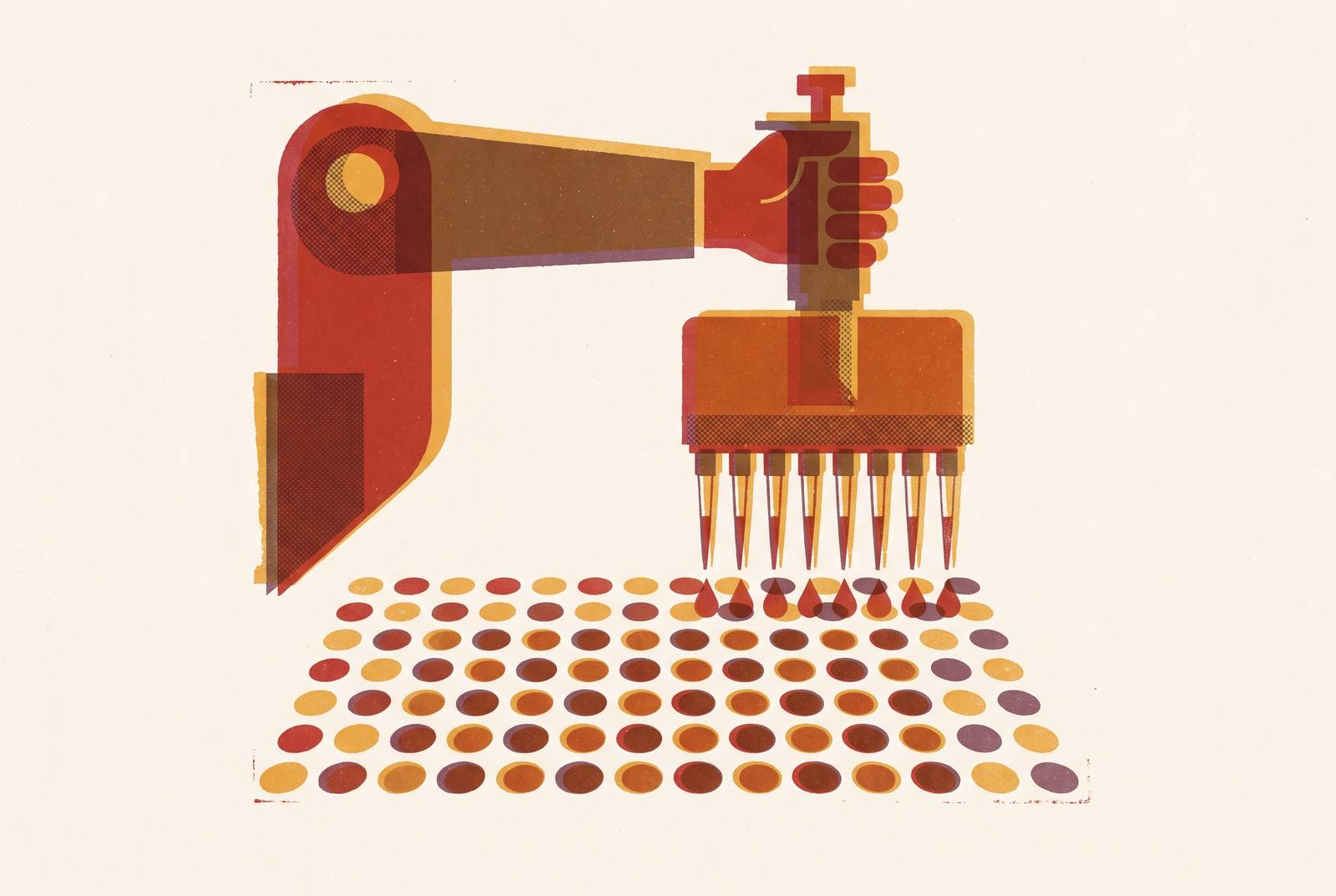
Automated liquid handling attacks the manual-handling layer directly, and the evidence for its effect is now multi-site, not anecdotal. An inter-lab validation of E. coli lysate-based CFPS, run across five international sites in Canada, Chile, Brazil, Colombia, and India, found inter-assay variability holding consistently low at every participating lab. Set beside the 40.3% coefficient of variation from manual multi-lab work, this result shows what hardware-standardized execution can achieve.
A second, distinct example is MANGO (MANufacturing on the GO), a purpose-built, open-source benchtop device for automated CFPS and purification. MANGO runs on computer-controlled pumps, valves, and a microchannel manifold that manage reaction volumes, buffer volumes, and flow rates entirely under software control, with a GUI that lets users build customizable, reproducible purification protocols. It was designed for point-of-use deployment, in settings where minimizing user input is a core requirement.
What connects the five-site validation and the MANGO platform is the same underlying mechanism, applied in different contexts. Software-controlled dispensing removes the volume drift between operators that you cannot avoid when you hand-pipette. Programmed timing removes the lag between reaction assembly and incubation start that varies with how fast a given person works. Closed-platform temperature management removes the ambient handling variation that depends on a lab's bench conditions and on an operator's habits. Each of these corresponds to one of the three manual failure points named earlier, now resolved through hardware design.
Where automation relocates rather than eliminates the variability problem
Automation does not make variability disappear. It moves variability to new locations, some of which are harder to see than a pipetting error and harder to diagnose once something goes wrong.
The clearest example concerns fluorescence normalization across plates. An AI-driven CFPS optimization workflow that automated execution still required a calibration step to standardize fluorescence readings from one plate against another, because cell-free reactions carry inherent plate-to-plate variability that automation of liquid handling does not touch. The variability has not gone away. It has moved from the pipette to the software that interprets the plate reader's output, and a calibration routine built into that software now carries the weight that operator consistency used to carry.
Instrument-to-instrument differences present a second, quieter problem. Two liquid-handling robots from different manufacturers, or two units of the same model with different maintenance histories, will introduce their own systematic biases. A protocol written and validated on one robot does not automatically transfer to another without revalidation on the new hardware. Automation solves the human-to-human gap while opening a machine-to-machine gap that a lab adopting a shared protocol still has to check for.
Reagent variability survives automation untouched. If the lysate batch changes between runs, an automated liquid handler will dispense the new batch with exactly the same precision it applied to the old one, and the results can still diverge for reasons that have nothing to do with execution. If a lab automates every manual step, that does not solve transferability on its own, because transferability depends on two separate things holding at once, execution consistency and input consistency. Automation delivers the first. Only reagent standardization and documented lot-level QC deliver the second. A lab that receives an automated protocol without the validated reagent batch behind it will reproduce the method. It will not necessarily reproduce the result.
ML-guided closed-loop workflows as the next layer of standardization
When platforms pair machine-learning-guided experimental design with automated execution, they start to close the normalization gap that calibration alone cannot solve at scale. An AI-driven closed-loop workflow applied active learning to CFPS condition optimization: automated execution generated experimental data, and machine learning selected the next round of conditions to test, cutting down on operator intervention while covering an optimization space far larger than a manual design-build-test cycle could handle in the same amount of time.
The reproducibility advantage here runs deeper than throughput. When both the experimental design logic and the execution protocol live in software, a lab can transfer the workflow at the level of the algorithm. The normalization rules travel with the code, not with whoever happens to be standing at the bench, which is a different kind of portability than automation alone provides.
That advantage has a real limit. Closed-loop optimization works well when the target is something with a clean, measurable objective, yield of a reporter protein, for instance. It gets harder to apply when the target protein has no convenient assay proxy to optimize against. Toxic, unstable, or multi-domain proteins remain operationally difficult to express and screen even with full automation in place, because the hard part of the problem in those cases is knowing what to measure, not execution speed.
Scale, protein type, and automated plate-based workflows
The reproducibility gains automation delivers are not uniform across every protein a lab might want to express. Scale and target complexity both change how much of the inter-lab gap automation can actually close.
Difficult proteins, toxic, membrane-bound, or multi-domain targets, stand to gain the most from cell-free plate-based workflows precisely because CFPS runs in an open reaction environment, free of the cell-viability constraints that would kill a cell-based expression system trying to make the same protein. Researchers can use automated liquid handling to explore reaction conditions systematically at a throughput manual pipetting cannot sustain, and that matters most for exactly these hard-to-express targets.
A 2026 study in FEBS Open Bio built a CFPS-based microplate platform for screening staphylokinase variants and found that activity rankings generated from crude, unpurified CFPS reaction mixtures closely matched the rankings obtained from fully purified protein. That result demonstrates something practically important: automated plate-based CFPS can produce functional readouts reliable enough for early-stage variant screening without requiring the purification step that would otherwise bottleneck throughput.
For proteins with no convenient functional assay to screen against, standardizing a crude-lysate readout across labs is harder, because the readout itself depends on the exact composition of the lysate being used. Automated dispensing helps keep execution consistent, but normalizing crude-lysate readouts across labs gets harder in these cases, because there is no independent purified-protein benchmark to check the crude-lysate result against.
A practical framework for designing transferable plate-based CFPS workflows
Building a plate-based CFPS workflow that actually transfers between labs means matching the automation strategy to the specific failure mode it is meant to fix, and pairing execution standardization with reagent documentation rather than treating either one as sufficient on its own.
For execution variability, covering pipetting, timing, and thermal handling, automating liquid handling should be the first intervention a lab makes. This is where automation's impact on coefficient of variation is largest and most directly measured, and where the evidence from the five-site international validation is strongest.
For reagent variability, covering lysate batch and buffer composition, lot-level QC data should be a non-negotiable condition before a protocol moves between labs. A workflow handed off without a documented reagent lot is incomplete, and any divergence in results between sites afterward cannot be traced to a cause. Published lot-level QC and open formulation documentation, of the kind OpenCFPS provides, gives labs the input-side transparency that makes execution-side automation actually worth having.
For normalization variability, covering plate-to-plate fluorescence drift and instrument-to-instrument differences, calibration needs to be built into the protocol from the start. Closed-loop ML workflows that encode normalization rules directly in software transfer more reliably than workflows that leave normalization to an individual operator's judgment call.
For protein-type-specific challenges, the open reaction environment of CFPS can be tuned to suit difficult targets, toxic, unstable, membrane-bound, or multi-domain proteins, in ways cell-based expression cannot match. Whether screening results from crude lysate actually transfer between labs comes down to the quality of the functional assay design behind the screen, not just how well the dispensing steps were automated.