NIH Reagent Reporting Requirements and Their Enforcement Gaps
NIH's enforcement system never verifies researchers actually followed reagent authentication rules.
NIH's reagent reporting rules are detailed, specific, and have been on the books for a decade. The gap that produces so much irreproducible science is not a weak policy but a monitoring system that never checks that anyone followed it.
What NIH's reagent reporting requirements say on paper
NIH's Rigor and Reproducibility framework took effect on January 25, 2016, under NOT-OD-16-011, and it did something grant applications had never formally required before: it made reagent identity a named, reviewable component of every proposal. Applicants must submit a separate "Authentication of Key Resources Plan" that spells out the methods used to verify the identity and validity of the biological and chemical resources central to the proposed work. Peer reviewers are asked to judge, at the application stage, that all four areas are adequately addressed.
The requirement doesn't end once the award lands. Annual progress reports, filed as RPPRs, are expected to document the steps taken throughout the life of the grant to keep results rigorous and unbiased. NIH's RPPR guidance, revised under Section 8.4.1 of the Grants Policy Statement, states that incomplete, inaccurate, or late reports can trigger real consequences: withheld funds, removal of standard award terms, or conversion to a reimbursement-only payment structure. In April 2026, NIH added another layer, launching a Replication and Reproducibility Initiative that the agency's own Extramural Nexus described as a continued institutional response to the problem, though what that initiative actually changes about enforcement practice remains unclear a year in.
There's also a parallel obligation that gets less attention than the authentication plan but carries its own teeth: the Resource Sharing Policy. Any unique reagent developed with NIH money has to be made available to qualified researchers once the associated findings are accepted for publication or reported to NIH, and the agency's definition of "research tool" is broad enough to explicitly include reagents, cell lines, monoclonal antibodies, and growth factors. Read together, these requirements describe an agency that took reagent quality seriously enough to write it into the architecture of every grant cycle, not an afterthought bolted onto a rigor checklist.
The RRID System's Design to Operationalize Reagent Identity
The mechanism NIH and the broader research community built to make reagent identity checkable is a persistent identifier system for research resources. It exists to make reagents "clearly and unambiguously identifiable" wherever they show up, in a paper's methods section or in a grant's resource list. RRIDs cover antibodies, cell lines, model organisms, and other reagent classes, and the RRID portal lets a researcher search, cite, and even deposit characterization data tied to a specific resource. Programs like NIH's Protein Capture Reagents Program and the EU's Affinomics Program pushed in the same direction, trying to build antibody collections that were systematically evaluated and renewable rather than one-off purchases from an unverified catalog listing.
The system exists because the alternative was worse. A 2013 analysis found that a striking share of published papers didn't report enough detail to identify which antibody had actually been used in the experiment being described.
But the RRID initiative doesn't perform any antibody characterization itself. It assigns an identifier. It does not verify that the reagent works, that a given lot matches the performance of the lot before it, or that the antibody binds what the label says it binds. Identification and authentication are two different problems, and RRIDs solve only the first one. Knowing which antibody a lab used tells a reader nothing about whether that antibody performed as claimed in that lab, on that day, with that lot. Given how sparse characterization data still is for most commercial antibodies, and how much lot-to-lot variability exists across manufacturing runs, a correctly cited RRID can sit right next to a result generated with a batch that simply didn't work.
Where the burden falls in lot-level authentication
NIH requires an authentication plan. It does not require a specific test, a specific threshold, or a specific protocol, for almost any reagent category. That design choice, deliberate or not, hands the actual definition of "authenticated" to the investigator writing the plan. Current guidance describes the practical expectation clearly enough: before a new lot or batch goes into an experiment, run functional tests against established positive and negative controls to confirm the reagent behaves as expected. A new antibody lot targeting a given protein, for instance, should be checked against known positive and negative cell lines to confirm it's binding with the specificity and affinity the earlier lot demonstrated.
Cell lines carry their own version of this obligation. Short tandem repeat, or STR, profiling is strongly recommended by NIH and by most journals as the standard for confirming that a cell line is what it's labeled as, and periodic mycoplasma testing is required on top of that. None of this is optional in spirit, even where it's not mechanically enforced.
The deeper complication is that reagent traceability isn't a single checkbox; it's a set of separate failure modes that each need their own documentation. A certificate of analysis that confirms purity says nothing about sequence accuracy. It says nothing about endotoxin contamination. It says nothing about degradation from a freezer that cycled a few degrees warmer than it should have over a long weekend. The authentication plan is the only check standing between a partial COA and a published result. Even NIH's own antibody guidance concedes the point indirectly: it states that reagents from trusted, established manufacturers still need to be authenticated before use, and that an authentication plan is still required at the grant stage regardless of how reputable the supplier is. Reputation is not a substitute for a functional test, and the policy says so, but the system that would confirm the functional test actually happened doesn't exist yet. Suppliers who provide COAs covering only one dimension are providing partial traceability, and NIH policy does not require investigators to detect the gap (the investigator's authentication plan is the only check).
Where the enforcement architecture breaks down
That system's absence isn't hypothetical. The requirement existed. Institutions missed it. NIH did not follow up.
That pattern maps almost exactly onto the authentication regime, which is what makes the OIG finding instructive well beyond its original scope. A requirement gets written, an institution delays or simply skips compliance, and the agency's response is silence. NIH does have formal sanctions on the books for reporting failures: withheld funds, removal of standard award terms, conversion to reimbursement-only status. Those tools include withheld funds, removal of standard award terms, and conversion to reimbursement-only status. The OIG's own characterization notes they are rarely applied to reagent-specific lapses specifically.
Look at where NIH's actual review points sit in a grant's lifecycle. Peer review, at the application stage, is a qualitative judgment about the authentication plan being "appropriately addressed," not a verification that the described methods will ever be executed. Progress reports rely on program staff reading what the investigator chose to report, with no audit mechanism to confirm that lot testing described on paper matches lot testing that happened at the bench. Journals add a layer of scrutiny that is genuinely independent, Nature, Science, Cell, and most biomedical journals now require reagent reporting checklists at submission, and JCI and JCI Insight started manually reviewing high-throughput sequencing and proteomic datasets in 2025. But journal review happens after the experiment is finished. It can catch a problem in a manuscript. It cannot catch a problem while the experiment is running.
So every meaningful checkpoint NIH has, application, progress report, publication, is either self-reported by the investigator or retrospective by design. No point in the process has anyone from outside the lab check lot-level authentication happening in real time. That's not an oversight that slipped through the cracks. It's a structural feature of how the whole system was built.
The reproducibility cost when authentication fails at scale
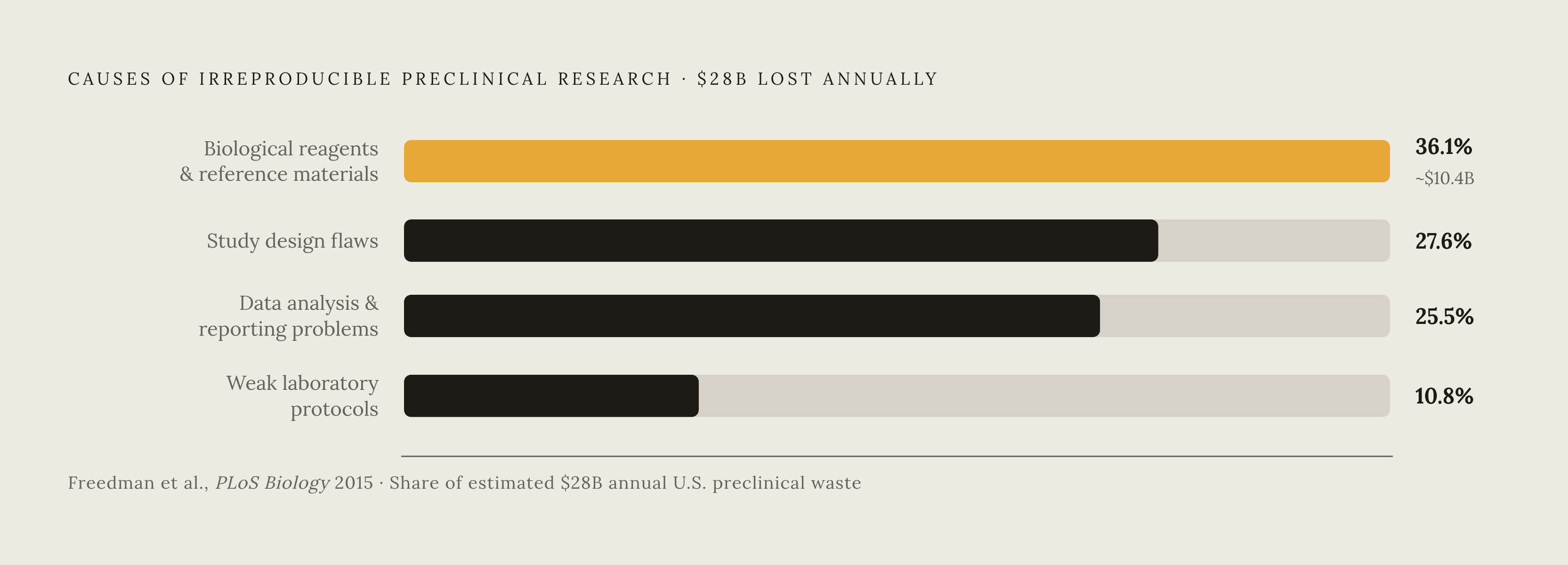
The dollar figure attached to this gap is not small. Irreproducible preclinical research costs an estimated $28 billion annually in the United States, a number that traces back to the 2015 Freedman et al. study in PLoS Biology proteinqc.com. Break that figure down by cause, and one category towers over the rest: biological reagents and reference materials account for 36.1 percent of it, something like $10.4 billion a year, ahead of flawed study design at 27.6 percent, data analysis and reporting problems at 25.5 percent, and weak laboratory protocols at 10.8 percent proteinqc.com PLoS Biology / Freedman et al..
Sit with that ranking for a second. Reagent failure isn't a secondary contributor tucked behind bigger methodological sins, it's the largest single driver of wasted research spending in the entire preclinical enterprise proteinqc.com PLoS Biology / Freedman et al.. Pair that with the enforcement picture from the last section, where authentication is the one checkpoint in NIH's whole oversight chain that nobody outside the lab ever verifies, and the policy gap stops looking like a paperwork inconvenience. It has a measurable price tag attached to it, and that price tag is the largest line item in the reproducibility crisis.
The broader R&D picture reinforces how much is riding on this. Experts describe the current biopharma R&D model, high-risk and high-cost at every stage, as unsustainable, and drug candidates today are more likely to fail in clinical trials than candidates developed decades earlier. R&D cost per approved drug roughly doubled every nine years between 1950 and 2010, driven largely by the cost of failure. None of the sources draw a straight causal line from a bad antibody lot to a phase two trial collapsing, and that line shouldn't be drawn here either. But the cumulative picture is hard to miss: reagent quality sits upstream of a research pipeline where failure is already extraordinarily expensive, and NIH's own initiatives, the April 2026 Replication and Reproducibility Initiative among them, along with the 2023 Data Management and Sharing Policy, exist precisely because earlier requirements never closed this gap.
The Biosafety Oversight Rewrite as a Signal of Where NIH Is Willing to Harden Requirements
NIH knows how to build a system with actual teeth in it when it decides to. In August 2026, the agency released a draft policy that would replace the long-standing NIH Guidelines for Research Involving Recombinant or Synthetic Nucleic Acid Molecules, with the public comment period closing October 19, 2026. The proposal changes the basic logic of oversight: instead of triggering review based on whether a material was genetically modified, it triggers review based on whether the material poses a biohazard at all, which pulls wild-type pathogens, toxins, and prions into scope.
The most consequential operational change is a compressed timeline. The draft also gives the Biosafety Officer role specific, federally defined duties, including periodic inspections meant to confirm that containment procedures in practice actually match what the Institutional Biosafety Committee approved on paper. That's active verification. Someone with a defined job goes and checks.
None of this needs to read as alarming for institutions that already run rigorous, broad biosafety review voluntarily; for them, the operational shift may be modest. What matters here is the architecture. The biosafety draft has a named responsible officer, a short and mandatory reporting clock, a standardized template, and inspection-based verification. NIH clearly knows how to design an enforcement structure that doesn't rely on self-report and hope. The open question is why that same structure hasn't been extended to reagent accountability, given that reagent failure is the largest documented driver of irreproducible research. The most operationally significant change is that the incident-reporting window has been compressed from 30 days to 24 hours for events posing significant risk to human health, using a standardized template, with a complete report still due within 30 days pmc.ncbi.nlm.nih.gov.
Where accountability lives for researchers navigating this gap today
Three points of pressure exist in the system as it stands, and none of them amounts to real-time verification. Grant reviewers weigh in at the application stage, but their judgment is qualitative and can't be checked against what actually happens at the bench. Journal editors weigh in at submission, and that layer has gotten considerably more rigorous, but it's still retrospective by nature. Institutional oversight varies widely from one place to the next and is largely self-directed.
The journal layer deserves specific credit here, because it's not just a checklist exercise anymore. JCI and JCI Insight began manually reviewing high-throughput sequencing and proteomic datasets before acceptance starting in 2025, and since 2024 both have required publication of raw immunoblot data along with the underlying values behind published graphs pmc.ncbi.nlm.nih.gov. Those are substantive checks, not procedural ones pmc.ncbi.nlm.nih.gov. They catch things. They catch them after the paper is written.
There's a related wrinkle for anyone collaborating internationally. NIH's clarification on foreign co-authorship, NOT-OD-26-084, notes that reagent provision resulting in co-authorship can constitute a foreign component that has to be reported. Investigators now need to track not just which reagent they used, but where it came from and what relationship that transaction created.
Given that NIH cannot, structurally, audit mid-project authentication practice, a reproducibility question raised after publication is checked against the researcher's own paper trail, which is the only real protection. Certificates of analysis, lot numbers, functional test results against positive and negative controls, storage logs, these are the researcher's defense, not the agency's. That puts a premium on reagent transparency from the supplier side of the transaction. A system that publishes lot-level QC data and documents its formulations openly hands an investigator something they can actually attach to a progress report or wave at a skeptical reviewer. A reagent that arrives as a black box with a single summary COA leaves a traceability gap that no authentication plan, however carefully written, can fully paper over.
None of this is an invitation to cut corners just because nobody's checking mid-project. That means the gap in formal enforcement means more responsibility sits with the researcher, not less. The gap in formal enforcement means more responsibility sits with the researcher, not less, to build accountability infrastructure at the bench, lot by lot, control by control. Knowing exactly where NIH's oversight stops is the first step toward understanding what a researcher actually has to supply on their own. Sepia Biosciences' OpenCFPS™ reagents are designed around this accountability reality: published formulations and lot-level QC data give researchers a documentation trail that makes an authentication plan substantive rather than nominal, particularly relevant for cell-free protein synthesis workflows where reagent performance directly determines whether a variant screen or a milligram-scale production run is reproducible.
Sources
- 8.4.1 Reporting
- A Proposed Biosafety Rewrite Could Reshape Oversight for Every US Lab
- The National Institutes of Health Generally Implemented the Safe Workplace Federal Reporting Requirement, but Opportunities Exist To Improve the Reporting and Monitoring Processes
- NIH and Other PHS Agency Research Performance Progress Report (RPPR) Instruction Guide
- rrid.site
- rrids.org
- orip.nih.gov
- ncbi.nlm.nih.gov