Reagent Batch Traceability Requirements Under Emerging Lab Accreditation Frameworks
Labs must now document reagent lots to meet unified global accreditation standards.

Lab accreditation just consolidated on a global scale, and the practical effect lands on reagent lots, not paperwork in the abstract. On January 1, 2026, two international accreditation cooperation bodies merged into a single body, Global Accreditation Cooperation Incorporated, unifying oversight of laboratory and certification accreditation across 135 economies with practical effects rather than a rebrand. That's not a rebrand. A coordinated body covering that many economies has less room for regional carve-outs and softer local enforcement. The audit criteria applied to over 114,600 laboratories, plus more than 15,600 inspection bodies and over 700 proficiency testing providers, are converging toward one set of expectations instead of a patchwork of regional interpretations. For any lab running quantitative work, and especially for labs using cell-free protein synthesis, that convergence turns lot-level reagent documentation from a nice-to-have into an audit line item.
The new body has taken over oversight responsibilities from its predecessor organizations, with the transition structured to maintain continuity of accreditation functions. Treating this as an administrative footnote misses what's actually changing: a lot-level QC record that meets the bar these frameworks are setting needs specific components, and most commercial reagent suppliers, CFPS suppliers included, aren't providing them yet.
What ISO 17025 requires from reagent documentation
ISO/IEC 17025 sets the international bar for testing and calibration laboratory competence, fusing quality management requirements with technical ones so that a result isn't just internally consistent but externally defensible. The standard's reagent-relevant provisions aren't buried in a footnote. They sit at the center of the document.
Metrological traceability comes first: every measurement has to trace back to international standards through a documented, unbroken chain of calibration. Method validation comes second. Describing how a reagent gets used in a protocol isn't enough; the method itself has to be validated, with evidence that it performs as claimed under the conditions the lab actually runs. Measurement uncertainty comes third, and it has to be reported wherever it bears on the validity of a result, or when a customer asks for it, or when it could affect whether a result conforms to a specification limit. Reagent performance variability is exactly the kind of thing that pushes a result outside spec without anyone noticing until an audit forces the question.
Formal document control has to support both external audit and internal root-cause analysis, and the standard requires internal audits and corrective action as a matter of course, not as damage control after something goes wrong.
Traceability under 17025 functions as a chain. If a reagent lot arrives without documentation, the chain doesn't break at the supplier's loading dock. It breaks at the bench, on the technician's watch, in the exact spot where a lab has the least ability to fix it after the fact. A supplier who publishes that data upfront moves the cost off the lab's ledger. A supplier who doesn't is just passing the bill downstream.
ISO 15189's extension of these requirements into research and medical lab reagents
ISO 15189:2022, the current edition, takes the traceability logic of 17025 and sharpens it specifically for internal quality control materials in medical and research laboratory settings. Three obligations fall directly on reagents. Measurement results have to be traceable to recognized reference standards through a documented chain. Reference materials and calibration standards need documented, current certification of that traceability rather than one that is assumed or out of date. And measurement uncertainty has to be calculated, documented, and factored into interpretation whenever the standard calls for it.
The detail that trips up most labs is definitional, and it's easy to skim past. ISO 15189 defines "laboratory equipment" to include instruments, reference materials, consumables, reagents, and analytical systems, all under one umbrella. That means a reagent lot is, in the eyes of the standard, legally equivalent to a pipette or a centrifuge. It falls under the same calibration and maintenance program, and a lab has to demonstrate proper function for that lot the same way it demonstrates proper function for a piece of hardware. Most labs have a maintenance log for their centrifuge. Far fewer have an equivalent record for the lysate lot sitting in their minus-80, and that asymmetry is the gap an auditor is trained to find.
The EU IVD Regulation's addition of mandatory batch-to-batch disclosure
EU Regulation 2017/746, governing in vitro diagnostic medical devices, pushes past ISO's language of "traceable" and "documented" into something more exacting: mandatory numerical disclosure. Where device performance depends on calibrators or control materials, metrological traceability isn't optional, and the regulation specifies exactly what has to accompany those materials.
The instructions for use must state the maximum self-allowed batch-to-batch variation for values assigned to calibrators and control materials, given with actual figures and units of measure. That's a specific, quantified commitment a supplier makes about its own manufacturing consistency, published for the customer to see before they ever run the reagent.
That changes what "lot-level QC" means in practice, and it should change it everywhere, not just in IVD contexts. A certificate of analysis with a pass or fail stamp doesn't satisfy the requirement anymore, at least not under EU IVD. The regulation asks for disclosed numerical bounds: how much can this lot drift from the last one before the supplier itself would consider it out of spec? Labs procuring reagents under this framework are entitled to ask for that number, and increasingly, they have to. Reagent transparency is a line item with a price attached, and procurement teams are right to negotiate over it before the purchase order goes out, not after the audit finding comes back.
The BIOSECURE Act and how federal funding now ties supplier vetting to reagent sourcing
A federal biosecurity law, signed into law on December 18, 2025, adds a narrower but real pressure specific to federally funded research. The Office of Management and Budget is set to publish an initial list of "biotechnology companies of concern" by December 18, 2026, and labs holding federal contracts, grants, or research funding will need to assess their equipment suppliers, service providers, and data handling partners against that list.
The connection to reagent traceability is direct, even if the Act itself isn't a traceability regulation. A federally funded lab can't verify that a supplier sits clear of the restricted list if the supplier won't say what's in the reagent or where its components came from. Opacity stops being a scientific inconvenience at that point. It becomes a procurement liability with funding consequences attached.
Keep this in proportion, though. Next to ISO 17025 or ISO 15189, which apply far more broadly and carry the deeper technical weight, the BIOSECURE Act is one additional pressure layered on top, aimed at a specific funding population. It isn't the dominant force reshaping reagent documentation industry-wide, and treating it as such overstates its reach.
What labs are required to document about each reagent lot
Pull the requirements from ISO 17025, ISO 15189, and EU IVD 2017/746 together, and the documentation a lab needs on hand for any given reagent lot sorts into a handful of categories. Identity comes first: lot number, manufacturer, date of manufacture or receipt, expiry. Performance comes second, and this is the one labs skip most often: lot-specific QC data showing that this particular lot meets the performance criteria the lab actually needs, not just the generic spec printed on the product page.
Then there's the traceability chain itself, linking the lot's measurements back to SI units or a recognized reference standard, followed by batch-to-batch variation data (numerical limits under EU IVD, or at minimum evidence that a lot change got evaluated before it went into use under the ISO frameworks). Corrective action readiness rounds it out: records detailed enough to support root-cause analysis if a result falls outside the acceptable range.
Labs document that a reagent arrived far more often than they document that it performs. Labs document that a reagent arrived. They document far less often that it performs. Receipt is necessary, but it was never sufficient, and treating it as sufficient is where most audit findings start.
When a supplier doesn't hand over lot-level QC data, the lab has to generate it internally just to survive the audit. That's labor and consumables spent duplicating work the supplier could have done once, at scale, and printed on a spec sheet.
Why cell-free protein synthesis workflows are particularly exposed to lot-level variability
Cell-free protein synthesis, or CFPS, produces proteins by harnessing the molecular machinery of living cells in an open, in vitro environment, without the constraints that keeping a cell alive would normally impose. Systems are built either from crude cell lysates or from reconstituted purified components, the PURE system approach. A lysate is a crude biological mixture, not a single defined molecule the way a buffer salt is. It's a crude biological mixture, and that distinction affects how much variability the reaction tolerates and how far that variability propagates into results.
That mixture carries ribosome concentration, chaperone activity, and energy-recycling capacity, all of which shift with the cell growth conditions, the lysis parameters, and the storage history behind any given lot. A lot of sodium chloride behaves like the last lot of sodium chloride, full stop. A lysate lot does not offer that guarantee, ever.
The yield numbers make the stakes concrete. CFPS platforms report yields ranging from 1 microgram per milliliter up to 2.3 milligrams per milliliter in batch mode, depending on the complexity of the protein being made. That's a multi-order-of-magnitude spread, and lot consistency is foundational to whether a quantitative downstream result means anything.
The same openness that makes CFPS useful, direct control over reaction conditions, the ability to drop in non-natural compounds, freedom from keeping a cell alive, is also exactly what strips away the buffer a living cell would normally provide. A cell has homeostasis mechanisms that smooth over small internal fluctuations. An open reaction in a tube has none of that. Whatever variability is in the lysate lot appears directly in the output, unfiltered.
What lot-level documentation from a CFPS reagent supplier should contain
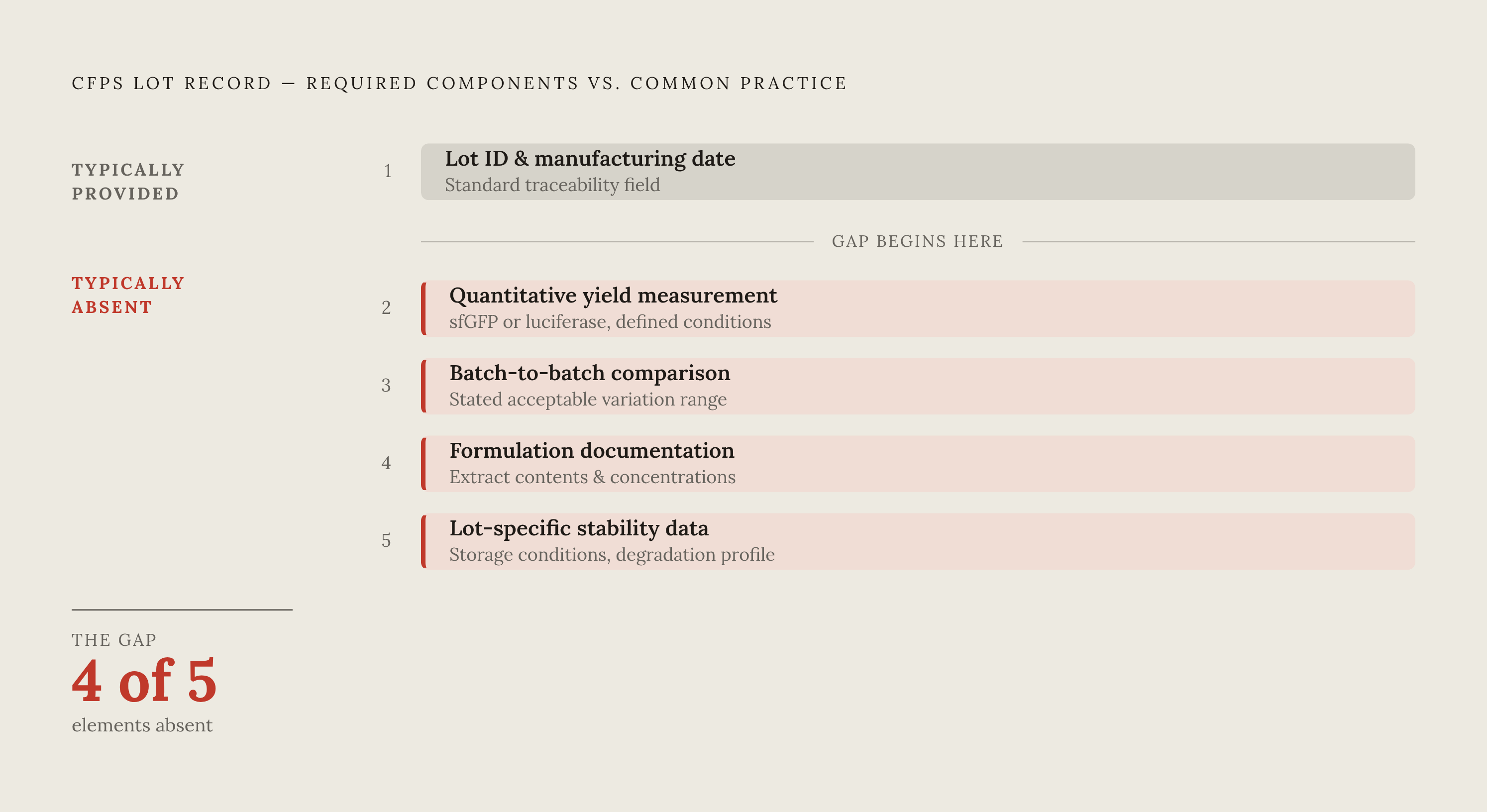
Lot identifier and manufacturing date come first, as the baseline, but that's the easy part and it's not where suppliers fall short. A quantitative yield measurement using a standardized reference reporter, sfGFP or luciferase under clearly defined conditions, has to replace the vague "passes QC" language that still shows up on a lot of certificates today.
A batch-to-batch comparison belongs in that same record: how does this lot's yield stack up against the prior one, and what variation range does the supplier consider acceptable before flagging a problem? Formulation documentation matters just as much, spelling out what's actually in the extract and at what concentration, so a lab can judge for itself whether a lot change is likely to matter for its specific assay. Storage and stability data round it out, and it needs to be lot-specific, a general shelf-life claim lifted from the product page.
The EU IVD Regulation's phrasing works as a useful template here even outside IVD contexts: information on maximum self-allowed batch-to-batch variation, given in real figures and units of measure. That's the exact shape a CFPS lot record should take, and any supplier that stops short of it is asking the lab to trust a claim it can't verify.
Formulation transparency is the prerequisite for traceability. It's the prerequisite for it. A lab can't build a traceability chain starting from a reagent whose contents are proprietary and undisclosed, because the chain has to start somewhere, and that starting point is the supplier's formulation record. Compare that against where a lot of the commercial CFPS kit market sits today: a single certificate of analysis, an activity pass or fail, no numerical variation bounds, no formulation disclosure. That's a documentation gap that is structurally incompatible with what ISO 17025, ISO 15189, and EU IVD are already asking for. It's structurally incompatible with what ISO 17025, ISO 15189, and EU IVD are already asking for.
How automation and plate-based CFPS workflows change the traceability calculus
CFPS has already moved into high-throughput formats: microfluidic platforms, 96-well plates, even femtoliter-scale reaction volumes. That's the operating environment now for any group running screens at scale, and it changes what "lot documentation" needs to accomplish.
At high-density plate scale, reagent gets dispensed in very small volumes, and at that scale a lot-to-lot shift in activity is invisible to whoever's running the plate in real time. It appears only through systematic QC benchmarking done deliberately, never through someone noticing that something looks off.
Automated Design-Build-Test-Learn pipelines for CFPS optimization are starting to appear, with AI-driven systems selecting experimental conditions and translating them directly into multi-instrument workflows. Those pipelines run on an assumption: that the reagent going in is consistent from run to run. Undocumented lot variation, in that context, is a systematic error source baked into every result the pipeline produces afterward. It's a systematic error source baked into every result the pipeline produces afterward, silently, without a flag anywhere in the output.
The traceability requirement scales with the throughput. When a single automated run generates thousands of data points, the lot identity for every reagent used has to get logged at the run level, as the run happens. Reconstructing that after the fact, from memory or from a half-updated spreadsheet, stops being realistic once the plate count climbs into the hundreds.
Questions for researchers and procurement teams before the next audit cycle
None of this is a distant hypothetical. Global ACI started operating January 1, 2026, and labs already under accreditation should expect updated audit criteria to work through their specific accreditation body within the current cycle, not several cycles from now.
Four questions belong on every procurement checklist for every CFPS reagent lot in active use. Can the supplier produce a lot-specific QC record with actual quantitative performance data, not a generic product specification sheet? Does that supplier publish batch-to-batch variation limits as numbers, with units attached, the way EU IVD already requires of calibrator and control material makers? Is the formulation documented well enough that a lab can judge, on its own, whether a lot change might matter to its validated method? And if a result comes back out of range, is there enough lot-level detail on hand to run a real root-cause analysis, or does the investigation dead-end at "unknown reagent composition," the answer no auditor wants to hear?
For procurement teams specifically, NIST-traceable documentation and lot-specific records are turning into baseline selection criteria, not differentiators that make one supplier look more polished than another. A supplier who can't produce that documentation is quietly shifting the compliance cost onto the lab buying from them, and that cost surfaces later as labor and consumables spent generating internally what the supplier should have shipped.
Pick suppliers who already publish this data. Don't wait for an audit finding to discover which ones don't.