Fluorescence Reporter Assays for CFPS Lot-to-Lot Consistency Testing
Fluorescence reporters reveal which CFPS lots produce functional protein, not just mass.

A replicate that worked last month fails this month, with no change to the protocol, the operator, or the target gene. In cell-free protein synthesis, that failure often traces back to the reagent lot itself, not the experiment built on top of it. The sources of that variability are structural, built into how the reagent is made. No amount of careful pipetting downstream will fix it.
CFPS Lot Variability Is a Real Experimental Problem
CFPS reactions depend on lysate pulled from lysed cells: the ribosomes, polymerases, energy regeneration enzymes, and accessory factors that carry out transcription and translation outside a living cell. Every production run of that lysate is its own biological event: it has its own cell density at harvest, its own lysis efficiency, its own enzyme activity profile. Two lots made from the same strain and the same protocol will not be identical, because the inputs were never identical to begin with. That difference in the lysate is where lot variability starts, and it starts before any scientist touches the reagent.
But once the lysate leaves the hands of whoever made it, the problem compounds. A lab running a CFPS reaction with no functional readout has no way to tell whether a disappointing result comes from a weak lot or a flawed experiment. Total protein assays and absorbance readings cannot make that distinction, because they measure mass, not activity. Without a test that isolates functional yield, the lab is stuck guessing, and guessing is not a basis for deciding whether to repeat an experiment, discard a lot, or trust a result enough to publish it or scale it.
The practical fallout is comparability. You can't set data from one lot next to data from the next lot with any confidence, unless both lots passed the same acceptance test under the same conditions. That shared acceptance test is what lets CFPS experiments be reproduced, extended, or compared across a research program.
What Fluorescence Reporters Measure
A fluorescence reporter like superfolder GFP (sfGFP) solves the challenge of verifying lot quality because it only lights up when the protein made in the reaction is correctly folded and functional. A well producing truncated peptides, misfolded chains, or stalled ribosomal products returns no fluorescence signal. The assay filters out everything that isn't a working protein, automatically, without requiring a separate purification or activity step.
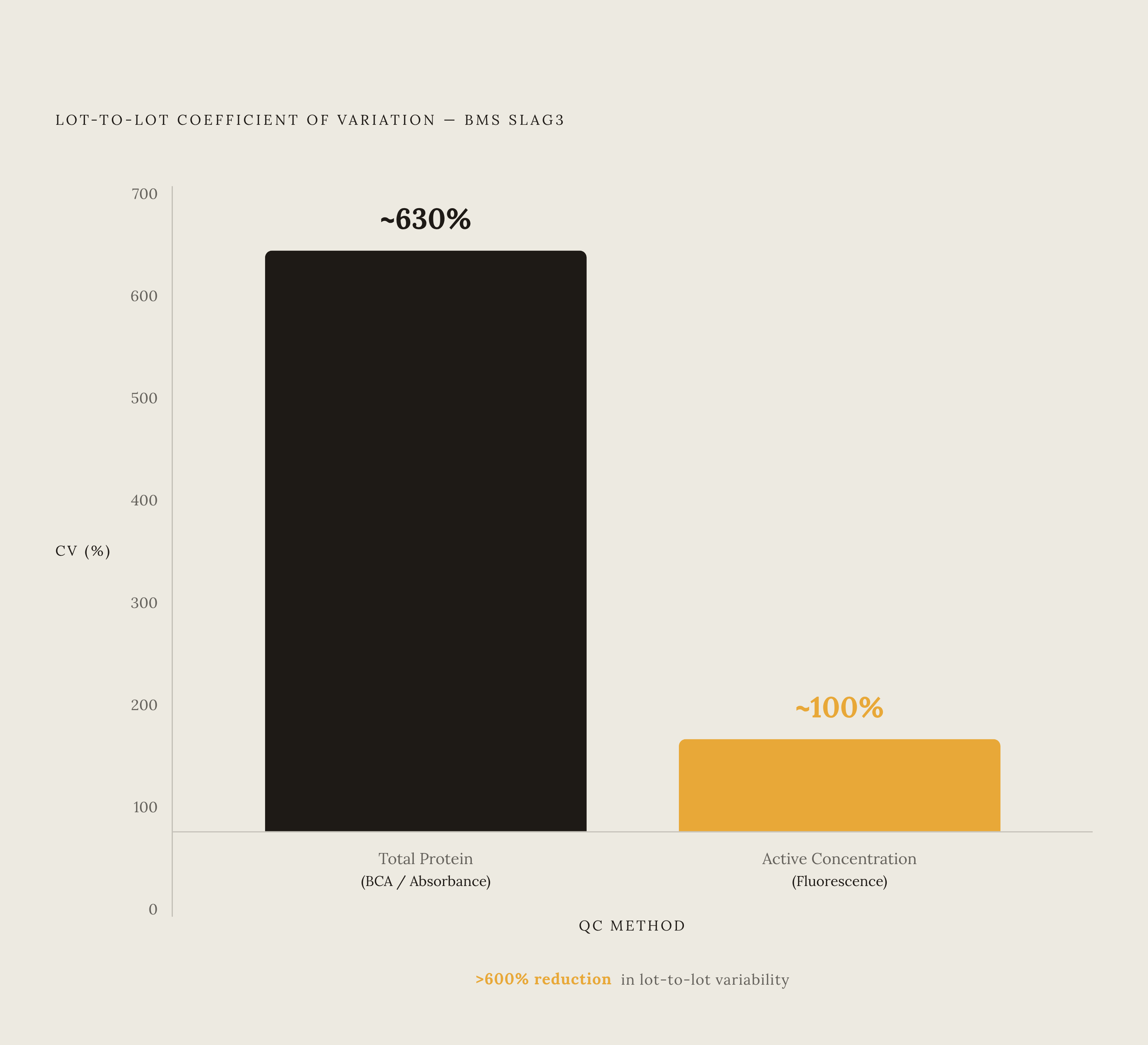
That distinction, between how much protein exists and how much protein works, has already reshaped quality control in an adjacent corner of the biotech industry. A study from Bristol-Myers Squibb found that switching sLAG3 reagent QC from total-protein concentration to active-concentration measurement cut lot-to-lot coefficients of variation by over 600%. The improvement didn't come from a better instrument or a more careful technician. It came from measuring the thing that actually determines reagent performance. CFPS yield measurement sits in the same position: a reaction can look productive by total protein mass while delivering almost none of that mass as usable, folded product.
A standard BCA assay or absorbance reading run on a CFPS reaction lumps together everything in the tube: ribosomal debris, partially translated chains, aggregated or misfolded protein, and the small fraction that folded correctly. Fluorescence readouts discard all of that noise by construction, because only correctly folded sfGFP fluoresces. For a lot-acceptance test, that single property is what makes the measurement trustworthy.
How an sfGFP Reporter Assay Is Structured
An sfGFP lot QC assay for CFPS has a few fixed parts, and each one exists to remove a specific source of noise from the final number. You start the reaction with a defined sfGFP expression construct, a plasmid or a linear DNA fragment, added at a fixed template concentration. Template amount directly drives expression level, so you need to hold that concentration constant; let it drift between reactions, and the assay will register template differences as lot differences, which defeats the purpose.
The reaction then runs for a set time window. Four hours at 37°C is the benchmark duration widely used for this kind of CFPS reaction, long enough for expression to reach a measurable plateau without letting degradation or resource depletion confound the comparison. At the end of that window, fluorescence is read on a plate reader, and end-point fluorescence is the primary number the assay reports. Some labs also take kinetic reads during the reaction itself, and these can reveal differences in expression rate between lots that an end-point number alone would miss.
Plasmid batch is a variable in its own right, separate from the CFPS lysate being tested, so every QC reaction across every lot comparison should draw from the same plasmid preparation. Otherwise a shift in plasmid quality can masquerade as a shift in lysate quality, and the two get conflated in the result. Incubation temperature, reaction volume, and plate format need the same discipline: small deviations in any of them change apparent yield independent of anything happening in the lysate. Finally, a no-template negative control belongs on every plate. It catches instrument drift and confirms that background fluorescence stays stable across runs, which is the baseline every other well's signal gets measured against.
What systematic protocol discipline does to measurement variability
A methods paper on CFPS standardization reported something striking: once extract preparation, master mix handling, and mixing technique were brought under systematic control, complete novices, specifically semester rotation undergraduates with no prior CFPS experience, produced data comparable to experienced users. That result matters because it shows the gains from protocol discipline are available to anyone willing to follow the procedure closely, not just specialists with years of bench intuition.
The same paper documented a coefficient of variation that collapsed from a very high level before standardization to a small fraction of that once the three variables (extract preparation, master mix solubilization, and mixing) were brought under control. That gap separates an assay too noisy to trust from one precise enough to build a QC program around.
Master mix solubilization deserves particular attention here. Incomplete solubilization creates well-to-well heterogeneity that looks, in the data, exactly like lot-to-lot variability, even when the lysate itself is consistent. A lab that skips careful mixing can end up chasing a lot problem that doesn't exist, while the real source of noise sits in how the master mix was prepared that morning.
The broader implication is that the sfGFP assay does more than flag bad lots after the fact. If you run it well, you tighten extract handling, mixing, and reagent prep across the board, so building a reliable lot QC test also builds a more reproducible CFPS workflow generally.
Plate-Based Fluorescence Measurement for Lot QC at Scale
If you run sfGFP lot QC in 96- or 384-well plate format, you can turn consistency testing from an occasional spot-check into something you run routinely, across many lots and many replicates, in a single session. A User's Guide to Cell-Free Protein Synthesis treats reduced reaction volumes and plate-compatible formats as core features of CFPS generally, not an afterthought bolted on for QC purposes. CFPS has small volumes, parallel wells, and fast readout, and those same properties make it attractive for high-throughput screening and practical for lot QC at any meaningful scale. A 2026 study in Biotechnology and Bioengineering collected a key set of its experimental data in 384-well microplate format, reinforcing that the plate-based workflow functions as the reference standard for quantitative CFPS performance measurement.
Running several replicate wells of the same lot on one plate has a second benefit beyond lot comparison: it exposes within-plate pipetting variation, which is its own source of noise separate from lysate quality. A lab reviewing its replicate spread is simultaneously auditing its own pipetting technique, at no extra cost in reagent or time.
Automating master mix dispensing removes technician time as a limiting factor on QC throughput and eliminates one of the larger sources of inter-replicate noise identified in standardization work on this assay. But the format's value isn't really about automation as an end in itself. It makes the plate the natural unit of lot testing, and that scales cleanly whether a lab runs five lots a month or fifty.
But none of this holds together unless plate readers across sites agree with each other. Recent work on fluorescence microscopy QC normalization shows that instrument-to-instrument differences in fluorescence measurement are real and need active correction, not assumption-away. The same correction discipline applies directly to plate reader calibration across CFPS labs: a lot that passes on one reader needs to pass on the same terms when read on a different instrument elsewhere.
Multi-site and field-deployed validation of the sfGFP reporter format
You get the strongest evidence for a lot QC assay's reliability when you watch it perform outside a single, carefully controlled lab. A distributed biomanufacturing study tested a fluorescence reporter format across five international partner sites, in Canada, Chile, Colombia, India, and Brazil, using freeze-dried CFPS reaction mixtures shipped between the sites. Intra-device and inter-device replicate variation came in below 7%, despite the reagents having traveled across borders and climates before being rehydrated and run.
Freeze-drying is the logistics layer that makes that result possible. Lyophilized reagents prepared centrally can ship to a receiving lab and be rehydrated there without losing the consistency the QC assay exists to confirm. That detail matters for anyone thinking about lot QC as an operational question rather than a lab-bench one: it means acceptance testing doesn't have to happen only at the site where the reagent was manufactured. It can happen wherever the reagent lands.
A further, more extreme demonstration comes from cell-free expression testing aboard the International Space Station, where researchers compared expression kinetics on Earth against expression in orbit with a fluorescent protein reporter. The environment there, microgravity, different thermal regulation, no possibility of a bench technician intervening mid-run, is about as far from a standard lab as CFPS testing gets. That the reporter format held up under those constraints reinforces the same point the five-site study makes on the ground: the assay's reliability isn't a feature of one well-equipped lab. It travels with the reagent, through shipping, rehydration, and genuinely unfamiliar environments.
Where sfGFP Lot QC Has Real Limits
sfGFP is a strong, broadly applicable test of whether a CFPS lot can transcribe and translate correctly. It is not a guarantee that the same lot will perform equally well on every protein a lab might eventually express with it, and treating it as such invites downstream disappointment. sfGFP folds co-translationally and tolerates a wide range of conditions, which makes it convenient as a reporter, but it doesn't depend on disulfide bond formation, membrane insertion, or chaperone-assisted folding pathways the way many real target proteins do.
The answer to that gap is to layer additional, target-class-specific secondary reporters on top of sfGFP as the primary QC test when a lot is headed toward structurally demanding targets, such as membrane proteins or multi-domain proteins requiring disulfide bonds. sfGFP stays the fast, cheap, automatable first gate that every lot passes through. Secondary tests, chosen to match the difficulty of the actual application, run only when the application calls for them.
Framed correctly, sfGFP measures whether the extract's core transcription and translation machinery works. Target-specific secondary tests measure whether that same extract suits a particular, harder application. A complete lot-acceptance framework needs both, run in that order, rather than asking one assay to answer a question it was never built to answer.
Building a practical lot-acceptance workflow around the sfGFP reporter
A workflow built around the sfGFP assay needs more than the assay itself to produce decisions a lab can trust and hand off to someone else. The anchor is a reference lot: a single, well-characterized batch frozen in aliquots and run alongside every new lot as an internal comparator. Comparing a new lot's fluorescence to that fixed reference, rather than reading an absolute number, converts the result into a ratio that holds steady even when the plate reader changes or the assay moves to a different lab.
You should set acceptance thresholds on that ratio, not on raw fluorescence counts, so the workflow survives instrument swaps and lab-to-lab transfer without needing to be rebuilt from scratch each time. The assay result, the reference lot result, the plate reader's calibration record, and the full replicate statistics belong together in a single lot QC record. Current CFPS quality frameworks, including work on microbial CFPS and its path toward industrial use, identify exactly this kind of traceable documentation as something still missing from much of the field.
Publishing that lot-level QC data at the point of reagent supply lets the scientist receiving the lot check the acceptance decision independently. That transparency is what separates a documented reagent system from a closed one. OpenCFPS™, a cell-free protein synthesis kit from Sepia Biosciences, is built around that same logic: lot-level QC data ships alongside the reagent, and the formulation itself is published openly, so a lab can set its own acceptance criteria against a known baseline. For a lab running CFPS at plate scale, the same sfGFP reaction used for lot acceptance can simply run as the first row of every screening plate, turning the QC check into a built-in part of normal operations.
Connecting sfGFP Lot QC to Higher-Throughput CFPS Applications
The plate-based fluorescence format built for lot QC is the same infrastructure that underlies the highest-throughput CFPS work being done today, so a lab investing in it for QC purposes is also building capacity it will use elsewhere. A high-throughput protease variant screening study used CFPS to produce and test a large library of protein variants, with each variant collection taking just six hours from production to readout on the same plate, using an ACS Synthetic Biology protocol. An autonomous, machine-learning-driven lab system went further still, running CFPS with sfGFP as its benchmark protein across tens of thousands of unique reaction compositions spread over hundreds of automated plates, achieving a substantial cost reduction against a prior cost-per-gram benchmark, the preprint describing the work reported. Neither study needed a different assay format to do this. The sfGFP reporter scaled from a lot QC check into a large-scale optimization engine, and its shape never changed.
A lab that has already standardized its sfGFP lot QC assay in plate format has, in effect, already built most of what a higher-throughput screening or ML-guided optimization program requires. The marginal cost of adding that screening capacity drops once the QC discipline, consistent template prep, controlled mixing, calibrated plate readers, reference-lot comparisons, is already in place.
That discipline matters even more once machine learning enters the picture. A model trained on CFPS reaction data can only learn as much biology as the data contains. Reproducible lots, confirmed by a reporter assay built and run with the rigor this piece has described, are what make that training data worth learning from. Good lot QC, in that light, is the precondition for doing more ambitious science at every scale above the single bench.
Sources
- 1 Automated Cell-free Protein Synthesis for Distributed Biomanufacturing 1 2
- Microbial cell-free protein synthesis and its progression toward industrial use - PMC
- Validation of cell-free protein synthesis aboard the International Space Station
- A User’s Guide to Cell-Free Protein Synthesis
- Quality-control Normalization of Fluorescence Microscopy Morphometry and Colocalization Measurements for Improved Accuracy and Cross-instrument Reproducibility