Reference Standards and Internal Controls in CFPS Yield Measurement
Adding reference standards and co-expressed controls improves CFPS yield reproducibility.

Cell-free protein synthesis trades the cell's walls for an open tube, and that openness is the entire reason researchers reach for the platform. It also happens to be why a yield number from CFPS deserves more scrutiny than the same number from a cell-based expression system. A living cell keeps its ionic concentrations, its ribosome density, and its energy supply in a narrow range through homeostasis, so two colonies running the same construct tend to behave alike. A crude lysate has none of that regulation built in. Open the reaction up so researchers can add factors, swap energy sources, and reprogram the genetic code at will, and the same template run in two separate tubes can produce very different amounts of protein, simply because nothing inside the tube is holding the variables in place. That lack of fixed composition limits reproducibility, systematic optimization, and genetic code reprogramming across the field, a limitation the Handbook of Synthetic Biology's chapter on cell-free systems lays out. The rest of this piece works through what researchers can build into their measurements to compensate for that absence of built-in control.
Extract preparation and baseline variability
The instability starts at the lysis step, before you run a single reaction. Extract preparation methods differ from lab to lab, so those differences produce batch-to-batch variation, and that undermines any screening effort built on top of it. Commercial kits have started to close that gap, but the problem has not gone away. Final protein yield depends heavily on the concentrations of Mg²⁺ and K⁺ carried over from the extract, because both ions are fundamental to ribosomal structure, catalytic activity, and the broader set of enzymatic reactions that drive synthesis. Those concentrations shift with how the lysis was done and with how much salt carries over from one run to the next, so two extracts made by the same protocol in the same lab can still behave differently.
That sensitivity is visible in Pichia pastoris CFPS work published by Wu et al. in Biotechnology and Bioengineering in 2026. Adding a modified Kozak sequence along with PEG-6000 and spermidine produced roughly a ten-fold increase in protein yield, and the cost per gram of protein dropped by an order of magnitude. That result demonstrates that the extract's formulation, not the DNA template alone, sets the scale of what a reaction can produce. A yield figure from one batch of extract tells a researcher almost nothing about what the next batch will do unless some reference standard, run alongside the target, tracks how active that particular batch actually is.
Fluorescent reporter standard curves: what they measure
The most common way researchers put a number on CFPS output is a purified sfGFP standard curve. Cell-free sfGFP concentrations are typically calculated through linear regression against that curve, reading fluorescence at matched excitation and emission wavelengths in small reaction volumes after a fixed incubation period. The curve maps raw fluorescence readings onto known sfGFP concentrations, so you can work backward from signal to an estimate of how much protein the reaction made. That estimate is a surrogate for protein amount, built from light output, not a direct measurement of mass.
How well that surrogate holds up depends on how carefully it gets calibrated, and most labs don't calibrate as tightly as the method demands. Conversion factors from purified fluorescent protein calibrations tend to reproduce within about twenty percent under good conditions, with coefficients of variation running between 0.06 and 0.09. Given that spread, run at least two independent calibrations, and treat a pair of replicates that diverges beyond that margin as suspect. The calibrant itself introduces a separate risk: many commercial fluorescent protein standards are built on first-generation GFP variants that excite preferentially in the UV range, unlike sfGFP, and many ship with incomplete datasheets that leave out sequence, brightness, or spectral data. A standard with no documented spectral properties is a poor foundation for a calibration a lab plans to rely on, no matter how easy it is to order.
Even a well-calibrated sfGFP curve has a hard boundary. Researchers favor sfGFP because it folds quickly and reliably under cell-free conditions, because its fluorescence tracks correctly folded, active protein rather than total polypeptide chain, and because purified standards are easy to source. None of that changes what the measurement actually captures: the reaction's general synthetic capacity, not the yield of whatever target protein the researcher actually cares about. If reagent suppliers publish lot-level QC data on the sfGFP yield achieved with each batch, researchers get something to calibrate against instead of starting cold with every new lot, and that turns a weak, lab-local control into something closer to a shared reference point. But going from "the sfGFP control yielded X" to "my target protein yielded Y" still requires an inferential leap, and the sfGFP curve alone cannot make that leap for you.
Co-expression controls: using a second protein to separate reaction health from target-specific problems
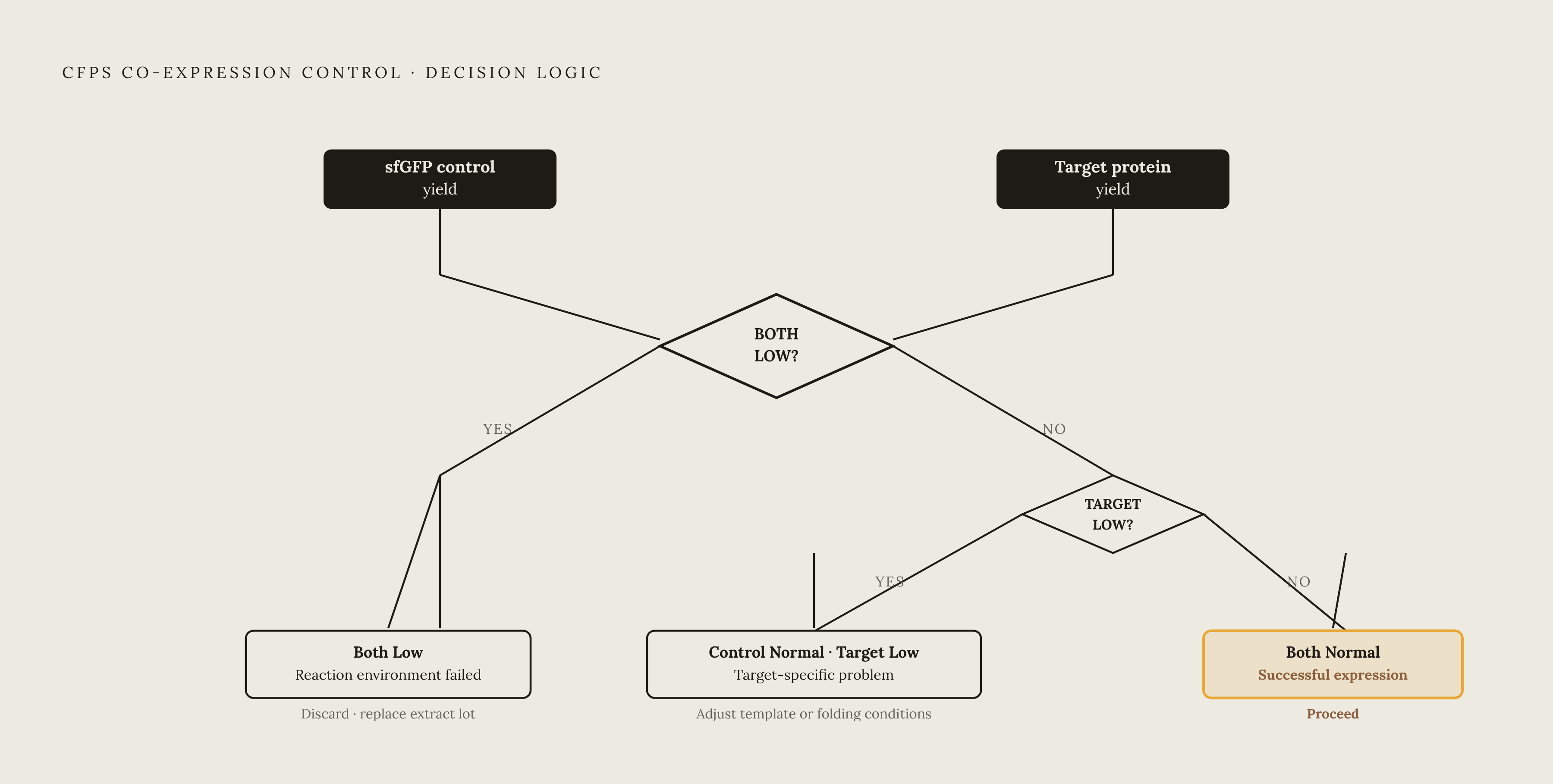
That gap is exactly where a co-expressed reference protein earns its place in the protocol. Run sfGFP, or another well-characterized reporter, in the same tube as the target protein; the two readouts together tell a researcher whether a disappointing yield number reflects a sick reaction or a difficult target.
The logic is straightforward. If the co-expressed control comes out at its expected yield and the target does not, the problem sits with the target itself, whether that means misfolding, a sequence issue, or a codon usage mismatch. If both readouts come out low together, the reaction environment failed, whether through poor extract quality, a wrong Mg²⁺ concentration, or a depleted energy source. That distinction decides what a researcher does next: swap the template, adjust the folding conditions, or discard the lot of extract. Those are three different remediation paths, and guessing wrong wastes a round of experiments chasing the wrong fix.
CFPS makes this kind of co-expression genuinely practical in a way cell-based systems often can't match, because the reaction is open. Chaperones, accessory folding factors, and a reporter protein can all go into the same tube at once without worrying about cellular toxicity, a flexibility the Handbook of Synthetic Biology's cell-free systems chapter attributes directly to CFPS's capacity to add factors that promote folding. In practice, most labs implement this with a separate plasmid or linear DNA fragment encoding sfGFP under the same promoter as the target, added at a defined ratio to the target template, with the fluorescence readout kept orthogonal to whatever downstream assay the target protein requires. Adding a second template does introduce competition for ribosomes and energy, and that competition can suppress target yield somewhat. At control-DNA ratios well below equimolar with the target template, that suppression stays small, and the diagnostic value of knowing whether the reaction or the target is the problem outweighs the cost. The ratio used belongs in the written protocol, not left to memory.
For targets that are toxic, unstable, or prone to misfolding, this separation matters even more than it does for routine proteins, because the yield of a difficult protein is exactly the number least reliably estimated by any indirect assay. A co-expression control confirms whether a low number reflects the protein's intrinsic difficulty or a lysate that failed to run.
Lot-anchored baselines: making yield data portable across time and between labs
A single experiment's co-expression control solves the problem within one reaction. It does nothing to tell a researcher whether a result that improved from last month to this month improved because of a better experimental design or because a new batch of extract happened to be more active. Without a lot-specific baseline, those two explanations are indistinguishable, and that ambiguity undermines the value of any data accumulated over time.
The fix follows directly from what extract lots already do: each lot has a characteristic maximum yield under a defined set of standard conditions. Measuring that maximum with the same reference protein and the same protocol every time gives the lot's QC baseline. Every later experiment then has a denominator to divide into. Yield becomes a fraction of lot maximum rather than an absolute number tied to the identity of whichever lot happened to be on the bench that day. If a target reaches fifty percent of lot maximum in one lot and fifty percent in a different lot, it is expressing consistently, even if the raw numbers behind those two percentages look nothing alike.
A 2025 international multi-site study, still in preprint form, shows what this kind of framework can do when applied across institutions. A standardized CFPS workflow transferred across five international sites produced a coefficient of variation of roughly ten percent across all of them, a useful benchmark for what counts as acceptable inter-site variability once lot-anchored controls are applied with discipline. The same study used colorimetric quantification, not fluorescence, to confirm protein yields and purity above ninety percent across every purification strategy tested, so the baseline framework holds regardless of which detection method a lab prefers.
None of this works without documentation on the supplier's end. If a reagent supplier publishes the sfGFP yield achieved with each lot under defined conditions, researchers get a baseline they can use immediately. Without that documentation, every lab has to generate its own baseline on every new lot, which adds cost and time that transparent lot-level reporting would otherwise remove. The field still lacks well-characterized reference lysates, across organisms such as E. coli and K. phaffii, with defined performance criteria that could serve as shared community standards. Until that kind of reference infrastructure exists, you have to rely on lot-anchored baselines built inside individual labs.
Scaling the framework: why controls become mandatory, not optional, in high-throughput screening
Everything described so far applies with greater force once CFPS moves from single tubes to plates. Consider a machine-learning-assisted enzyme screening campaign that expressed a library of more than a thousand variants across a very large number of reactions. At that scale, even a small systematic shift between plates produces false rankings that no amount of biological replication will fix after the fact, because the shift looks exactly like signal until someone checks the control well.
CFPS scales linearly in a way few expression systems can match, running in 24- or 96-well plates with the same reaction chemistry used at the bench. That scalability pays off when the yield measurements taken across a plate can be compared to one another, and a control framework is what makes that comparison valid. CFPS also plays well with robotic liquid handling, so an sfGFP co-expression control or a reference well can be dispensed automatically on every plate, and the Handbook of Synthetic Biology's cell-free systems chapter confirms that compatibility with robotic and microfluidic systems extends CFPS's high-throughput capacity.
A 2026 nanobody variant screening platform that paired CFPS with bio-layer interferometry reported a Pearson correlation of 0.968 between CFPS-derived results and traditional methods. That agreement depended on a GFP-based fluorescent calibration curve the study's authors built specifically to quantify nanobody concentration and enable the kinetic BLI analysis behind it. Without that calibration curve, the functional rankings pulled from crude reactions would not have held up. A separate 2026 staphylokinase variant screening platform found that activity rankings from crude CFPS mixtures tracked closely with rankings from purified proteins, but the authors noted that you still need classical production and purification to characterize the top hits with precision. The control framework is what tells a researcher which hits earn that further investment and which don't.
The practical rule that comes out of all this: run one reference well per plate, sfGFP, with a defined DNA input and a defined incubation time, on every plate, every time, not just on the plates that happen to matter most. Flag any plate where that reference well falls outside the lot-baseline tolerance before you trust anything else on it.
Challenging proteins and the measurement framework
CFPS earns its place in a researcher's toolkit most clearly with the proteins cell-based systems struggle to produce at all: toxic proteins that would kill a host cell, unstable proteins that degrade before a cell can accumulate them, and multi-domain proteins that fold poorly inside a crowded cytoplasm. These are the exact targets where a missing control framework produces the most misleading numbers, because a low yield reading for a difficult protein is inherently ambiguous. It might mean the protein is genuinely hard to make. It might mean the extract lot was weak that day, or that Mg²⁺ drifted out of range, or that the reaction simply failed before transcription ever got underway. An sfGFP standard curve alone cannot tell those apart. A co-expression control, read against a lot-anchored baseline, can. For the proteins where CFPS offers the clearest advantage over any cell-based alternative, that framework is the only way to know whether the basics worked.