Machine-Readable Protocol Formats for Automated and Semi-Automated Biology
Standard formats encode execution but miss reagent quality and biological preconditions.
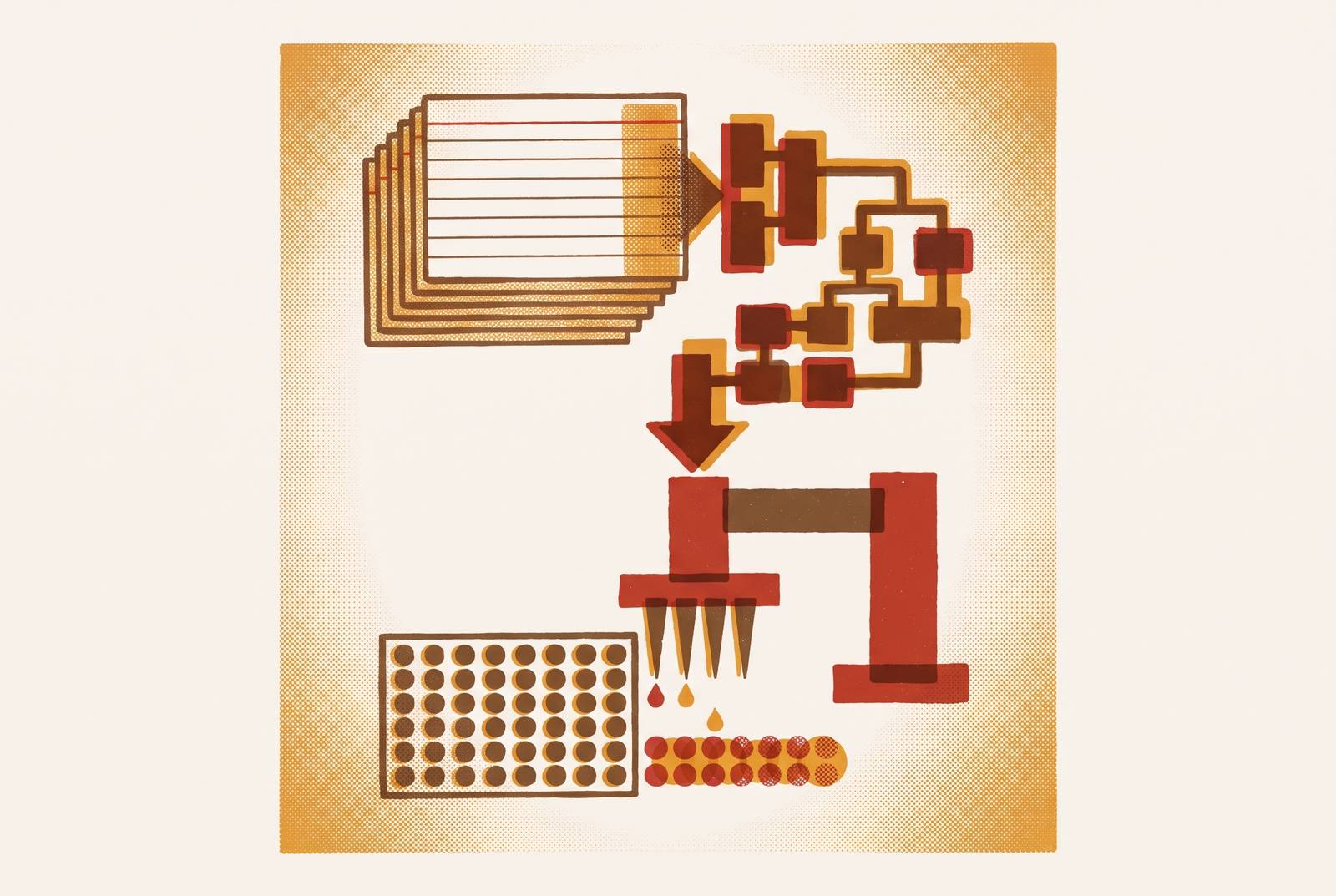
Machine-readable protocol formats link what scientists intend to do in cell-free protein synthesis (CFPS) to the steps that machines carry out. They make reproducible throughput possible, but executable instructions alone are not enough. A reliable workflow also needs explicit biological requirements, documented reagent lots, and traceable links between each run and its results. Understanding what current formats encode (and what they leave to people) is therefore central to designing automated and semi-automated CFPS workflows.
Why protocol representation becomes a bottleneck as CFPS scales
A written instruction can be clear to a scientist and still be incomplete for a machine. A lab notebook entry, Word document, or supplementary methods section describes what the scientist intends, but a liquid-handling robot needs the operations and parameters spelled out. A LIMS or downstream analysis system also needs records in a structured form. People translate between these forms. Each time they do, they make small choices about details the original author left unstated.
CFPS is unusually sensitive to those decisions. Small deviations in reagent addition order, timing, temperature, or volume can compound into large differences in yield and consistency. Across hundreds of variants, extract preparation, energy regeneration mix, DNA template concentration, reaction volume, and incubation regime must remain controlled for comparisons to be meaningful. Otherwise, procedural variation becomes entangled with the biological variation under study. Faster pipetting does not resolve that ambiguity.
Without a shared, computable description, different operators and instruments can execute different interpretations of the same written method. Those differences also accumulate as protocols change over time. The community has responded with several distinct formalization approaches, each addressing a different part of the distance between a scientist’s instructions and a reproducible run.
What "machine-readable" actually requires a protocol to encode
A machine-readable protocol must separate logical structure, physical operations, resources, and parameters. Natural language often blends these into a single instruction. For a 96-well plate of DNA template variants, the logical structure defines iteration over samples and any branching or error-handling rules. The physical operations specify transfers, mixing, incubation, or centrifugation through a controlled vocabulary. An instrument driver or scheduler can then map those actions to hardware commands.
Resources identify the reagents, labware, and instruments required for execution. Unique identifiers let software validate those requirements against inventory and support reuse on another instrument without rewriting the scientific specification. Parameters must be just as clear, with typed values and units. A representation must distinguish “10 µL” from “10 mL” and permit deliberate parameter changes for a screen.
Executability is only one test of adequacy. Scientists also need to inspect the procedure, understand its decisions, and check that it represents the intended experiment. A format that only a robot can interpret provides no adequate basis for peer review, troubleshooting, or regulatory documentation. Human auditability therefore belongs in the requirements from the outset, rather than being treated as a separate documentation task.
The major protocol representation approaches currently in use
Vendor-specific scripting languages place the protocol close to the hardware. The Python-based Opentrons Protocol API and Tecan’s Freedom EVOware software platform each work closely with their own liquid-handling platforms. These approaches are the most widely used in practice because laboratories commonly acquire a platform and optimize around it. Portability is the corresponding trade-off for that integration. A validated 384-well CFPS screen cannot readily move to a different instrument brand without rewriting its execution instructions.
YAML and JSON describe what scientists intend in a structured form that sits between that intent and instrument-specific commands. They make resource declarations and parameter values accessible to both software and human readers. Several laboratory automation middleware systems use YAML for configuration, while Opentrons Protocol Designer exports Python (.py) protocols rather than the JSON-encoded protocols exported by earlier versions. The distinction prevents confusing a data format with an execution environment. Complex conditional logic can be hard to read and maintain when it is written as structured data alone.
The Synthetic Biology Open Language (SBOL) emphasizes exchange across tools and organizations. It represents biological designs and, in later versions, experimental workflows. For CFPS, its particular strength is biological context. A reaction description can include machine-readable annotations about the genetic construct, intended assay, and prior experimental data informing the design. It is still little used outside dedicated synthetic biology software ecosystems.
The Investigation/Study/Assay (ISA) framework addresses experimental metadata through ISA-Tab and ISA-JSON. It describes investigations, samples, protocols, and measurements, and is widely used in life-science data repositories and FAIR data compliance workflows. ISA supports archival and data publication, but does not replace a format that drives instruments.
Graph- and ontology-based representations aim to describe more of the links between the parts of a protocol. Some academic and commercial groups represent procedures as directed graphs or RDF triples linked to controlled ontologies, including the Ontology for Biomedical Investigations (OBI). These approaches would support automated reasoning about protocol equivalence, reagent substitutability, and compliance. They remain largely at the research stage. Their contribution is a model for exchanging meaning.
What current formats standardize well and where they fall short for CFPS workflows
Existing formats handle much of the physical execution layer well. Volume transfers, plate layouts, incubation times, and temperature ramps are within the capabilities of vendor scripting languages and JSON-based representations. Loop-capable formats also support DNA template concentration gradients and volume titrations. Declared labware geometry and deck layouts allow pre-run validation, including detection of mismatched well counts. These capabilities make partial automation a substantial improvement over fully manual execution.
Many formats identify a reagent as a named deck position without specifying its composition, lot number, QC status, or expiry. For CFPS, that leaves extract quality and energy mix composition outside the executable description even though they directly influence yield. Two runs can therefore use identical transfer instructions without documenting whether their reagents were equivalent. A precise transfer record is not a complete experimental record.
Biological preconditions create a related gap at the input. Template DNA must meet quality, topology, and concentration requirements for the starting material to be good enough for a CFPS run. Yet no format in wide use has a machine-checkable specification for those requirements. A person still has to judge whether to accept the starting material. That limitation separates successful execution of a script from validity of the experiment it performs.
The same separation appears after the reaction and during failures. Fluorescence measurements, activity assays, gels, and mass spectrometry commonly have separate protocols whose relationship to the CFPS reaction is managed informally. Current formats also generally lack a machine-readable specification of what should follow a failed pipetting step or a logged temperature deviation. Human coordination returns at precisely these boundaries. Consequently, automated pipetting can coexist with manually coordinated setup, reagent qualification, assay linkage, and interpretation, limiting the throughput available from the larger workflow.
How reagent transparency and lot-level documentation close gaps that format standards cannot
A format cannot supply information that a reagent provider has not documented. CFPS extracts and energy mixes are complex, variable biological preparations, so a fully specified procedure run against an opaque reagent remains difficult to reproduce. Published formulations, lot-level QC data, and defined acceptance criteria help distinguish procedural failure from reagent quality problems. Without them, the cause of a failed run remains ambiguous. This is a documentation gap that a more expressive protocol language alone cannot close.
Documented composition and lot-level QC give protocol records something concrete to reference. A specific run can be linked to a specific reagent lot and its known properties through machine-readable metadata. Published formulations describe what is in the system, while lot-level records describe the preparation used in the experiment.
Treat reagent QC documentation as protocol infrastructure. Laboratories should version-control that documentation together with protocol records. The record needs an explicit relationship between the run, the lot, its documented properties, and the acceptance criteria used for that experiment. A documented reagent system makes this linkage tractable without requiring the execution format itself to represent every chemical and biological detail.
Designing a CFPS automation workflow that accounts for current format maturity
A vendor scripting language or JSON-based format can handle instrument execution where close hardware integration is valuable. A separate, human-auditable specification in structured YAML or a lab-managed schema should record biological intent, reagent requirements, and acceptance criteria. This is the specification a scientist reviews and signs off on.
The two representations need a traceable connection through a LIMS or electronic lab notebook. That record should identify which execution script ran, which reagent lots it used, and which raw data files it produced. Separation does not mean independent documentation. The scientific specification explains what constitutes the intended experiment, while the linked execution record establishes what was run.
For variant screening, the protocol should use the DNA template variable as its loop axis. The robot then iterates over template positions while holding other parameters fixed, preserving the structure needed for interpretable comparisons. Plate layout should be a declared resource, so a change from 96-well to 384-well format can be parameterized. Controls must also be part of the machine-readable specification. A no-template control and a reference template of known yield should have set positions in every run so they can serve as internal calibrants for comparisons when reagent lots change.
The same rigor should extend to milligram-scale production. Mixing order and timing have larger consequences during scale-up, so formalization should not end when screening does. Otherwise, an automated discovery workflow can revert to manual execution at production scale. Consistent naming supports both stages of the workflow. Laboratories should agree on names for reagents, labware, and operations across protocol documents, establishing the minimum ontology hygiene needed for data aggregation and future interoperability.
Where protocol format standards are heading and what that means for CFPS labs planning now
The field is moving toward convergence at the semantic layer. Shared ontologies and exchange formats would allow protocols written for different platforms to be compared, validated, and partially translated. Hardware-specific instructions would still have a role. Broader efforts in laboratory automation are also working toward self-describing protocols with metadata that states what they need and what outputs to expect. A scheduler could use that information to check a laboratory configuration’s ability to execute a protocol before the run begins.
For CFPS, closer integration between protocol metadata and experimental data management is particularly consequential. Direct links from a protocol to the yield, activity, or sequence data it produced connect execution to interpretation. Those links help with the iterative, data-driven screening that protein engineering needs. A protocol then becomes more than an instruction set. It also provides the structured context needed to compare results across runs without reconstructing their history from separate documents.
Laboratories should choose a reagent system with machine-importable documentation, including published formulations and structured QC data, and a LIMS or ELN that version-controls protocols with the data they generate. Neither choice depends on a particular standard prevailing. Both create structured records that can migrate into more expressive formats as those formats mature. The practical distinction is whether future adoption begins with clean experimental records or with another round of interpreting natural-language notebooks.
Sources
- Towards autonomous biology: Compiler-Verified Protocols as a Foundation for
- ProtoAct: Turning Wet-Lab Protocols into Embodied Robotic Actions
- A path towards AI-scale, interoperable biological data
- ProtoCode: Leveraging Large Language Models for Automated Generation of
- Automated and Programmable Cell-Free Systems for Scalable Synthetic Biology with a Focus on Biofoundry Integration
- The Laboratory Automation Protocol (LAP) Format and Repository: a platform for enhancing workflow efficiency in synthetic biology
- An Annotated Corpus for Machine Reading of Instructions in Wet Lab Protocols
- A Self-Evolving Agentic System for Automated Generation and Execution of Biological Protocols