Supplementary Materials Quality in High-Impact Synthetic Biology Papers
Incomplete supplementary materials block reproducibility of cell-free protein synthesis.

A high-impact synthetic biology paper on cell-free protein synthesis needs complete supplementary materials to offer a reproducible method. Extract preparation, reaction conditions, reagent compositions, and quality-control data make up the record of the experiment. When that record is incomplete, CFPS’s promise of open, modular protein production stops at the boundary of the originating laboratory.
Why CFPS results so often cannot be reproduced from the main text alone
CFPS abstracts describe an “open system,” “precise control,” and a “modular” platform, yet the methods needed to exercise that control are often underspecified. Results depend on a cascade of upstream decisions, including extract source and preparation, reaction composition, energy regeneration, and DNA template quality. Each decision constrains what follows in the reaction. An undescribed step can therefore prevent another laboratory from reproducing the reported yield, even when the main text explains the experimental rationale clearly.
That flexibility creates a substantial burden for documentation. There is no single standard protocol from which a reader can safely infer missing details, because laboratories configure their systems differently. Supplementary materials are the place to record those differences, but their preparation after acceptance, without independent peer review or an enforced reporting schema, leaves completeness weakly protected. The resulting barrier is especially high for new users, who must choose and execute a platform while also reconstructing decisions that the paper leaves unstated.
What extract preparation details must appear in a supplement for the result to be repeatable
The cell extract is the single most variable component in a CFPS reaction. Because cell-derived components differ from batch to batch, an extract name alone cannot tell another laboratory what the experiment started with. A repeatable preparation begins with the organism and strain, growth conditions, and OD at harvest. Those details establish the biological source of the material. Without them, a second laboratory cannot distinguish a comparable preparation from one that merely uses the same organism.
The record of the preparation must then give the lysis method and buffer composition, centrifugation steps, and run-off reaction conditions. The record also needs the storage format and freeze-thaw history. These are not interchangeable descriptions of a generic extraction procedure, but separate parameters governing how the reported extract was prepared and handled. A supplement that specifies lysis while omitting run-off conditions still leaves part of the preparation undefined.
DNA template preparation belongs in the same upstream record. Small differences in plasmid quality arising from cell culture and purification conditions can produce large differences in CFPS protein yield. A catalog number does not document that preparation. If the extract is described fully but template quality is left implicit, a failed replication still has an unresolved upstream cause. With records of both preparations, another laboratory can compare its starting materials with those used in the paper.
The strongest objection is that extract preparation may be proprietary or specific to a laboratory’s competitive advantage. A supplement need not disclose intellectual property to document reportable parameters such as strain, growth phase, lysis method, and run-off conditions. The distinction is between revealing a proprietary process and identifying the conditions that govern reproducibility. Treating every preparation detail as inseparable from proprietary knowledge leaves the published result without a usable experimental foundation.
How reaction condition underreporting compounds the extract problem
Even a fully documented extract cannot compensate for an undefined reaction mixture. CFPS performance is acutely sensitive to Mg²⁺, K⁺, amino acid and NTP concentrations, as well as the energy regeneration system. “Standard conditions” does not specify any of these. Because laboratories use different systems, the phrase substitutes a local convention for information that another practitioner needs. The supplement must report the conditions actually used, rather than assume that a familiar protocol name supplies them.
An instruction such as “Mg-glutamate was titrated to optimal concentration” illustrates the gap. It identifies an optimization step but omits its outcome. Another laboratory is left to repeat the search. The same problem arises when an energy source is named without its concentration or an incubation format is left unstated. Batch, continuous flow, and continuous exchange are distinct setups, so the format itself belongs in the experimental description.
The open reaction environment makes these omissions particularly consequential. CFPS lacks a cellular membrane and is not constrained by cellular life objectives, which permits direct control over synthesis conditions. It also lacks the cellular regulation that might otherwise moderate a concentration error. A validated protocol optimization study reduced the coefficient of variation by nearly two orders of magnitude, illustrating how strongly controlled conditions can affect experimental consistency. For eukaryotic CFPS, where standardization and cost are barriers to industrialization, incomplete reaction reporting also obstructs the shared baseline needed for standardization.
Why reagent composition disclosure is the hinge between a reproducible result and an admirable one
Procedural detail defines how a reaction was assembled, but reagent disclosure defines what was assembled. When a supplement identifies a kit without its formulation, reproduction depends on that product remaining available, unchanged, and affordable. None of those conditions can be guaranteed. The experiment may be described accurately as a purchasing workflow while remaining inaccessible as a transferable formulation.
This dependency also complicates the interpretation of variation. Lot-to-lot differences in protein activity can introduce uncertainty into downstream measurements, yet a product name alone gives no basis for tracing that uncertainty to the reagent lot. Sourcing artifacts may then be mistaken for biological variability. Lot-level quality-control data provide a way to examine that alternative. Their value is not simply to reassure the reader that a reagent passed a test, but to connect the material used with evidence of its performance.
Sharing the formulation gives another laboratory a starting point it can rely on for longer. Buffer compositions, cofactor concentrations, and energy system components show what materials went into the result and bring them out of the black box. Documented formulations and lot-level QC data make this standard achievable in practice. Together, they allow a supplement to describe both reagent identity and lot performance without relying on a product name to stand in for either.
This is a question of what publication makes available to the field. A reported yield demonstrates an outcome under the originating laboratory’s conditions. A disclosed formulation makes those conditions available for reconstruction and comparison. Reagent transparency turns the supplement from evidence that an experiment occurred into a record that supports further work.
How the reproducibility problem intensifies for challenging protein targets
The reporting burden becomes greater for the targets that give CFPS some of its clearest advantages over cell-based expression. Toxic antimicrobial peptides, membrane-disrupting proteins, and multi-domain eukaryotic proteins requiring post-translational modification depend on precisely the conditions that incomplete supplements leave uncertain. These are cases in which control over the synthesis environment can make CFPS useful when in vivo expression fails. The value of that control depends on others being able to reconstruct it.
Membrane proteins, antibody fragments, and proteins requiring PTMs show especially clearly how synthesis conditions affect whether the protein can be used. Producing a protein is not the same as documenting the conditions that support the reported outcome. In eukaryotic systems, post-translational modification capabilities and the molecular chaperone network contribute to correct folding of complex proteins. Chaperone supplementation therefore cannot remain an incidental methods detail. Its presence or absence, and its concentration when used, belong in the supplementary record.
For toxic, insoluble, or multi-domain targets, missing information limits more than direct replication. It also restricts what another laboratory can learn from a result, because the conditions supporting successful synthesis remain unresolved. A reader cannot confidently separate a target-specific constraint from an undocumented feature of the reaction. The supplement is where that distinction becomes examinable.
The practical objection is that papers on novel proteins already demand extensive documentation. Reporting everything adds work, especially when the conditions for several targets must be described. Omitting the record transfers the work to every laboratory attempting to build on the result. The supplement has room for those details, so the main narrative need not become a protocol. Its purpose is to preserve the experimental basis of the claim wherever that basis is too extensive for the main text.
What high-throughput and automated CFPS workflows reveal about supplementary materials standards
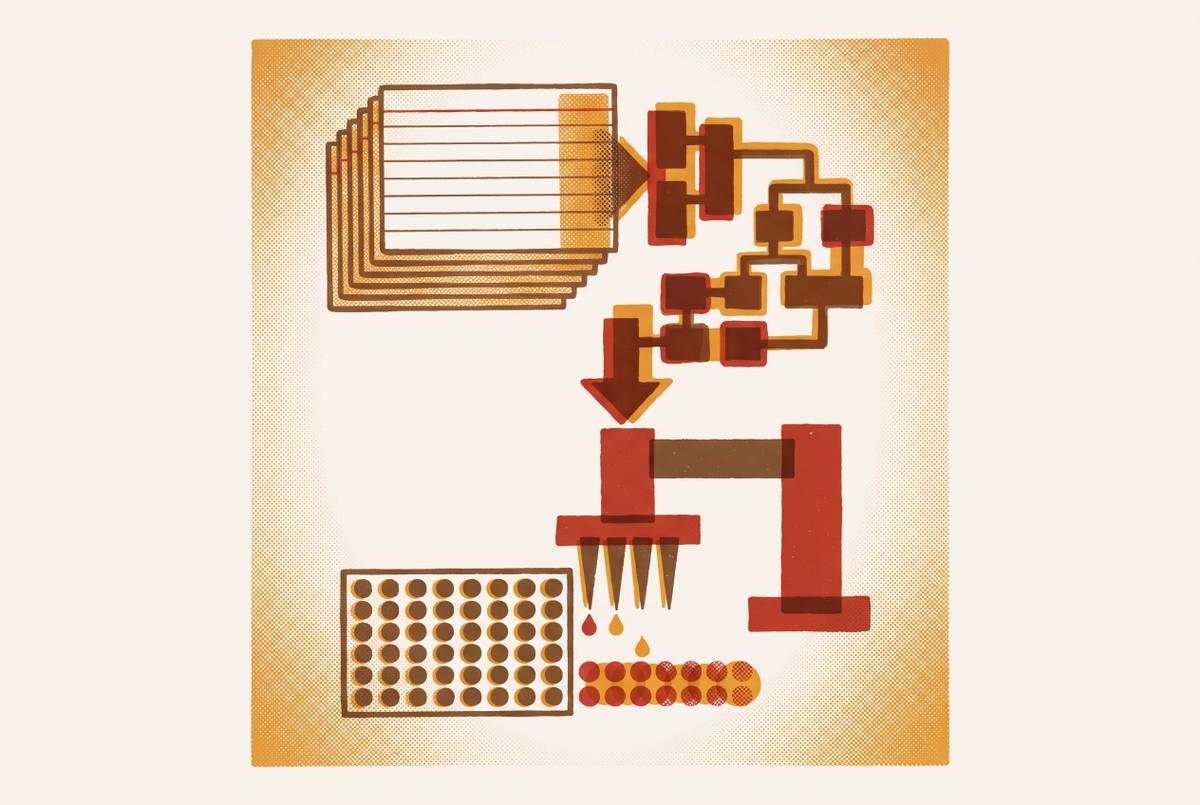
Reactions run in 384-well plates using acoustic liquid handling have computationally specified compositions, plate layouts, and controls. Those records already exist in machine-readable form. Depositing them would give readers an auditable account of the experiment. At this scale, the central failure is not necessarily an absence of data, but an absence of deposited data.
A 2025 bioRxiv preprint describes i-POPFLEX, with 34 translation factors and a split T7 RNA polymerase individually synthesized in vitro and integrated into an Opentrons OT-2 automated liquid-handling workflow. The platform illustrates how automation generates a documentation trail that supplementary materials can preserve. Component identities, synthesis conditions, and validation data for each factor belong in that trail. A description of the automated platform alone is insufficient.
The MANGO device, described in medRxiv in 2025, similarly produces a computable record of automated benchtop CFPS and purification steps. Its open-source hardware documentation allows the device specification to accompany the experimental record. Hardware openness and reaction disclosure serve related but distinct purposes. One describes the system performing the steps, while the other describes what those steps contained and produced.
AI-driven optimization brings the same need for records to a series of experiments. Work on colicin M and colicin E1 in E. Reproducing that optimization requires every cycle’s reaction composition, ML model inputs, and output predictions. These workflows offer an opportunity to publish comprehensive experimental records held inside the systems that generated them.
What journals and authors can do to close the documentation gap
The practical response is a required CFPS reporting checklist applied before acceptance. It should cover extract source and preparation, reaction composition with concentrations, DNA template preparation, incubation format, and lot-level QC data for all commercial reagents used. Crystallography deposition requirements show how journals can require the experimental records needed to repeat the work before they publish it. Asking for “sufficient detail” without defining the required categories leaves the same omissions open to interpretation.
JCI began manual quality control of high-throughput sequencing and proteomic datasets before acceptance in 2025, demonstrating that pre-acceptance data review is operationally feasible. The same logic applies to CFPS reaction documentation. A special issue on reproducibility in Synthetic Biology has already brought the broader problem to the attention of the field’s editors. The next step is to convert recognition into submission requirements. That shift would make documentation part of evaluating the paper rather than an administrative task after its scientific claims have been accepted.
For authors, the minimum viable supplement has a concrete test. A competent CFPS practitioner at another institution should be able to assemble a reaction with the same components at the same concentrations, using the same extract preparation logic. Lot-specific QC data should support the reagent description, while automated workflows should deposit their computationally specified records. As more users gain access to extract types, these records matter more because missing details leave each new user to work out how the experiment was done.
The documentation gap is fixable with tools already available. Complete protocols, disclosed formulations, lot-level QC, and machine-readable records give practical form to the field’s commitment to open and modular science. When that standard is met, supplementary materials do more than support a paper’s credibility. They let another laboratory begin from the published result rather than from the unanswered questions surrounding it.
Sources
- A User’s Guide to Cell-Free Protein Synthesis
- Eukaryotic cell-free protein synthesis: Chassis diversification, system engineering, and emerging applications - ScienceDirect
- Designing of an extract production protocol for industrial application of cell‐free protein synthesis technology: Building from a current best practice to a quality by design approach
- Exploring the Potential of Cell-Free Protein Synthesis for Extending the Abilities of Biological Systems
- Ten simple rules for making the supplement increase your ...
- Synthetic Biology