Throughput and Cost Tradeoffs in High-Throughput Protein Variant Campaigns
Choosing the right cell-free system balances speed, scale, and cost for variant screening.

Cell-free protein synthesis for high-throughput variant screening is a strong fit when hundreds of constructs must be expressed and scored in parallel without transformation or cell culture. For robotic 96- or 384-well campaigns, the best system is one with documented formulations, lot-level QC, and reliable performance at the intended dispensing volume. Throughput and cost improve together only when platform choice, reagent economics, and workflow design match the campaign.
Why protein variant campaigns fail before the science does
The next variant library is ready, but expression and screening are still processing the last one. AlphaFold-descended design pipelines can propose hundreds to thousands of variants per engineering cycle, shifting the bottleneck from generating sequences to expressing and functionally scoring them. Purification at the scale needed to train or validate ML models is time-consuming and resource-intensive, so a training-data shortage can begin as an expression-throughput problem.
The constraint is not simply a slow assay. Speed, scale, and per-variant cost pull in different directions, and an expression platform determines which constraint the campaign accepts. A workflow that produces excellent purified protein for a few constructs may be poorly suited to scoring a library. When that mismatch holds back the next design cycle, the infrastructure stalls the work before the scientific hypothesis can be tested.
How CFPS structurally differs from cell-based expression in a variant campaign context
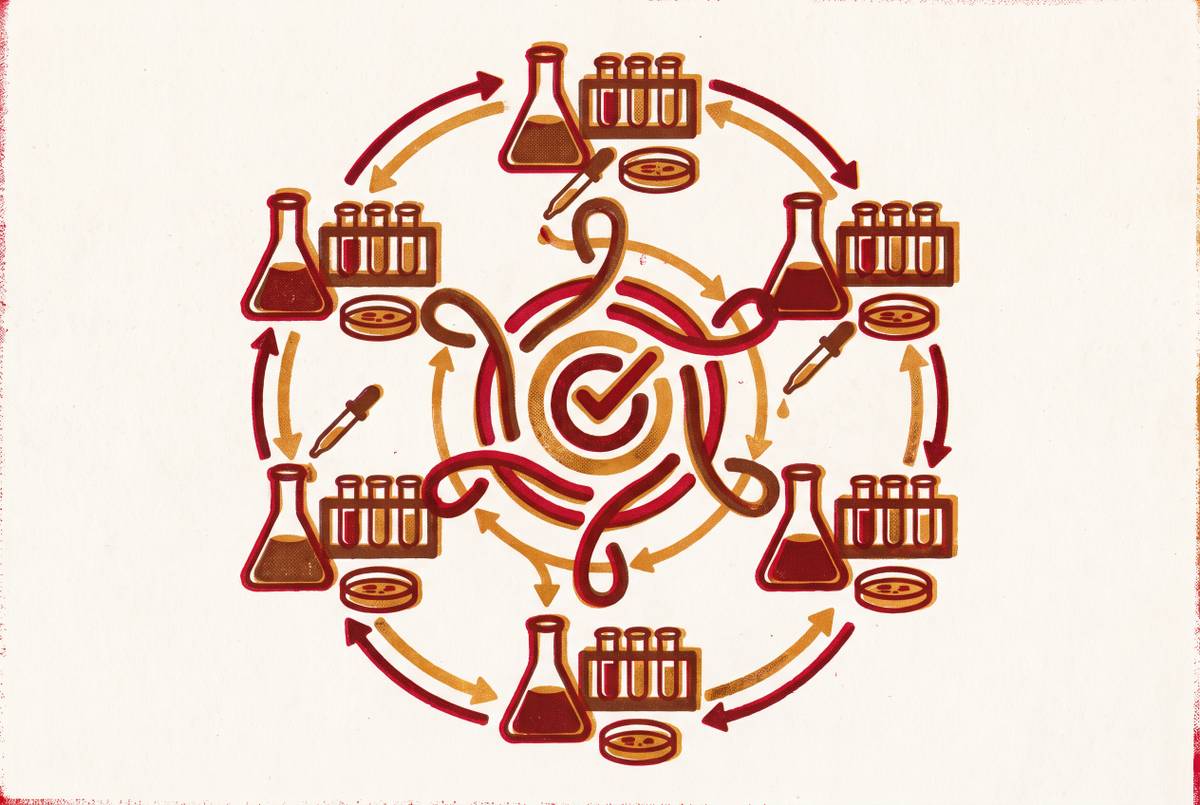
Cell-based expression places a sequence of biological operations between a construct and its protein readout, including transformation, culture growth, induction, harvest, and lysis. Each introduces time and potential failure modes. CFPS instead uses protein synthesis machinery outside living cells and starts directly from PCR product or plasmid template. It removes the need for culture, colony picking, and amplification for each construct, enabling synthesis and functional assay in hours.
The cited two-day setup-to-result timeline, compared with a minimum of 7 days for transient or stable transfection, reflects a structural difference between the processes. Linear expression templates can also bypass molecular cloning, compressing weeks of plasmid construction into days. These comparisons describe turnaround times for particular workflows and targets.
Energy substrates, chaperones, cofactors, detergents, and lipids can vary across wells, allowing condition screening to proceed with sequence screening. That flexibility comes in two main architectures. Crude cell lysate systems are fast and lower cost but have undefined composition, while reconstituted systems offer defined composition and greater reproducibility at historically higher expense.
Where CFPS wins, where it doesn't, and how to read the decision axes
The first decision axis is the target class. For toxic proteins, CFPS removes the requirement that an expression host survive recombinant overproduction. For membrane proteins, direct addition of detergents or lipids provides a defined hydrophobic environment that is difficult to reproduce through heterologous host selection alone. Proteins requiring unnatural amino acids also benefit from access to custom aminoacyl-tRNA synthetase machinery without the cell-viability constraints of in vivo workflows.
Campaign phase supplies the second decision axis. Early screening of tens to hundreds of variants favors speed, parallelization, and small amounts of protein with a functional readout. Above roughly the gram scale, cell-based production has historically cost less. CFPS reagent costs per gram have historically been an order of magnitude above the $10–$100/g range typical of cell-based fermentation, although formulation improvements are narrowing that gap.
Processing requirements can override both of those advantages. No cell-free system currently replicates complex mammalian glycosylation requiring full Golgi processing. Cell-based expression also has advantages in late-stage manufacturing, where regulatory precedent and process validation are already in place for in vivo platforms. Teams must choose a platform with both the protein needed for screening and the protein needed for final manufacture in mind.
How throughput compounds across thousands of variants — the math of campaign scale
Thornton et al., ACS Synth. Biol. 2025 provide a concrete example through a protease engineering campaign. The study screened 80 variants in two rounds, with 48 random variants followed by 32 ML-guided variants. The first round took approximately six hours. A purification-dependent version of that workflow would require weeks per round, making the expression-to-score interval a constraint on both model-guided iteration and laboratory scheduling.
The arithmetic starts with repeated experimental cycles. When expression and scoring take days instead of hours, fewer design-build-test-learn cycles fit in the time a program has. Each missed cycle also removes an opportunity to refine the ML model before choosing the next library. Throughput therefore affects both the number of variants tested and the sequence of decisions made from their results. Crude lysate CFPS systems can express 24 open reading frames in a single day, illustrating the parallel capacity available before extensive cell-based infrastructure is required.
Thousands of variants may be screened at nanoliter-to-microliter volumes, while only the top few require milligrams for downstream work. Teams pay for each reaction across every variant, condition, and campaign, but make larger amounts only for the candidates they select. The design implication is to match expression volume to each stage.
Reagent cost and reproducibility as campaign infrastructure, not consumable line items
Traditional CFPS formulations rely heavily on expensive phosphorylated energy substrates such as phosphoenolpyruvate (PEP). Those inputs have historically made up most of the total material costs by far. When reagents use up most of the materials budget, teams must cut variant counts or library size, leaving less data to refine the ML model.
Olsen et al., Nature Communications 2026 addressed that constraint with a multi-dimensional definitive screening design spanning more than a thousand reagent formulations. The study found a simpler 12-component system that gave high bench-scale protein yields at per-gram costs that could compete with other systems. Reagents accounted for less than 10% of material costs in the resulting system. The result makes formulation design an economic variable, rather than treating kit pricing as an unavoidable property of CFPS.
Reproducibility imposes a separate requirement on those savings. Crude lysate has undefined composition, making batch variability a structural concern. Comparisons between variants expressed with different lots can therefore become confounded by the reagent itself. Reconstituted systems address composition directly, but preparation has historically been expensive and complex. The automated i-POPFLEX system, published in Trends in Biotechnology in 2026, replaces gravity-flow chromatography with automated FPLC, reducing purification time and reporting elimination of batch-to-batch variability at higher yield and lower cost than commercial kits.
Transparency connects the cost and reproducibility requirements. OpenCFPS™ offers a concrete example through competitive pricing, documented formulations, and published lot-level QC. Documentation gives researchers a basis for troubleshooting, optimization, and standardization, while lot-level results make consistency assessable. Neither alone establishes suitability for a robotic campaign. The reagent must also perform reliably in the chosen plate format at the volumes the liquid handler actually dispenses.
Which CFPS workflows support screening hundreds of variants on a liquid-handling robot
High-throughput CFPS commonly uses 96-, 384-, or 1536-well plates to parallelize variant expression and condition optimization. However, the format produces a throughput advantage only when reaction setup, liquid handling, readout, and data processing work together. A formulation that behaves differently at nanoliter dispensing volumes, or requires incompatible handling steps, can force manual work back into the process.
The DropAI platform, published in Nature Communications in March 2025, demonstrates how screening can feed formulation optimization directly. Its in-droplet CFPS results enter an ML model that estimates component contributions and predicts high-yield combinations. The platform achieved a fourfold reduction in the unit cost of expressed superfolder green fluorescent protein (sfGFP). It also validated the optimized formulation across a panel of different proteins.
A fully automated pipeline published in iScience in October 2025 extends that integration across the design-build-test-learn cycle. It connects experimental design, microplate layout generation, liquid handling execution, readout calibration, and data-driven candidate selection within Galaxy. FAIR compliance and accessibility for non-programmers are built into the workflow. The data path is part of throughput. To close the loop, teams need to use results to choose candidates as well as speed up synthesis.
MANGO (MANufacturing on the GO), introduced in a 2025 medRxiv preprint, is an open-source benchtop CFPS device that achieved high yields and purity across runs, with inter-device variability below 7%. Its preprint status distinguishes it from the published examples. The CF2H platform, published in Nature Communications in March 2026, extends CFPS screening into protein-binder interactions. Wheat germ extract systems described in Applied Microbiology and Biotechnology in June 2026 offer a eukaryotic alternative for small-scale, high-throughput production of diverse eukaryotic proteins.
Difficult protein targets: where CFPS workflow design must adapt
Membrane proteins can be hard to express under generic expression conditions. Their transmembrane domains can range from 1 to 24, creating highly hydrophobic targets, while mismatch between host and target lipid composition adds difficulty in cellular systems. For these campaigns, the lesson is to treat detergent or lipid supplementation as the solubilization strategy within the expression reaction. Published protocols produce milligram amounts of functionally folded prokaryotic and eukaryotic membrane proteins in under 24 hours. Published GPCR results likewise demonstrate plasmid-to-milligram production within hours, compared with months for cell-based approaches.
SLC transporters remain a less settled application. The largest transporter family is implicated in metabolic disease and drug transport, yet traditional expression methods can yield poorly or not at all. CFPS offers a more tractable screening entry point, with production methods still requiring development. Detergent selection, lipid type, and lipid concentration still require optimization for each target.
Post-translational modifications require equally deliberate reaction design. Wong et al., Nature Communications August 2025 used high-throughput cell-free expression to characterize and engineer PTMs that matter for the stability and function of therapeutic proteins. That is a published workflow capability, not merely a theoretical benefit of an open reaction. It does not erase the full Golgi-processing limitation. Instead, it supports treating PTM engineering, chaperones, cofactors, lipids, and unnatural-amino-acid machinery as experimental variables that can be screened with sequence variants.
Building the decision framework: matching platform choice to campaign requirements
A team choosing a platform should start with the readout it needs, the target class, and the campaign phase. CFPS is a strong primary option for tens to thousands of variants when the campaign requires fast design-build-test-learn cycles and can proceed with less than gram-scale yield. It is also well suited to toxic or membrane-associated targets, unnatural amino acid incorporation, and campaigns that optimize conditions and sequences together. In-reaction detection strengthens that fit when functional assays can run in the same plate as expression.
Cell-based expression remains the appropriate choice when complex mammalian glycosylation, production above roughly the gram scale, or established manufacturing validation dominates the requirements. Screening and production need not share a platform. A published and validated approach for therapeutic proteins uses CFPS for screening and condition scouting, then moves hits to cell-based production. CHO cell-free systems provide a bridge because conditions identified in CHO lysate transfer more directly to CHO cell-based production than conditions developed in E. coli lysate.
Reagent selection should then test documented formulation, lot-level QC, format compatibility, and cost per reaction at campaign scale. The relevant cost is the expenditure per variant at the volumes and throughput the campaign requires, including the conditions being screened. Recent formulation optimization reported in Nature Communications in 2026 demonstrated a 95% reduction in reagent costs, showing how much this axis can shift. OpenCFPS fits these screening-phase criteria through its published formulations and lot-level QC, with robotic format performance remaining a requirement for the intended workflow.
Low-cost, reproducible reactions and workflows that work with automation let teams run more rounds in the time they have, giving ML models more variant data to learn from and teams better candidates for downstream work. That is the campaign-scale return on deliberate platform selection.
Sources
- Cell-free protein synthesis as a method to rapidly screen machine learning-directed protease variants
- Cell-free protein synthesis platforms for accelerating drug discovery - PMC
- Cell-Free Protein Synthesis as a Method to Rapidly Screen Machine Learning-Generated Protease Variants
- AI-driven high-throughput droplet screening of cell-free gene expression
- A User’s Guide to Cell-Free Protein Synthesis - PMC