Community Benchmarking Initiatives in Synthetic Biology Measurement
Shared protocols and reference materials can reduce cross-lab variation by over 80-fold.

A large interlaboratory fluorescence study found that measurements lined up closely across flow cytometry results and two full years of plate reader results, with an average spread of 1.52-fold. Then, with no warning and no change in protocol, the third year of plate reader data shifted by an average of 28.9-fold. Nothing about the experiment looked different from the outside. The instruments were calibrated, the operators were trained, and the samples were prepared the same way they always had been. The numbers moved by more than an order of magnitude. A comparison that looked solid for two years could have been built on a foundation that was already failing.
That example captures the deeper problem synthetic biology measurement faces. A given biological construct can behave differently depending on the host strain, the reagent lot, the instrument, and the exact protocol used to run it, and even small, undramatic differences in any of these can change the result. The field does not suffer from a shortage of data. Labs around the world generate enormous volumes of measurements every year. What they lack is commensurability: an agreed unit, a shared reference material, or a common protocol anchor that lets a result from one lab mean the same thing at another site. Without that anchor, two labs can report the same number and be describing two different realities.
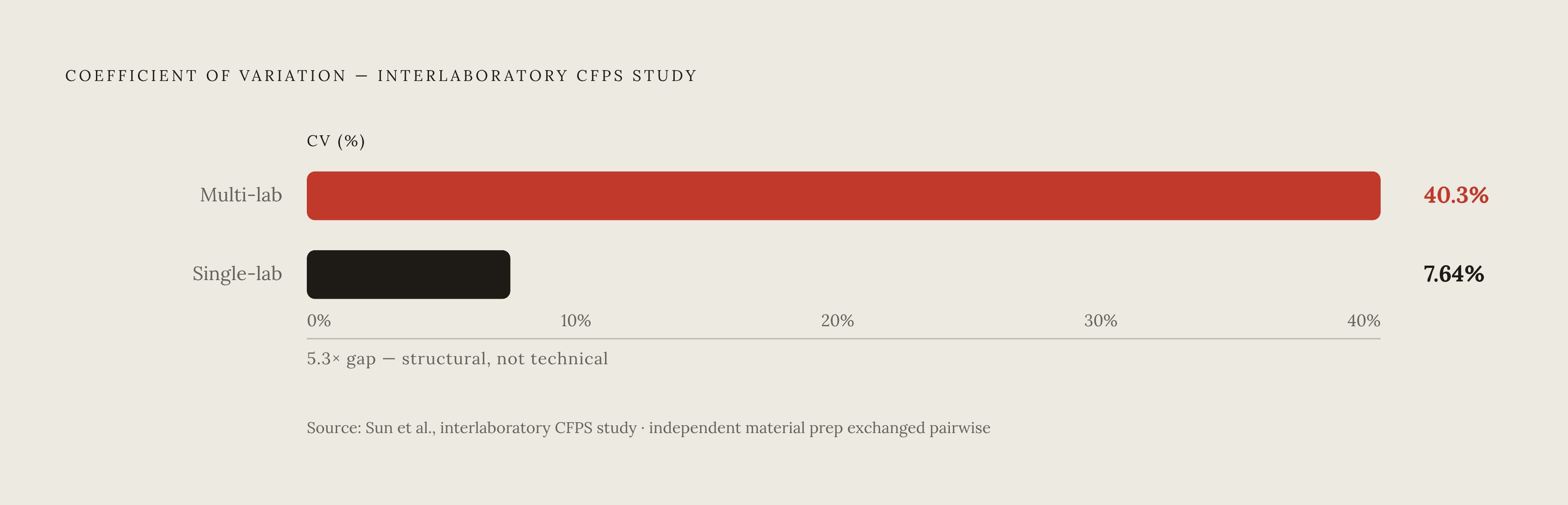
Protein synthesis output makes the stakes concrete. Yield, enzymatic activity, and folding quality all depend on the precise composition of the reaction, so a small change in how an extract is prepared or how concentrated a buffer is can turn into a large reported difference in performance. A landmark interlaboratory study on cell-free protein synthesis found that when materials were prepared at each lab, exchanged pairwise, and tested at every site, the result was a 40.3% coefficient of variation. A single operator working across days with one set of materials, by contrast, produced a coefficient of variation of just 7.64%. That gap, more than fivefold, shows that the distance between what one careful lab can achieve on its own and what multiple labs can achieve together is not a matter of fine-tuning instruments. It reflects a structural weakness in how the field defines and shares its measurement foundations.
What community benchmarking initiatives do to close that gap
Benchmarking initiatives exist to close that distance, and they do it by building three things that reinforce each other: shared reference materials, standardized protocols, and agreed metrics. If any one of the three is removed, the value of the other two drops sharply, because each depends on the others to mean anything.
Reference materials give every lab in a study the same starting point. A calibrated reagent, a validated construct, or a specific lysate batch distributed to all participants lets each site measure its own results against a common baseline. Without that shared object, a lab has no way to tell whether a change in its results reflects something real in the biology or something that drifted in its own local supply chain.
Protocols do the parallel work on the process side. A standardized protocol does more than list steps in order. It identifies the specific points in a procedure, such as how the extract is prepared, the order in which reaction components are assembled, or the exact incubation conditions, where a small deviation produces an outsized effect on the result. Pinning those control points down is what separates a protocol that transfers cleanly from lab to lab from one that only works in the hands of the people who wrote it.
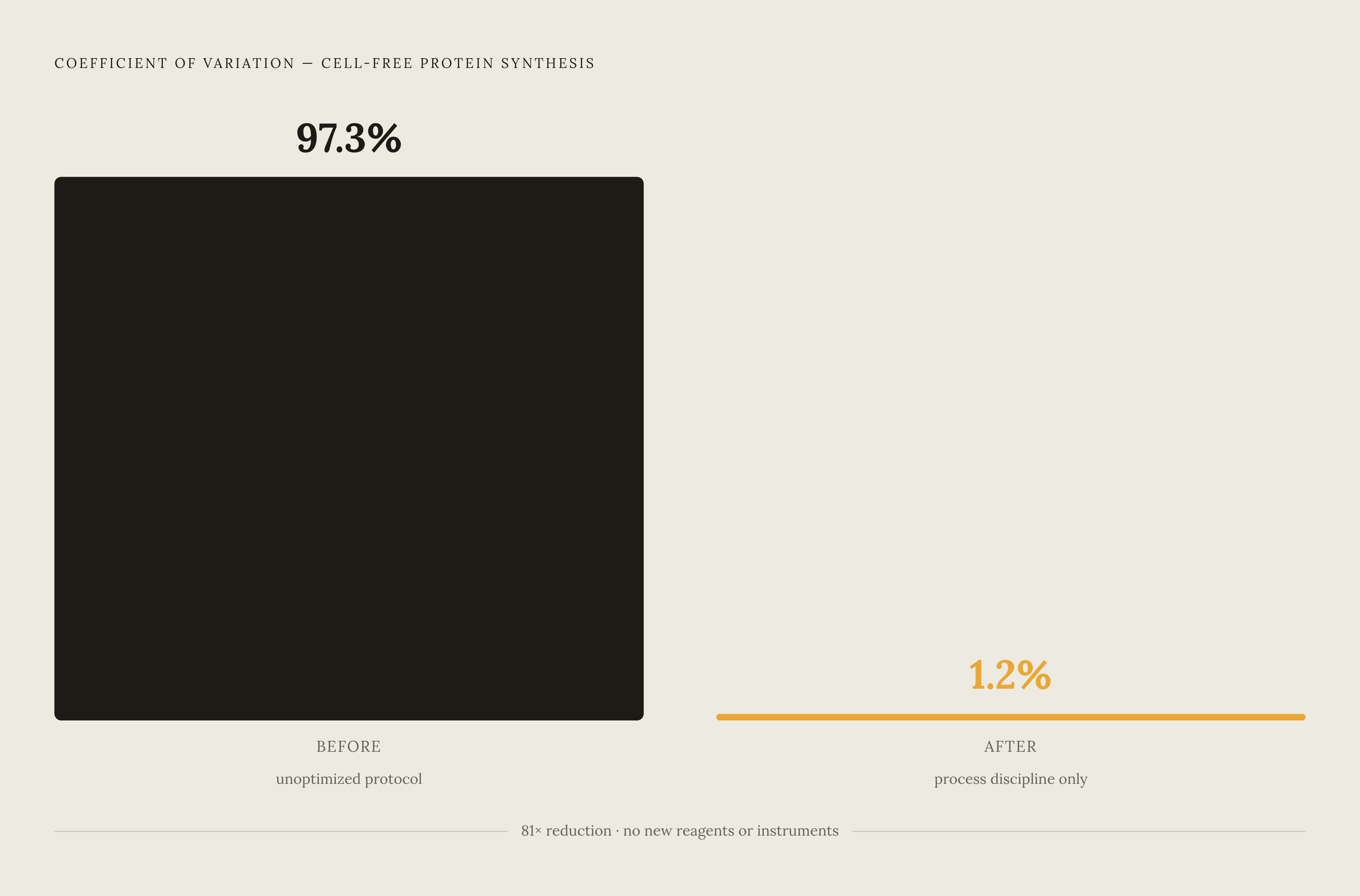
Metrics close the loop by defining what is actually being compared. Yield in micrograms per milliliter, activity in defined units, and coefficient of variation across replicates all sound like obvious choices, but without explicit agreement on which one a study is reporting, two labs can use the same words to describe different quantities. The scale of what good protocol design can achieve is already documented: one protocol that combined optimized extract preparation, fully solubilized master mix components, and careful reaction mixing cut coefficient of variation from 97.3% to 1.2%, an improvement of roughly 81-fold. That number did not come from a new reagent or a new instrument. It came from tightening the protocol itself, which is the clearest demonstration available that standardization is as much a matter of process discipline as of material supply.
The undefined composition of crude lysates as the deepest obstacle to standardization
The hardest problem in cell-free protein synthesis reproducibility is that crude lysates, the extracts most labs actually use, do not have a defined chemical composition in the first place, and this is truer than either instrument drift or sloppy lab technique. When a batch that worked well is followed by one that does not, there is often no clean way to know what changed, because nobody fully knows what was in either batch to begin with.
This is a counterintuitive place to land, because crude extracts are also the dominant platform in community benchmarking work precisely because they are cheap and productive. That combination of popularity and opacity is the core tension running through this entire field. A crude extract carries an undefined mixture of host-cell proteins, RNA, residual metabolites, and cofactors, and the exact makeup of that mixture shifts with the growth phase of the source cells, the extraction method used, and how the extract was stored before use. Current systems draw on a range of these extracts, including E. coli, wheat germ, rabbit reticulocyte lysates, and, more recently, human cell-free systems, and each carries its own background activity profile, its own cofactor availability, and its own sensitivity to reaction conditions. A cross-system comparison of mammalian and tobacco-based lysates found that the mammalian lysates underperformed on both expression level and protein functionality relative to the tobacco system, a result that matters for benchmarking because it shows that "mammalian CFPS" cannot yet be treated as one stable, comparable category. The same label can describe meaningfully different systems.
This is not a problem that more careful lab work can fix within the crude-extract paradigm as it currently exists. A lab cannot standardize what it cannot characterize, and characterizing a crude lysate down to the molecular level is not achievable at the throughput that benchmarking work actually requires. In the landmark interlaboratory study, reagent preparations, not the biological extracts themselves, contributed significantly to the variability observed across sites. The buffers, energy systems, and salts that labs assume are well-defined because they come from a published recipe are often prepared locally and independently, and that local preparation is where the drift actually enters. That produces a genuine inversion of expectations: the part of the system that looks most standardized, the written recipe, often drives the most variability, while the biological extract, which looks like the obviously uncontrolled variable, can turn out to be the steadier component of the two.
CFPS platform differences that matter for benchmarking: extract source, modularity, and tunability
Treating cell-free protein synthesis as a single, uniform category is a mistake that any serious benchmarking effort has to avoid, because the choice of extract source, energy regeneration system, and reaction modularity each introduces a variable that a shared standard either has to control for or state explicitly.
Extract source is the first axis of difference. Beyond the established bacterial, wheat germ, and mammalian extracts already in use, newer platforms have extended the range further: extracts derived from additional bacterial species and from other microbial sources have each been developed and optimized for different expression contexts and different energy metabolism profiles. A system that performs well with one extract source will not automatically transfer its performance characteristics to another. Benchmarking studies need to specify extract source as an explicit variable.
Modularity is the second axis, and it maps onto a real tradeoff. Purified-component systems, often built around a reconstituted defined-component architecture, offer a defined composition at the cost of higher price and a lower ceiling on yield. Crude extract systems invert that tradeoff, offering higher yield in exchange for undefined composition. A benchmarking protocol has to specify which class of system it is describing, because a protocol tuned for one architecture will not carry over cleanly to the other. Simplified CFPS approaches make the same point from a different angle: decisions about which components to include, how to prepare the extract, and what energy source to run the reaction on are themselves design choices that can and should be benchmarked, not background assumptions that a study can take for granted.
Tunability is where cell-free systems offer something cell-based systems structurally cannot. Because CFPS reactions allow direct, independent adjustment of pH, temperature, substrate concentration, cofactors, and chaperones, a researcher can change one variable at a time and observe its effect in isolation, an approach that living cells, with their interconnected regulatory networks, do not permit in the same clean way. That tunability is an asset for systematic benchmarking, and it also means platform choice has to be documented carefully, since a system this adjustable can be adjusted into incomparability if nobody records what was changed.
Distributed multi-site CFPS studies as de facto benchmarking trials
The most rigorous cross-site comparability data available in synthetic biology right now comes from distributed manufacturing studies that had to solve standardization simply to function, because a platform that cannot produce consistent output across sites cannot do the job it was built for.
The MANGO (MANufacturing on the GO) platform is a clear example. Benchmarked at sites in Canada, Brazil, and Colombia, MANGO demonstrated that a standardized, open-source CFPS platform could produce enzymes at an input cost of roughly $6.60 per product, compared with more than $7,800 for equivalent quantities of commercially produced enzyme. The cost analysis itself was conducted centrally in Canada, with reactions freeze-dried there and shipped to the Brazil and Colombia sites rather than produced and costed independently at each location. Even with that caveat, the economics held up across sites with very different local infrastructure, which is itself a form of cross-site validation. A related multisite study extended this further, implementing standardized, reproducible CFPS production of model proteins across five countries spanning North America, South America, and Asia, with the platform deployed at 10 sites across seven countries in total.
None of these studies set out to be benchmarking initiatives in the formal sense. They were manufacturing and access studies, built to answer a practical question about whether a low-cost production platform could work outside a single well-resourced lab. But answering that question required exactly the infrastructure that formal benchmarking requires: a common protocol distributed to every site with preparation steps specified in enough detail to control the variables that matter, a shared reference output such as the yield of a specific protein or the activity of a specific enzyme that gives every site something commensurable to aim for, and cross-site data pooling that makes variability visible instead of letting it hide inside separate, siloed lab reports. CFPS is generating this infrastructure as a byproduct of doing applied science, which is a more durable foundation than infrastructure built for its own sake tends to be.
What high-throughput variant screening adds to the benchmarking picture
Cell-free protein synthesis also enables a form of benchmarking that happens entirely within a single lab, because its plate-compatible, cell-free format allows dozens to hundreds of protein variants to be produced and measured under identical reaction conditions in one experiment. A published high-throughput CFPS variant screening workflow illustrates the scale this can reach: by screening just 48 random variants to sample the fitness landscape, followed by 32 more targeted variants, researchers identified several protease variants, with the best, designated TB27, showing a fourfold improvement in fitness over the original Con1 protease.
That result matters for benchmarking for two reasons. When every variant in a screen is expressed under the same reaction conditions, the comparison between variants is controlled in a way that sequential expression in living cells cannot match, because the reaction environment itself serves as the reference standard against which every variant is measured. The medium-throughput microplate format, handling roughly tens to hundreds of variants at a time, integrates directly with liquid-handling robotics and plate readers that already carry their own calibration standards, embedding variant screening data inside an instrument-level measurement framework.
Newer architectures push this further still. The i-POPFLEX system, described in a December 2025 bioRxiv preprint, assembles 34 translation factors that are individually synthesized in vitro using automated liquid handling. By making every component of the reaction individually controllable and traceable, this approach moves toward a fully documented, reproducible benchmark reaction, one where the contribution of each component can in principle be tracked. This kind of variant-level comparative data is exactly the input a fitness-landscape model needs, and the point here is about what CFPS throughput generates, not about machine learning as a benchmarking method in its own right.
Open, documented reagent systems as a prerequisite for credible cross-site standards
A benchmark is only as trustworthy as the reagent system it runs on. If the components in a reaction are undefined, undocumented, or inconsistent from lot to lot, the benchmark ends up measuring reagent variability rather than biological signal, and a cross-site comparison collapses into a comparison of local reagent preparations.
The field's own data makes this case directly. In the landmark CFPS reproducibility study, reagent preparations, not the biological extracts, were identified as the primary driver of interlaboratory variability. Opaque, locally prepared ancillary reagents turn out to be the single most tractable source of cross-site noise, tractable because, unlike the undefined composition of a crude lysate, a reagent formulation can in principle be written down, published, and matched exactly from site to site. The broader analytical reagent field has already built standards around this logic: benchmarking efforts there target a defined coefficient of variation threshold for statistical validity, and eliminating batch-to-batch fluctuation is treated as requiring Master Lot validation paired with high-purity reference materials. That standard demands documented, traceable reagent systems as a baseline requirement, not simply good technique in the lab.
The structural logic follows directly from that evidence. A lab that cannot see what is actually in its reagent has no way to know which component shifted when a lot underperforms, and its only recourse is to rerun the experiment and hope the next batch behaves. A lab with access to the full formulation and lot-level quality control data can instead identify the specific source of drift, correct it, and pass that correction on to collaborating sites, which is the actual mechanism by which cross-site standardization gets built. Published formulations carry a second benefit beyond any single study: they allow independent verification and let the broader community refine a reference standard over time, rather than leaving every lab to rediscover the same problems on its own.
OpenCFPS™ from Sepia Biosciences is one example of reagent design built around exactly this logic. It is offered with documented formulations and lot-level QC data, and priced as low as $25 per mL, a structure aimed at making high-throughput, multi-replicate benchmarking experiments economically workable. For a lab looking to take part in cross-site CFPS standardization work without rebuilding its reagent economics from the ground up, a system built on those terms aligns directly with what the interlaboratory variability data points to as necessary.
Where the next benchmarking work needs to happen
Cross-site CFPS standardization has made genuine progress on soluble proteins produced in defined, plate-compatible formats. Two problems remain largely untouched by the current benchmarking framework: membrane proteins and reaction duration.
Membrane proteins are the field's most consequential open target. Overexpressing membrane proteins is generally toxic to living cells, which is part of why cell-free synthesis is such a valuable alternative route for producing them. But no community benchmark has yet established a gold-standard protocol for membrane protein CFPS at preparative scale. Current approaches each run into a different limitation: some yield only small quantities, some yield large quantities of aggregated protein that then requires refolding, and some yield large quantities of protein synthesized directly into detergents or liposomes without passing through any natural folding pathway. It is not yet established which of these outputs represents a comparable, reproducible result that a cross-site standard could actually be built around, and that ambiguity is a real limit on what membrane protein benchmarking can claim today.
Reaction duration places a second, more structural limit on what any CFPS benchmark can certify. Cell-free reactions run for a finite window before synthesis stops, and any standard that claims equivalence with cell-based, milligram-scale production has to account for that ceiling honestly. The longer-horizon response to membrane protein folding comes from synthetic cell research. The SynCell Asia initiative, representing that research community, is pursuing a ten-year roadmap to build fully synthetic cells from defined, non-living molecular components, an agenda that would eventually dissolve the membrane protein folding problem by reconstituting a complete cellular environment in vitro. That work remains a research frontier rather than a substrate available for benchmarking today.
The near-term opportunity does not depend on that frontier arriving first. Soluble, well-characterized proteins produced in plate format, expressed from documented reagent systems with published lot-level quality control, and distributed across sites using a shared protocol, represent a benchmarking target the field can act on now. The infrastructure for exactly this already exists, and the distributed manufacturing studies run across Canada, Brazil, Colombia, and the broader multi-country platform deployments have already shown that it works in practice, not just in principle.