Role of Water Quality and Lab Infrastructure in CFPS Reproducibility
Water purity and lab discipline are essential to reproducible cell-free protein synthesis.

A cell-free protein synthesis reaction is built from four components: cell extract, DNA template, master mix, and water to bring the solution to its final volume. Each of those four contributes its own independent source of variance, and none of them sits in the system as an inert background against which the "real" biology happens. That is the structural fact that makes CFPS reproducibility difficult in a way that is easy to underestimate from outside the field. The openness that makes cell-free synthesis attractive in the first place, direct control over reaction conditions and tuneable composition, is the same property that turns every input into a potential source of noise. A living cell buffers its internal chemistry through homeostatic machinery; a tube of extract and master mix has no such buffer, so whatever varies in the inputs appears directly in the output. Aw's 2026 perspective in Microbiology lists reproducibility among the persistent barriers to industrial adoption of microbial CFPS, alongside supply chain vulnerability and the absence of CFPS-specific quality expectations, and it treats reproducibility as an active, unresolved barrier, not a problem already behind the field.
Water's role in CFPS reactions and the importance of purity
Water in a CFPS reaction functions as a participant in the chemistry, not a passive filler brought in to hit a target volume. It takes part directly in enzyme activity, in maintaining ion balance, and in the stoichiometry of the reaction, so anything dissolved or suspended in that water changes the biochemistry of the system itself, not merely the cleanliness of the glassware. Heavy metal contamination is one route by which this happens: trace metals chelate cofactors that enzymes depend on, inhibit enzyme activity, and disrupt the metal-dependent translation factors the reaction needs to build protein. Endotoxin contamination works differently: endotoxins interfere with protein folding assessments and with downstream assay readouts, so a reaction can produce a yield that looks acceptable while the result underneath it is ambiguous and untrustworthy. Bacterial contamination and biofilm formation introduce a third failure mode, seeding the reaction with nucleases and proteases that degrade both the DNA template and the protein the reaction is trying to express. None of these three failure modes announces itself as a water problem; each one just looks like ordinary biological variability from the bench. The practical standard is ultrapure water produced by reverse osmosis, ion exchange, and ultrafiltration, certified free of endotoxin, applied as a baseline condition rather than a precaution reserved for edge cases, since it keeps contamination from manufacturing variance that gets misread as biology.
Compounding effects of master mix preparation and reaction mixing
Water quality is necessary but it does not cover the whole surface of the problem. Incomplete solubilization of master mix components introduces a separate and additive source of variance: salts or energy-regeneration substrates that have not fully dissolved create local concentration gradients within the mix, so two reactions drawn from what looks like the same master mix are, in fact, chemically different from the moment they are assembled. Mixing technique during reaction assembly adds a third layer on top of that. Inconsistent pipetting, incomplete blending of extract into master mix, and air bubbles introduced while combining reagents all generate variance between replicates that gets attributed to the reagents when the actual cause is the handling. These variables do not sit side by side independently; they interact with each other and multiply rather than simply add up. Poor water quality can itself worsen solubilization, because trace ions in low-grade water compete with the buffer components for the chemistry the master mix depends on. Inadequate mixing then prevents even a properly prepared master mix from equilibrating before transcription starts. The practical consequence is that fixing water quality alone leaves most of the variance untouched if preparation and mixing discipline are not addressed at the same time.
Lysate batch variability and storage conditions as infrastructure problems
The cell extract is the component with the greatest intrinsic variability in a CFPS reaction, and Aw 2026 identifies maintaining consistent extract quality and activity across batches as a persistent challenge in the field, positioning it alongside supply chain vulnerability as a barrier to industrial use. That framing matters because it locates the problem above the bench: inconsistent extract quality is not simply noise that a careful technician can pipette around, it is a structural obstacle to scaling CFPS into industrial production. Storage conditions for extract need that same structural treatment; you cannot file them under administrative housekeeping. A defined storage temperature, a validated container material, and a documented limit on freeze-thaw cycles determine the extract's quality from the moment it is made. A lab that treats storage as logistics rather than as a technical variable is introducing variance into its results that it has no way to diagnose later. Lyophilized reagent formats offer a partial way around this problem by decoupling storage-condition variance from extract quality, since a lyophilized extract does not depend on an unbroken cold chain to remain stable. Aw 2026 notes that lyophilization is a format CFPS lends itself to for storage and transport, which matters both for decentralized deployment and for maintaining lot-to-lot standardization inside high-throughput labs; the implications of that format choice return once automation and decentralized deployment enter the argument.
Lot-level QC data and batch variance control
A lab can get water quality right, prepare its master mix carefully, and control storage conditions with discipline, and still have no way of knowing whether its results are actually reproducible. Lot-level QC data on the reagents the lab receives is missing, and extract batch variance is invisible without a documented baseline against which a new batch can be compared. This gap exists in part because the field lacks CFPS-specific quality and regulatory expectations, a barrier Aw 2026 identifies directly, and the practical effect is that most reagent suppliers are under no obligation to provide the kind of lot-level performance documentation that would let a user separate variance caused by the reagent from variance caused by technique or by the surrounding environment. Lot-level QC data closes that diagnostic loop. When a user knows the activity and composition of each extract batch, a deviation in an experimental result can be traced to a specific variable instead of being absorbed into a general category of unexplained noise. Reagent transparency, meaning documented formulations and published QC data, functions as infrastructure in exactly the sense that ultrapure water functions as infrastructure: without it, every other control a lab has put in place is unverifiable, because there is no baseline against which to confirm that those controls are doing their job.
How automation changes the infrastructure calculus for high-throughput CFPS
Liquid-handling automation removes one of the largest sources of noise in manual CFPS: the variance introduced between different operators pipetting the same reaction. It does not remove the infrastructure burden so much as relocate it, substituting instrument calibration, tip or nozzle consistency, and dead-volume accounting at nanoliter scale for the human variability it replaces. Jun et al. 2025 reviews how automated systems such as the Echo 525 enable highly precise, tipless transfer of nanoliter-scale reaction volumes, optimizing reagent use and cutting down on human error in the process. At that scale, any contaminant or concentration error present in the source reagents is replicated identically in every single replicate the system produces, affecting water quality and master mix homogeneity across the entire batch. Jun et al. 2025 also reports miniaturized reactions of approximately 1.56 μL achieving high reproducibility in a cell-free biosensor platform, and at that reaction volume, a single pipetting error or a water quality excursion changes the result by a disproportionate amount relative to the total reaction. Automation does not substitute for the upstream controls described earlier in this piece; it raises the cost of skipping them. The same logic applies to plate format and reaction geometry, which are infrastructure decisions with direct cost consequences. A 2026 autonomous-lab study found that reagent composition choices made at 384-well, 20-μL scale reduced reagent cost per gram of protein substantially, which demonstrates that infrastructure decisions and reaction economics are not separate questions but the same question viewed from two angles.
What decentralized and resource-limited deployments reveal about infrastructure dependencies
Decentralized CFPS deployment puts every infrastructure assumption described above under direct pressure, because you may simply not have standard ultrapure water systems, controlled cold chains, or calibrated liquid-handling equipment at the point of use. Studying how these settings are handled reveals something useful for a bench scientist working in a conventional, well-resourced lab: which infrastructure variables can be engineered around through reagent design, and which ones cannot be substituted for at any scale. Aw 2026 frames decentralized manufacturing as one of the primary motivations driving microbial CFPS development, notes that the UK introduced a legal framework for point-of-care manufacturing, and points to lyophilized reagent formats as a direct answer to cold-chain and infrastructure constraints in those settings. Lyophilization shifts the water quality requirement from something that has to be maintained continuously across a facility to a single, controlled rehydration step performed at the moment of use. A lab without a validated ultrapure water system can still hit the water quality a reaction needs at that one moment, as long as the rehydration protocol specifies the correct water grade and that water is sourced appropriately. What lyophilization solves, namely cold chain, storage stability, and batch consistency, and what it cannot solve, namely water quality at the point of rehydration and the integrity of the DNA template, together draw a clean line for any lab to work from. That line tells a well-resourced lab exactly which infrastructure investments are not optional and which are simply a matter of convenience.
Building a reproducible CFPS workflow: the infrastructure checklist
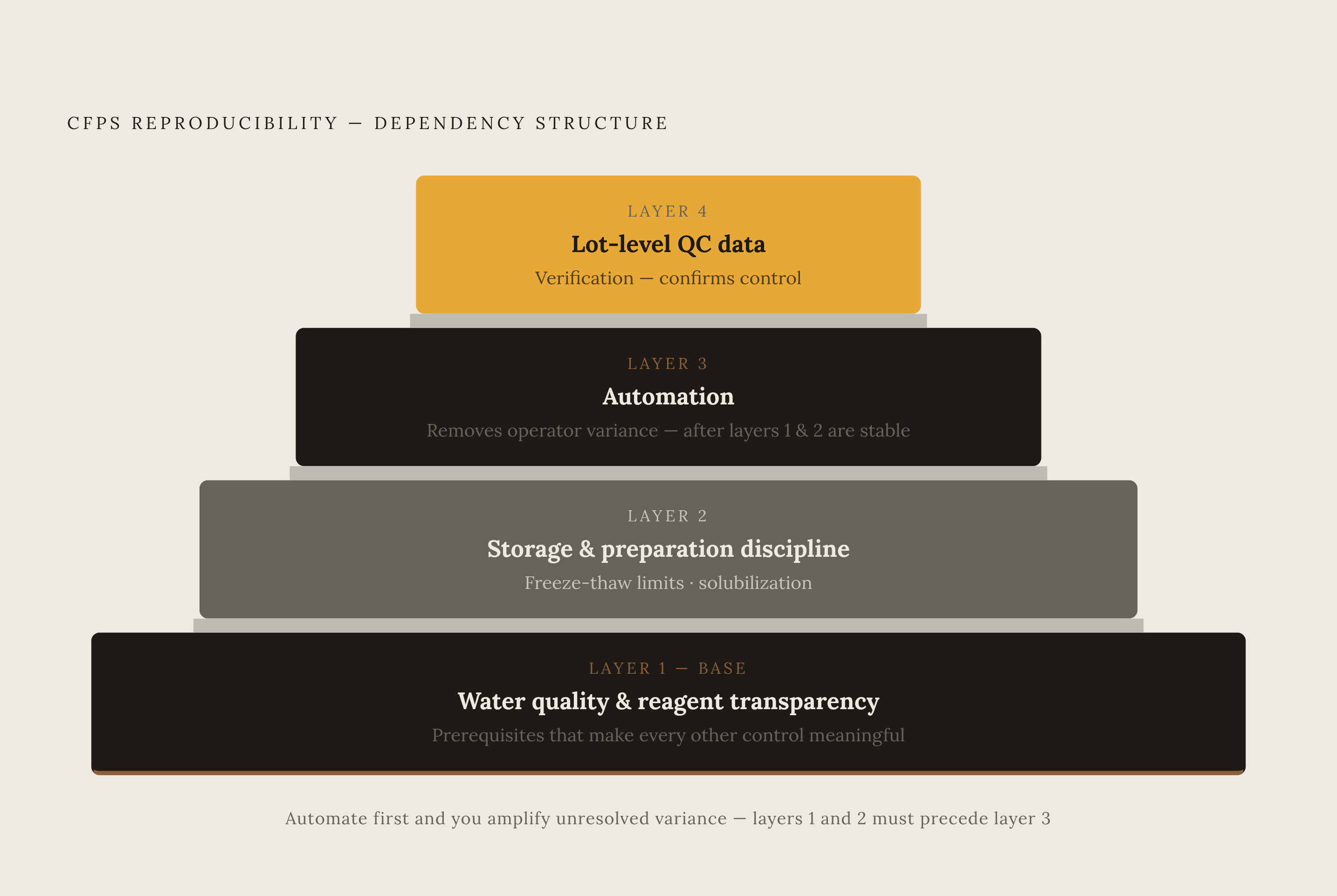
The argument built across this piece resolves into a hierarchy, not a flat list of equally weighted concerns. Water quality and reagent transparency sit at the base of that hierarchy as prerequisites: they are what make every other control in the workflow meaningful, because without a known water grade and a documented reagent baseline, there is nothing stable to measure the rest of the system against. Storage and preparation discipline sit above that base layer, and they eliminate variance that water quality controls cannot touch on their own, because even perfectly pure water cannot make up for an extract stored past its validated freeze-thaw limit or a master mix that was never fully solubilized before use. Automation sits above both of those layers, and it only earns its value once the layers beneath it are stable: it removes operator-technique variance, but it cannot fix a contaminated water supply or an unverified extract batch, so it just repeats whatever variance already exists in the inputs, at scale and without hesitation. Lot-level QC data functions as the verification layer that sits over the entire structure, confirming that the system built from the layers below is actually in control. In practice, that means specifying ultrapure, endotoxin-free water produced by ultrafiltration as a standing requirement and recording the water grade in every protocol, so a change in the water system becomes a traceable variable. It means treating master mix preparation as a step that requires full solubilization and verified homogeneity before combination with extract, since incomplete solubilization is a common and easily overlooked source of within-plate variance, particularly in high-throughput formats. It means you treat extract storage conditions, freeze-thaw limits, and container validation as technical specifications, not logistics, and you treat any temperature excursion as a potentially batch-invalidating event, not a minor deviation to note and ignore. It means requiring lot-level QC data and documented formulations from any reagent supplier, and treating a supplier's unwillingness to provide that documentation as a reproducibility risk rather than a matter of vendor preference, since opacity at the reagent level makes every downstream control impossible to verify. OpenCFPS™ publishes lot-level QC data and documents its formulations openly, so users get the diagnostic baseline they need to tell reagent variance apart from variance introduced by technique or by infrastructure, and that transparency is what closes the diagnostic gap described earlier in this piece. Finally, it means introducing liquid-handling automation only once water quality, mix preparation, and storage conditions have already been standardized, because automation multiplies whatever variance survives in the steps that come before it, for better or for worse.